
Political stability to ensure higher growth
FE Desk | Sunday, 3 May 2015
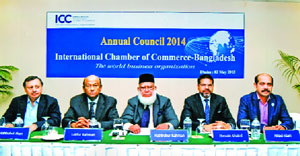
International Chamber of Commerce-Bangladesh (ICCB) said Saturday continued robust remittances and recovery in private consumption demand will help propel the economic growth of Bangladesh, but political stability would be vital to ensure the sustainability.
The ICCB in its executive board report made this observation quoting a World Bank report.
The ICCB released its report at the 20th Annual Council of the National Secretariat of the Paris-based world business organisation held on the day at a local hotel in the city, according to a statement issued by the ICCB.
The ICCB said Bangladesh is on the way to become middle income country by 2021, but the country must increase its investment, GDP growth and industrial contribution to the economy to ensure the graduation.
The on-going political unrest may deal a blow to the vision for becoming a middle income country by 2021 as it will be difficult to increase the required industrial contribution of 35 per cent of gross domestic product (GDP), one of the important factors to achieve the target, the ICCB said.
Before five years industrial contribution to GDP was 22 per cent, but it rose to 28 per cent last year. The per capita income, presently at $1190, is going to reach $1450 in 2021. Investment is very important to achieve the middle income status. Presently, GDP growth is 6.3 per cent. It needs to go up to 8.5 per cent.
However, the unstable political situation that has started from the beginning of the year will have an adverse effect on the economy if prolonged.
"We must, therefore, work together to overcome all hurdles and come out of the stagnant 6.0 per cent GDP growth, the ICC Bangladesh Annual Council observed.
Bangladesh economy, over the past decade, has maintained a healthy 6 per cent-plus growth rate, despite global shocks.
Sustained growth has generated higher demand for improved infrastructure including uninterrupted power supply, better transport and telecommunication services. All these require increased private investment, according to the ICCB Executive Board Report.
In the budget of current fiscal, the government has set 7.3 per cent growth target. To achieve the target, according to ADB, the total investment should be around 34.3 per cent from the present level of 28.7 per cent of GDP. The Bank blamed lower than expected level of investment as principal reason for growth deficit in Bangladesh, the report said.
The Council adopted the Executive Board Report & Audited Financial Statements of ICC Bangladesh for the year ended 31st December.
ICCB President Mahbubur Rahman presided over the programme.
Among others, ICCB Vice President Latifur Rahman; DCCI President Hossain Khaled; ICCB Board Members AmCham President Aftab ul Islam; BGMEA President Atiqul Islam; CCCI President Mahbubul Alam; BIA Chairman Sheikh Kabir Hossain; A.S.M.Quasem; Mahbub Jamil; R. Maksud Khan; Barrister Rafiq ul Huq; Kutubuddin Ahmed & Waliur Rahman Bhuiyan, OBE; ICCB Members M. Ghaziul Haque, Chairman, Transmarine Logistics Ltd.; M. A. Awal, Chairman, Prime Textile Spinning Mills Limited; Salahuddin Kasem Khan, Managing Director, A. K. Khan & Company Ltd.; Nasir A. Chowdhury, Adviser, Green Delta Insurance Co. Ltd.; Ishtiaque Ahmed Chowdhury, Managing Director, Trust Bank Limited; Mr. Muhammad A. (Rumee) Ali, Advisor to the Executive Director, BRAC Bank; Barrister Fida Mohammad Kamal; Abu Alam Chowdhury, Managing Director, CONEXPO Limited; Md. Khalilur Rahman, Managing Director, National Housing Finance and Investments Limited; Ashraf H. Chowdhury, CCAO, Airtel; Sujon Kumar Saha, Chairman & Managing Director, BASF as well as MDs/CEOs and senior officials of banks, insurance companies, national and multinational companies attended the Council.
raihanmchowdhury@gmail.com