
Pollution haunts sea at Cox's Bazar
Shihab Sarkar | Tuesday, 27 June 2023
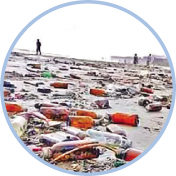 The view of the shorelines of the Cox's Bazar beach filled with myriad types of viscous and rotting sewage may have remained beyond the furthest thoughts of the beach-goers. Woefully, this is feared to be the common scenario in the Cox's Bazar beach, and the surrounding areas. Cox's Bazar is no longer a tranquil seaside resort filled with tourists. Over the last two decades, the district headquarters have emerged as a centre of brisk urban activities befitting a fast rising city. The crowded beach and the densely populated city of Cox's Bazar is dotted with over 500 hotels, motels, guesthouses, cottages and residential houses, and even hatcheries. These set-ups are said to be discharging around 150 tonnes of waste substances annually into the once-transparent and largely unpolluted water of the sea --- the Bay of Bengal. The moot point is the situation has deteriorated to this pass due to the absence of sewage treatment plants (STPs) normally attached to the hotels, residential buildings, and the numerous hatcheries, says a FE report.
Environmental experts have long singled out the hazardous impacts of the reckless dumping of waste into the beach nearly abutting the sea and the coastal line. Persons in charge of the Cox's Bazar-based tourism have started bracing for worse times ahead. As they fear, the odious smell of the waste materials will continue to become more intense in the days to come. Unless the sources of the foul-smelling waste are sealed on an urgent basis, this burgeoning tourist spot may have to fall on bad times. It is feared to leave adverse impacts on the whole tourism sector. The picture is clear. The negative developments will possibly see hundreds of unsuspecting tourists getting sick with the foul-smelling sea-water. Many of them will be compelled to leave the area. This will disrupt many future projects of the government which it has envisioned for the development of tourism. Worse, with tourists not coming to the site like before, thousands of people will lose their jobs. Lots of people in the area are panicked to even distantly think that a spectre of unemployment and the related tense situation shadows Cox's Bazar. If the tourism authorities still foot-drag on forcing hotels to set up individual sewage treatment plants (STPs) or establish a central STP, they are doing it at their peril.
The common people will not sit idle. They chiefly include persons engaged in medium and petty businesses in handicraft items and restaurants. If the situation turns worse, these people are feared to be badly affected. As a corollary, the economically hurt people may join the aggrieved groups who may have lost their jobs at hotels, motels, guesthouses and other accommodations. Many environmentally conscious local people feel alarmed at the possibility of the grand beach turning into an unsightly place not worth visiting. The local people unanimously demand that a central sewage treatment plant be in place at the busy Cox's Bazar tourist point, in order to save the 155-kilometre beach, the world's longest natural sea beach. According to Cox's Bazar Development Authority, out of the hotels, motels, guesthouses etc in the 'designated area', only six own sewage system plants. To speak unsparingly, the vast scenario is filled with glaring loopholes; and this is unconscionable.
The resort town started with a handful of residential hotels launched by local entrepreneurs. The British-modelled hotels served non-local tourists for long. The beach in those days was quiet with genuine visitors having a passion for tour. The limited number of hotel staff was enough to keep the hotels and their surroundings free of waste pollution. As the hotels were located in the mid-town, there was no question of any flow of effluents. It took time for the Cox's Bazar town to emerge as a full-fledged district headquarters. The prospective hoteliers didn't wait longer. As a result, the 134 hotels, motels, guest houses etc that were built had changed the tourist city's skyline. In the newly independent sovereign Bangladesh, the crowd of tourists was manageable. But it became unwieldy as decades wore on. It was just two decades back that the mushrooming of residential hotels got off the ground. The multi-storey deluxe hotels are now found dotting the whole beach area.
As the hotels continue to abut on the sea waters, untreated and rotting waste materials are found floating along the shoreline. Few had ever thought of this repugnant turn of things at the beach resort. The sight stands in sharp contrast to the honey-mooning couples viewing the sea from a high-rise hotel balcony. But those checking in the low-height hotels go through a few smelly nightmarish days and nights.
Following the appeals from the owners of hotels and other structures to control man-made pollutions, the authorities have failed to take measures for effective waste management. It prompted the stakeholders to raise the demand for a central sewage treatment plant. Many now view its materialisation to be a pipedream. The developments in the area of waste management do not elude the environmental activists. As they view it, if the sea water remains polluted, tourists will lose interest to visit Cox's Bazar. It will, inevitably, lead to financial losses for the ambitious tourism entrepreneurs coupled with unemployment for those who are engaged in the fast-rising industry. Thus the advocacy on keeping the hotel surroundings pollution-free could be a wise option. The vital campaign should be aimed at the hoteliers in particular and the general beach-goers in general. Mindless littering in the main beach area continues unabated these days.
shihabskr@ymail.com