
Dengue situation
Poor healthcare, surveillance blamed for more female deaths
SM NAJMUS SAKIB | Tuesday, 10 October 2023
 More women than men have died of dengue fever in Bangladesh, showcasing weaknesses of a centralised healthcare as well as surveillance system, according to official data and health specialists.
On Monday, the Directorate General of Health Services (DGHS) reported 10 more deaths due to dengue and 2,660 cases of hospitalisation.
The total deaths climbed to 1,096 and cases to 226,224.
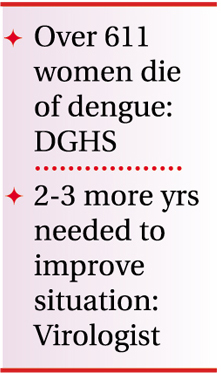
Of the total, according to the DGHS, 1,096 dengue-related fatalities, 617 women and 479 men died of the mosquito-borne dengue from January until October 09.
Of the total 226,224 cases, 89,330 were women and 136,894 men. Despite less cases of infection, women's picture of casualties is much higher than men.
A big number of female fatalities were pregnant mothers, said officials. The DGHS, however, did not share the figure.
Bangladesh has the worst dengue situation this year, including the highest dengue death rate (0.8 per cent in Dhaka and 0.5 per cent) globally, according to the World Health Organisation.
Bangladesh also ranked as the deadliest in south Asia.
Health specialist and former DGHS chief Prof Dr MA Faiz flagged up a serious surveillance weakness in the healthcare system.
This has failed to reach women, certainly pregnant mothers, resulting in more casualties in infectious diseases like dengue, he told the FE.
"Yet, we don't have a complete health surveillance system. All information doesn't come from all 64 districts or remote areas equally. Therefore, we have a partial picture of fatalities."
Earlier, a DGHS survey said there are four to five times higher the number of dengue cases than the one reported by the DGHS.
The health authorities only get cases when there is a critical patient admitted to hospital.
Currently, there are more dengue patients from outside Dhaka, but hospitals elsewhere are not well-equipped to deal with a critical patient, health specialists said.
"We have some critical care units with limited beds but need a critical illness management system that will support patients in normal beds," stated Dr Faiz.
He also asked for examining and evaluating dengue deaths to understand in which stage the persons died and which technical improvement is needed.
Renowned virologist Dr Mushtaq Hussain said the country developed a Dhaka-based multilayer healthcare system.
"We have health clinics from the capital city to remote villages, but rural clinics don't have necessary medical equipment," he added.
"Under this centralised healthcare system, a patient has to visit a medical college hospital, but a pregnant mother won't visit too long away. A woman or pregnant mother needs a testing facility near her living place, but we failed to ensure it."
Even after getting infected with mild fever with dengue symptoms, patients often ignore tests for dengue.
"Dengue shock syndrome develops six to seven days after fever and families then try to take patients to a district hospital or Dhaka but some critical patients hardly survive by then," said Dr Mustaq.
Pregnant mothers are usually vulnerable to diseases as they develop a weak immune system during pregnancy that cannot help them fight against diseases which is among the cause of more deaths among women.
DGHS director general Prof Dr Ahmedul Kabir at a media briefing this week said an increasing number of women, certainly pregnant mothers, are being affected by deadly dengue fever.
They are among the most vulnerable groups to dengue despite being admitted to hospitals. Women tend to come to hospitals late or in the last stage, he added.
Meanwhile, pregnant mothers are usually physically vulnerable for which fatalities among them are higher, explained Dr Kabir.
On the other hand, virologist Dr Hussain questioned the healthcare system and some officials' satisfaction on the preparedness to deal with dengue.
"When dengue patients have to take treatment from hospital floors even in Dhaka, we understand the real picture."
"It'll take 2-3 years to bring the dengue situation to normal with existing facilities if the authorities take effective measures right now," said the virologist.
Having similar weather, he said, neighbouring India and other countries have not experienced such worsening conditions in terms of dengue outbreak.
nsrafsanju@gmail.com