
Port customs consumes more time despite digitisation
Container import dwell period at Ctg seaport longer than desired for multiple hurdles
DOULOT AKTER MALA | Monday, 27 July 2026
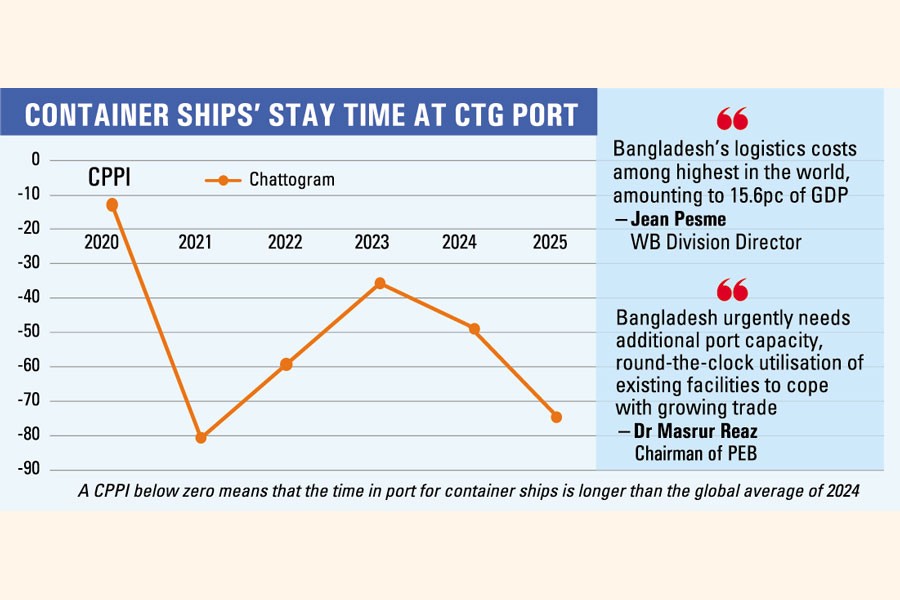
Import container-dwell time at Bangladesh's principal seaport has increased despite a series of customs- digitisation initiatives and procedural-simplification measures, exposing persistent inefficiencies in the country's trade logistics.
According to the World Bank's Logistics Performance Indicators (LPI), the average container import-dwell time (CIDT) at Chattogram Port increased from 7.8 days in 2023 to 8.3 days in 2024.
Earlier, Bangladesh Customs' Time Release Study (TRS) 2022 estimated the average container-clearance time at around 11 days.
Customs officials say the average container-dwell time remained above 11 days in 2025, indicating that modernisation of customs procedures alone is insufficient unless other stakeholders -- including importers, shipping agents and port operators -- also improve their efficiency.
At a recent meeting, Chattogram Customs House (CCH) urged importers to submit the bill of entry (B/E) within 10 hours of the arrival of imported cargos.
Officials have said many importers take more than a week to submit the customs declaration, preventing customs authorities from initiating assessment and clearance procedures in time.
Based on six years of time-series data, the World Bank found that container ships spend significantly longer periods at the seaport than the global average.
"The World Bank and S&P Global data show that in Chattogram, container ships spend about 50 per cent of their time waiting at anchor, significantly higher than the global average of around one-third of vessel time in port," the World Bank said in a clarification note sent to The Financial Express in response to queries.
Responding to questions, Jean Pesme, World Bank Division Director for Bangladesh and Bhutan, said Bangladesh's logistics costs remained among the highest in the world, amounting to 15.6 per cent of GDP, while congestion at Chattogram Port -- which handles more than 80 per cent of the country's international trade -- continues to undermine competitiveness, investment and job creation.
"Regardless of the timing of LDC graduation, Bangladesh needs to act with urgency to reduce trade costs and transport times at ports in order to maintain export competitiveness," he said.
Mr Pesme notes that the World Bank is supporting these efforts through a $650-million investment in the Bay Terminal, which will add deep-sea capacity, accommodate larger vessels and reduce transport delays, generating estimated economic savings of about $1.0 million per day.
He said the Bank is also supporting port digitisation, customs and logistics modernisation, institutional reforms and capacity building to transform Chattogram Port into a modern trade and industrial gateway.
"Efficient ports and logistics are essential for attracting private investment and creating jobs at scale," Mr Pesme added.
A senior official of Chattogram Customs House told the FE that the actual container-dwell time is difficult to determine accurately because the clearance process involves multiple stakeholders whose actions are interdependent.
"The biggest delay occurs in the submission of the bill of entry. Some importers submit their declarations more than a week after the goods arrive," he said.
To identify the reasons behind the delay, the CCH recently held a meeting with companies operating under the Authorised Economic Operator (AEO) programme, which enjoys expedited customs-clearance facilities.
The official also pointed out an ambiguity in Customs Act.
"The law stipulates that customs clearance should be completed within a maximum of five days. However, it does not specify whether the countdown begins from the arrival of goods at the port or from the submission of the bill of entry."
He notes that implementation of the legal provision requires detailed rules defining the starting point of the clearance period, but such rules have yet to be issued.
He claims customs process takes less than two days now after getting B/E.
ABM Shamsul Arefine Khan, Senior Manager (Procurement) of Incepta Pharmaceuticals' Supply Chain Management Division, acknowledges that delays also occur because shipping agents often do not provide the necessary documents promptly.
"Shipping agents generally do not accept scanned copies. Importers, therefore, have to wait until the original shipping documents arrive from overseas suppliers before submitting the bill of entry," he said.
Mr Khan, who attended the customs meeting, said the CCH requested AEO companies to submit bills of entry within 10 hours of cargo arrival.
Former President of the American Chamber of Commerce in Bangladesh (AmCham) Syed Ershad Ahmed has said Bangladesh must prioritise modern logistics infrastructure if it wants to leverage its competitive advantages and attract greater foreign investment.
He said foreign direct investment (FDI) is essential for developing large-scale logistics facilities and improving supply-chain efficiency.
According to him, the proposed Bay Terminal at Chattogram Port could substantially increase cargo- handling capacity and reduce vessel congestion.
Likewise, the planned relocation of Kamalapur Inland Container Depot (ICD) to Dhirasram should be expedited to improve inland freight movement and reduce pressure on Dhaka.
He also stressed the need to establish modern warehousing facilities at all major ports, alongside integrated cold-chain infrastructure at Chattogram Port and Hazrat Shahjalal International Airport to support exports of perishable products, including agricultural produce, seafood and pharmaceuticals.
At the same time, he said, the government should accelerate comprehensive customs automation across all ports to reduce clearance time, improve transparency and lower trade costs.
Dr M Masrur Reaz, Chairman of the Policy Exchange Bangladesh, has said import volumes have increased significantly over the years while port-handling capacity has failed to keep pace.
"The Bay Terminal has yet to become operational, and existing infrastructure is already operating beyond its optimal capacity," he added.
Although the introduction of new equipment has improved efficiency to some extent, physical infrastructure, berthing capacity and operational efficiency remain inadequate relative to the country's rapidly growing trade, he notes.
Dr Reaz has stressed that Bangladesh urgently needs additional port capacity and round-the-clock utilisation of existing facilities, including more efficient management of tidal movements.
He has also called for globally competitive port operations, noting that Bangladesh continues to lag behind international standards in crane productivity, equipment utilisation and terminal management.
"Unless the government focuses on achieving global standards of port efficiency through better infrastructure, equipment and operations, container-dwell time will continue to increase," he warns.
doulotakter11@gmail.com