
Poverty cut progress fragile in BD, income equality rising
UN rapporteur says
FE REPORT | Tuesday, 30 May 2023
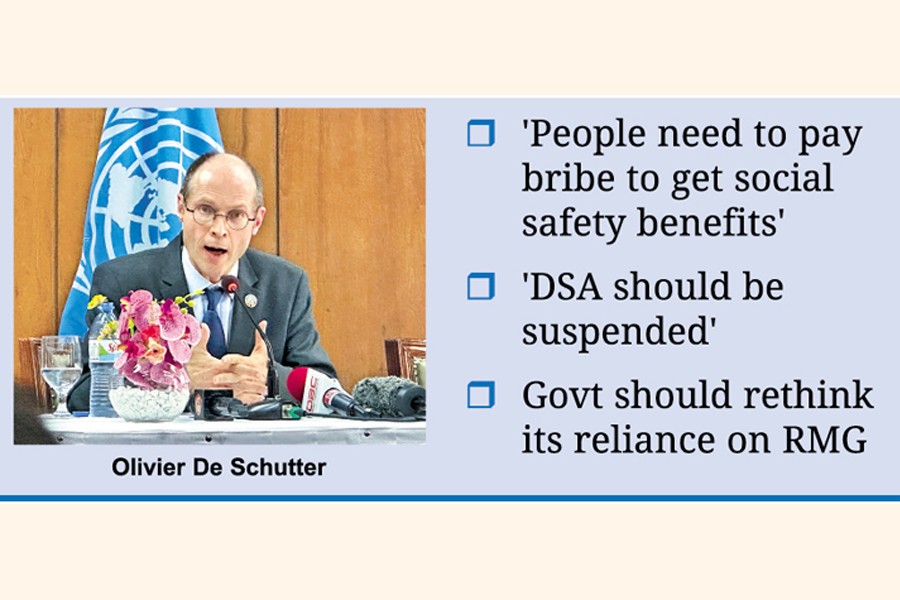
Olivier De Schutter, the visiting UN special rapporteur on extreme poverty and human rights, said Bangladesh has made significant improvement in poverty reduction in last decade, but recent trend shows that the progress remains fragile and income inequality is rising.
Speaking at a press briefing on Monday he also stated that to get benefits of the social protection schemes, people either need to pay bribe or to have political connections.
He strongly recommended suspension of the Digital Security Act (DSA), increasing minimum wage in the ready-made garment (RMG) sector, and reforming the tax-mobilisation process.
"General indicators do not tell the whole story. First, income inequality is rising. Measured in the Gini coefficient, income inequality stood at 0.458 in 2010, and rose to 0.499 by 2022, with consumption inequality increasing from 0.321 to 0.334 over the same period," he said.
According to the UN rapporteur, a category of "new poor" is emerging. These are households, which are just above the poverty line, have little to no savings, and are therefore highly vulnerable to becoming poor after a shock.
"Similarly, a 2022 survey in Dhaka by the Bangladesh Institute of Development Studies (BIDS) found that 51 per cent of the people in poverty had recently fallen below the poverty line to become new poor."
"In other terms, general progress in poverty reduction remains fragile. Many households, especially in urban areas, remain vulnerable to shocks," he added.
About the impact of rising inflation on poverty situation, Mr Schutter said against such a background, inflation is a major concern.
The Bangladesh Bureau of Statistics (BBS) estimated inflation in April 2023 to be at 9.2 per cent (food inflation was at 8.8 per cent), and real inflation faced by the poorest people, who must spend a higher proportion of their income, is much higher even.
"Inflation is the enemy of the poorest people: eating away at low incomes and rapidly resulting in food insecurity, falling living standards and debt."
"This is why, beyond seeking to stimulate economic growth, the government should focus on strengthening the resilience of households to shocks. So, not only income inequality, but wealth inequality should also be addressed," he noted.
About irregularities in the government's safety net programmes, he said there are examples of asking bribe by representatives of respective upazila committees, by union council members, or especially by ward councillors for applicants to be put on the beneficiary list.
"Non-payment of bribe resulted in denial of support. Such 'entry payments' for social programmes are a source of political clientelism. These lead to leakage and capture of the process by local elites. Such abuses, in a way, are inherent to a system," he added.
Mr Schutter noted that the government must move away from its reliance on cheap labour, if it is to ensure a rights-based development following its expected graduation from the least developed country (LDC) status.
"A country's comparative advantage cannot lie in keeping its people poor," the UN special rapporteur said, adding that Bangladesh's development has largely been driven by one export sector - the RMG - which is highly dependent on keeping wages low.
He urged the government to use its upcoming graduation from LDC status in 2026 as an opportunity to rethink its reliance on the RMG industry, which currently accounts for 82 per cent of the country's export revenue and employs some 4.0 million workers.
"As Bangladesh moves towards graduation, it continues to focus much of its energy on providing tax incentives to international investors and establishing special economic zones."
Mr Schutter also expressed concern over the government-run NGO Affairs Bureau's chilling effect on ability of the civil society to operate freely.
He recommended immediate suspension of the DSA, saying that, in particular, it has been severely used to suppress independent thoughts and voices, including those on the internet.
Under the DSA, journalists, human rights defenders, opposition politicians and academics have been detained for exercising their rights to freedom of expression and opinion.
"These developments will not only scare off the very investors that the country is trying to attract, but these are also obstacles to the realisation of economic and social rights."
"You cannot deliver healthcare, education or social protection without improving accountability and transparency."
"Overall economic progress has been uneven, with groups such as the adibasi, dalit, bede, and hijra along with the religious and linguistic minorities such as the Bihari have been left out," the UN special rapporteur noted.
"The government has also carried out evictions in informal settlements under the guise of development, without following due process or providing adequate compensation and rehabilitation - in violation of the right to adequate housing."
Mr Schutter urged the government to rationalise its social protection system, which he described as "a patchwork of 119 schemes that emerge on an ad-hoc basis, are poorly coordinated and do not provide the level of income security that the Bangladeshis should expect."
He expressed concern over the fact that the country's tax-GDP ratio was particularly low (at around 7.8 per cent) and that almost two-thirds of public revenue to finance social protection came from indirect taxation, while only one-third came from direct taxation on income.
"This should be reversed. It is the high-income earners and large businesses that should contribute to the financing of public services and social protection, not consumers."
"Social protection programmes should be developed to protect the country's population from the new and significant risks posed by climate change," the UN special rapporteur said.
He noted that in 2022 alone, 7.1 million Bangladeshis were internally displaced due to riverbank erosion, cyclones, floods, and other disasters, or because their livelihoods were threatened by water salinisation.
On Rohingya situation, he said until the conditions for repatriation are met, the Rohingyas must be allowed to live a decent and dignified life.
It was "unconscionable" that the international donors had contributed so little to the 2023 Joint Response Plan, which called for US$876 million to address the urgent humanitarian needs in the camps, only 17 per cent of which was funded.
Since March 2023, the World Food Programme (WFP) has cut the value of its food vouchers from $12 to $10 per person per month, and the value would be further reduced to $8.0 in June.
Mr Schutter also warned that malnutrition and undernutrition would increase, with dramatic consequences, especially for children.
The UN special rapporteur will present his final report on Bangladesh to the Human Rights Council in June 2024.
mirmostafiz@yahoo.com