
PPP projects included in ADP face chronic delays
Most see little progress even in years
FHM HUMAYAN KABIR | Thursday, 4 June 2026
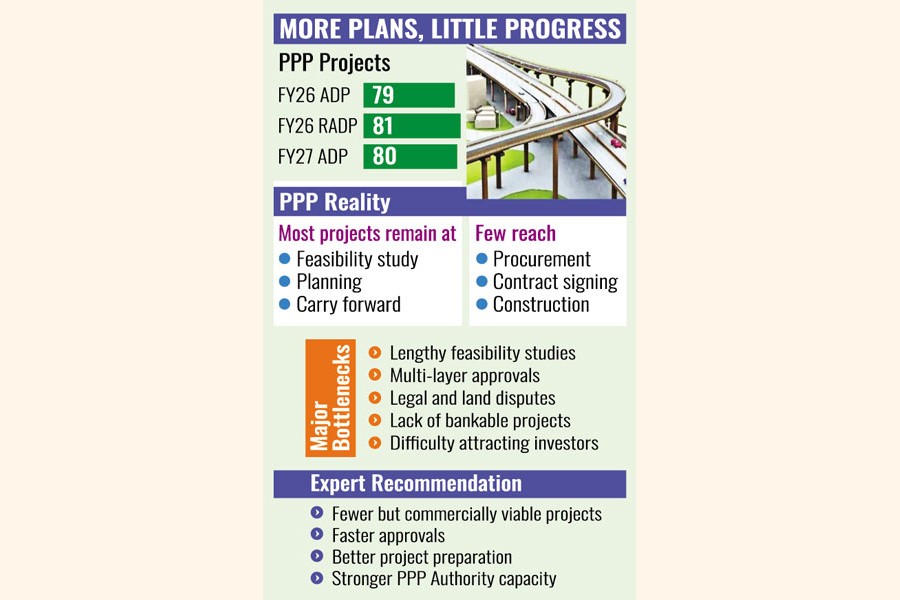
A significant number of projects included each year in the development budget for implementation through public-private partnerships (PPPs) fail to take off, officials said on Wednesday.
Most of these projects are carried forward to the Annual Development Programme (ADP) year after year, they said.
The government has included 80 PPP projects in its newly approved Tk 3.0 trillion ADP for fiscal year (FY) 2026-27, alongside around 1,150 public-sector development projects undertaken by various ministries and agencies.
In the outgoing FY2026 ADP, the government had included 79 PPP projects, most of which were not even initiated for implementation.
For FY2027, a total of 80 PPP projects have again been included in the ADP, with most of them carried forward from the current programme.
While the inclusion of these projects reflects the new administration's intention to leverage private investment for infrastructure development, economists and policy analysts caution that, without substantial institutional reforms, the projects risk facing the same delays and implementation failures that have characterised Bangladesh's PPP programme for more than a decade.
Analysts say the main concern surrounding the 80 initiatives is the longstanding gap between policy commitments and actual execution.
For years, the government has routinely included large numbers of PPP projects in the ADP -- ranging from 78 projects in FY2019-20 to 81 projects in the revised FY2025-26 ADP -- largely to demonstrate a commitment to private-sector participation in infrastructure development.
A senior official of the Planning Commission said PPP projects are included every year based on proposals and priorities submitted by ministries and the PPP Authority.
"However, we have observed that the ministries and the Authority often fail to implement these projects on time, resulting in their being carried over to subsequent years or eventually dropped after remaining in the ADP for several years," the official said.
In the original ADP for FY2026, the Planning Commission included 79 PPP projects during the programme's finalisation in May last year.
However, in March this year, the government revised the list, incorporating 81 projects in the Revised Annual Development Programme (RADP) after dropping some projects and adding new ones.
Another Planning Commission official said available data suggest that actual progress beyond inclusion in planning documents remains limited.
According to historical tracking by the PPP Authority, a large number of listed ventures remain stalled at the preliminary stage.
Most initiatives remain trapped in the detailed feasibility study phase, while only a small proportion advance to procurement, commercial agreements or operational status.
Experts noted that attracting private investment is considerably more challenging than implementing publicly funded projects because of a range of systemic obstacles.
Excessive bureaucratic procedures, delays in securing administrative approvals and the need for clearances from multiple ministries are among the key barriers to implementation.
Lengthy legal disputes, land acquisition and right-of-way issues for major infrastructure corridors, as well as the lack of bankable feasibility studies, have also hindered efforts to attract private investors.
A senior official of the PPP Authority told the FE that some progress had been made on a number of PPP projects that have remained listed in the ADP for years.
"However, those projects now need to be implemented efficiently and within a reasonable timeframe," he said. Although a handful of PPP projects have been completed or are at different stages of implementation, many have taken an exceptionally long time to move from planning to execution.
The government initiated the Establishment of a Haemodialysis Centre at Chittagong Medical College Hospital and the Haemodialysis Centre at the National Institute of Kidney Diseases and Urology (NIKDU) in 2012, but private partners were appointed only three years later, in 2015.
Similarly, the Dhaka Elevated Expressway project was launched in 2011 and a concession agreement with a private partner was signed in 2013, yet the project remains incomplete.
kabirhumayan10@gmail.com