
Promising pickup in RMG export to newer markets
Shipments to western markets like Germany, USA on downturn
MONIRA MUNNI | Wednesday, 12 July 2023
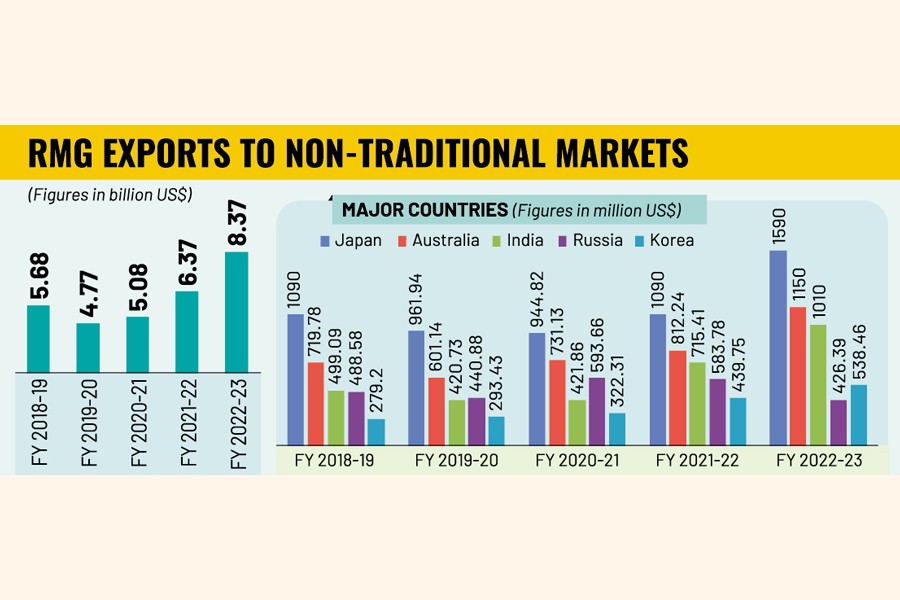
Apparel export to newer markets looks on an encouraging pickup yielding to Bangladesh in the last fiscal US$8.37 billion in a 31.38-percent annual growth, amid a downturn in the West.
Official statistics show Australia, Japan and India leading the list of switch to non-traditional export destinations for the country with earnings from each of the three Asia-Pacific economic majors having surpassed a billion-dollar mark.
By a contrast in the economic partnership, the country's export receipts from existing major markets like Germany and the USA showed a fall in the just-past fiscal year (2022-23).
Earnings were US$6.37 billion from the non-traditional markets in the fiscal year of 2021-22, according to Bangladesh Garment Manufacturers and Exporters Association (BGMEA) data.
The non-traditional market accounted for 17.82 per cent of the total RMG earnings worth US$46.99 billion in the last fiscal year.
In fiscal 2009-10, RMG exports to non-traditional markets were only US$1.08 billion or 8.66 per cent of total earnings, as per the data.
According to industry people, Australia, Brazil, Chile, China, India, Japan, Korea, Mexico, Russia, South Africa, the United Arab Emirates, Malaysia, Saudi Arabia, New Zealand and Turkey are the 15 prospective markets beyond the three traditional export destinations: the United States, the European Union and Canada.
Exports of the country's readymade garment (RMG) items to the up-and-coming markets have been on the increase over the years, pushed by ongoing efforts for diversifying export markets.
The drives include visits, participation in trade shows and government support, especially the cash incentives, for shipping goods to non-traditional markets, they said.
Besides, exporters are now focusing more on such markets for sluggish demand in major traditional markets mainly because of economic slowdown, high inflation and interest-rate rises over there for global factors like the Russia-Ukraine war, post- COVID inventory swelling.
Out of these countries, Bangladesh's exports fetched US$1.59 billion from Japan, US$1.15 billion from Australia, US$1.01 billion from India and US$538.46 million from Korea in over 45-percent, 42-percent, 41-percent and 22-percent growth respectively during the July-June period of 2022-23.
On the other hand, the export of Bangladeshi-readymade garments declined about 27 per cent to $426.39 million to Russia and by 11 per cent to $163.10 million to Chile in the last fiscal.
Talking to the FE, BGMEA vice-president Md Shahidullah Azim said they were actively working to raise both export earnings and market share in the non-traditional destinations mainly to diversify market and reduce dependence on the traditional ones where demands are changing due to the economic turmoil, high inflation rates and the Russia-Ukraine war.
"We are now focusing more on new markets and product diversification, especially based on non-cotton or manmade fibre, to sustain the country's export growth amid the uncertain economic situation in major markets, especially in the EU and the USA," he says.
Out of the US$46.99 billion worth of earnings, some 50.07 per cent or US$23.52 billion came from the EU while exports to the USA declined by 5.51 per cent to US$8.51 billion which accounted 18.12 per cent of the total RMG exports.
Apparel earnings stood at US$ 5.02 billion in the UK and US$1.54 billion in Canada, recording 11.78-percent and 16.55-percent growth respectively, according to data.
"Bangladesh's clothing sector is struggling to boost its growth in the USA due to the unstable economic situation there," Mr Azim said, adding that the RMG sector's potential is growing rapidly in non-traditional and new markets.
New markets offer opportunities to access new customer segments that may have different tastes, preferences, and requirements from existing markets, he noted.
Echoing similar views, Mr Fazlul Hoque, former president of Bangladesh Knitwear Manufacturers and Exporters Association (BKMEA), however, said the country enjoys duty benefits in many of the non-traditional markets like Japan, Australia, Chile, China and India.
He recommends government-level discussions with the countries that offer duty-free market access to local RMG so that "the duty facility continues after Bangladesh graduates from the least-developed country (LDC) status".
Munni_fe@yahoo.com