
Promoting agro-industry: Government support inadequate
Rahman Jahangir | Saturday, 8 November 2014
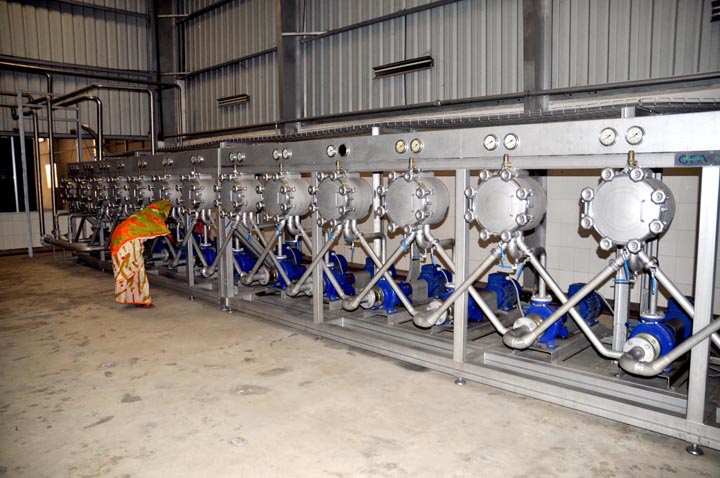
'Malaysian paratha' is now at the door-step of people in urban areas of Bangladesh. So are Thai noodles. Thanks to open market in this time of globalisation, farm products from one end of the globe travel without any restrictions to the other end. So are Bangladeshi agricultural products like spices and food items. Manufactured by a few companies like Pran, these are gaining popularity in markets which were once out of bound for them. Pran products are reportedly available in more than 20 countries. As these items are of daily use by billions, Bangladesh can take advantage of such a vast market abroad.
The other day, a seminar organised by Palli Karma-Sahayak Foundation (PKSF) highlighted the strong potential of Bangladesh for expanding agro-industry as its land is very fertile to produce wide varieties of crops and fruits. But entrepreneurs must come forward with innovative ideas by assessing potential market values of those agro-products, experts told the seminar titled "Expanding the horizon of opportunities: Promoting innovative enterprise".
The Chairman of National Board of Revenue (NBR), agriculture scientists and representatives of non-government organisations, among others, addressed the seminar with MA Quashem, member of board of directors of Palli Karma-Sahayak Foundation (PKSF) in the chair. PKSF Chairman Qazi Kholiquzzaman Ahmad, PKSF managing director Md Abdul Karim and other senior officials were present.
Executive director of Habitat and Economy Lifting Programme (HELP) Mir Al Mamun and Coordinator of Jonobiggan Foundation Ayub Hossain made separate presentations. In his presentation, the Executive director of HELP said, "We have tremendous prospects to transform agriculture sector into agro-industry as some potential varieties of crops and fruits are available in the country."
There is better value addition to fish resources, mushroom, rice, jackfruit, ladies finger and coconut. "We can produce fish fry, fish oil and various other food items from fish resources, and side by side, we can produce tasty rice crackers from local rice varieties and candy and chips from jackfruits. All of these food items have market demand", he pointed out.
Bangladesh can learn from examples of many foreign countries thriving on agricultural products. Japan has produced rice crackers, with better tastes than other crackers produced from wheat. Bangladesh can follow Japan as rice is the major crop in both two countries. But then the new entrepreneurs need to be more innovative while selecting crops, vegetables and fruits for running agro-based industry to make it financially profitable.
Support of the government in promoting production of farm products is necessary. The government should offer soft-term loan for small entrepreneurs, who are interested to build agro-based industry in the country. It is to be noted that agriculture plays a significant role in the country's economy, accounting for around 20 per cent of the GDP (gross domestic product) and employing 48 per cent of the labour force. That is why, agriculture sector is required to be transformed into agro-industry to generate employment opportunities as well as accelerate rural economy.
Studies on the potentials of agro products show that driven by economic growth, rising incomes, and urbanisation, demand is shifting away from traditional staples towards high-value food commodities. High value agricultural commodities include fruits, vegetables, spices, fish, and livestock products, many of which are processed before reaching the market.
In Bangladesh, additional demand for these commodities is projected to be worth about $8 billion by 2020 (in 2005 prices), said one study. This represents an enormous opportunity for food producers, processors, and sellers. Owing to the labour-intensive characteristic of high value agricultural production, it also provides an opportunity to generate rural employment and raise rural incomes.
It is to be noted that more than 80 per cent of people living on less than $2 a day in Bangladesh live in rural areas. This spatial distribution of poverty makes capitalising on the opportunities offered by high value agricultural production an important strategic priority for those seeking to reduce poverty in the country. Yet, for all of its promises, capitalising on these opportunities is fraught with challenges.
High-value agricultural products are generally more perishable than traditional staples, and require more sophisticated post-harvest technologies and equipped methods of transportation. Insufficient processing capacity, lack of cold storage facilities or persistent bottlenecks in transportation are main constraints to promoting high-value agriculture products in Bangladesh.
The prospect of Bangladesh earning increased export receipts by accessing international markets is fraught with the challenges of meeting the required quality and standards of the export markets. Most importantly, even assuming that opportunities offered by high-value agriculture products are successfully seized upon, there is no reason whatsoever to assume that the benefits of this success will extend naturally or automatically to those who need them most urgently -- Bangladesh's rural poor.
arjayster@gmail.com