
Push for tax breaks, policy support to meet 10,000 MW solar target by 2030
FE REPORT | Tuesday, 5 May 2026
Tax exemptions for a certain period, adoption of appropriate technology, adequate financing and strong political commitment are vital to achieve the government's target of generating 10,000 megawatts of solar power by 2030, speakers at a programme on Monday said.
Describing the target as ambitious, they said it is both realistic and necessary for the country's energy security, and called for a transparent, inclusive and sustainable roadmap to reach the target.
They came up with the observations at a press conference styled 'Welcoming the government's target of 10,000 MW of solar power generation by 2030 and presenting civil society's expectations and pathways'.
The press conference was jointly organised by ActionAid Bangladesh, the Bangladesh Sustainable and Renewable Energy Association (BSREA) and the Just Energy Transition Network Bangladesh (JETnet-BD).
Energy experts, academics, environmentalists and civil society representatives presented a social, technical and economic framework aimed at addressing the ongoing energy crisis and advancing energy sovereignty.
Lead Energy Analyst, Institute for Energy Economics and Financial Analysis Shafiqul Alam and Chief Executive and Managing Director, Change Initiative M Zakir Hossain Khan presented the keynote paper.
Energy expert Dr Ijaz Hossain, Dipal Chandra Barua, Founder and Chairman of the Bright Green Energy Foundation, President of Bangladesh Sustainable and Renewable Energy Association (BSREA), Mostafa Al Mahmud, and General Secretary of the National Press Club Ayub Bhuiyan spoke on the occasion, among others.
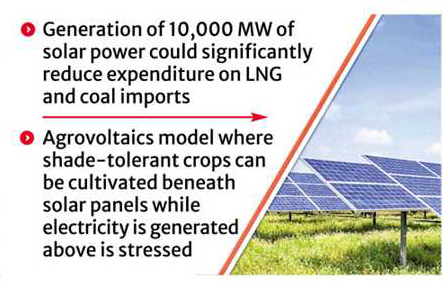
Dr Ijaz Hossain said integrating 10,000 MW of solar power into the grid could significantly reduce the country's expenditure on LNG and coal imports.
He said solar power is no longer an alternative, but is set to become the backbone of Bangladesh's energy system.
He also stressed the importance of battery energy storage systems to ensure that surplus daytime electricity can be used at night and to maintain grid stability.
"Problem is that a heavy tax is imposed on battery, that needs to be addressed," he said.
Addressing concerns over land scarcity, Dipal Chandra Barua said electricity generation is possible on agricultural land.
He highlighted the agrovoltaics model, where shade-tolerant crops can be cultivated beneath solar panels while electricity is generated above. He also identified riverine char areas and floating solar projects as key sources for achieving the target.
Climate finance expert M Zakir Hossain Khan said expanding rooftop and irrigation-based solar solutions could deliver visible progress within three to six months provided there is administrative commitment.
Over-reliance on large, import-dependent projects, he warned, poses risks to national energy security.
Mostafa Al Mahmud identified high import duties on solar panels and inverters as a major barrier.
He said investors remain interested but are discouraged by lengthy administrative procedures across multiple agencies. He called for a fast-track mechanism and a one-stop service to facilitate investment.
Highlighting the importance of political commitment, Ayub Bhuiyan said Bangladesh must move away from its reliance on imported fuels and prioritise domestic renewable resources. He noted that integrating smart grid systems and modern technologies could establish solar power as the country's primary energy source.
The event was moderated by Abul Kalam Azad, Manager of the Just Energy Transition Team at ActionAid Bangladesh.
saif.febd@gmail.com