
Putin will search for way to save face in war
Thursday, 17 March 2022
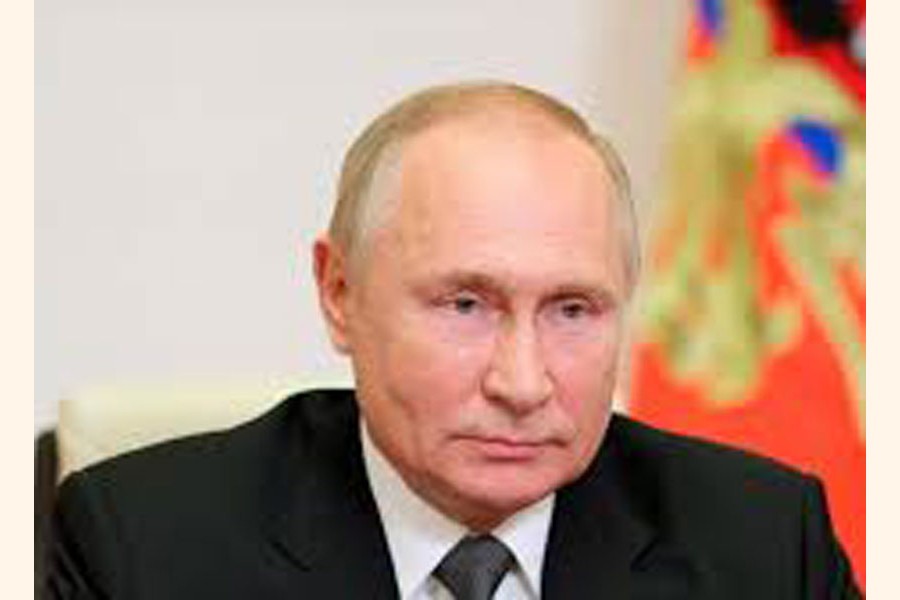
MOSCOW, Mar 16 (BBC/Reuters/AP): Even the worst war comes to an end. Sometimes, as in 1945, the only outcome is a fight to the death. Mostly, though, wars end in a deal which doesn't satisfy anyone entirely, but at least brings the bloodshed to an end.
And often, even after the worst and most bitter conflicts, the two sides gradually resume their old, less hostile relationship.
If we're lucky, we're beginning to see the start of this process happening now between Russia and Ukraine.
The resentment, particularly on the Ukrainian side, will last for decades. But both sides want and need peace: Ukraine, because its towns and cities have taken a terrible battering, and Russia, because it has already, according to the Ukrainian president, sacrificed more men and materiel than it lost in its two shockingly violent wars in Chechnya - although that is impossible to verify.
But no-one willingly signs a peace agreement which is likely to lead to their own downfall.
For Russian President Vladimir Putin the search is on for ways of saving face. Ukraine's President Zelensky has already shown remarkable skill as a diplomat, and he's clearly willing to say and do whatever is acceptable to himself and his people in order to get Russia off his country's back.
For him, there's one overriding objective - to make sure that Ukraine comes out of this appalling experience a united, independent country, not a province of Russia, which is what President Putin originally seemed to think he could turn it into.
For President Putin, all that counts now is that he can declare victory. No matter that everyone in his entire administration will understand that Russia has been given a bloody nose in this unnecessary invasion. No matter that the 20% or so of Russians who understand what's really going on in the world will know that Putin has bet the house on a fantasy of his own devising, and lost.
So what will make President Putin come out of this disastrous war looking good in the eyes of Russia's majority?
Firstly, an assurance, perhaps even to be written into Ukraine's constitution, that it has no intention of joining Nato in the foreseeable future. President Zelensky has already prepared the way for this, by asking Nato for something it couldn't agree to (establishing a no-fly-zone over Ukraine), then criticising the alliance for letting him down on this, and finally musing out loud that he wasn't sure that if Nato behaved like this, it was actually worth joining.
As clever and wise political positioning goes, it doesn't get much better than this. Nato gets the blame, which it can easily cope with, and Ukraine gets the freedom to act as it wants.
But that's the easy bit. It'll be harder to finesse the urgent ambition which Zelensky and Ukraine have to join the EU, something Russia is almost equally hostile to, though there are ways around that too. Hardest of all for Ukraine to swallow will be Russia's outright theft of Ukrainian territory, in total defiance of the solemn international treaty it had signed to protect Ukraine's borders.
Russia bars entry to Biden,
Trudeau and US officials
Russia said on Tuesday it had put US President Joe Biden, Canadian Prime Minister Justin Trudeau and a dozen top US officials on a "stop list" that bars them from entering the country.
Alongside Biden, US officials on the list included Defence Secretary Lloyd Austin, CIA chief William Burns, National Security Adviser Jake Sullivan and former secretary of state and presidential candidate Hillary Clinton.
The ban was in response to sanctions imposed by Washington on Russian officials. The foreign ministry later added Trudeau to the list of sanctioned individuals.
3 EU prime ministers visit Kyiv
as Russian attacks intensify
The prime ministers of Poland, the Czech Republic and Slovenia traveled to the embattled Ukrainian capital of Kyiv and met with President Volodymyr Zelenskyy on Tuesday in a show of support for Ukraine even as bombardment by the Russian military edged closer to the center of the city.
The three leaders went ahead with the hours-long train trip despite worries within the European Union about the security risks of traveling within a war zone.
"It is here, in war-torn Kyiv, that history is being made. It is here, that freedom fights against the world of tyranny. It is here that the future of us all hangs in the balance," Poland's Prime Minister Mateusz Morawiecki said on Twitter.
The long journey over land from Poland to Kyiv by Morawiecki, Poland's deputy Prime Minister Jaroslaw Kaczynski and Prime Ministers Petr Fiala of the Czech Republic and Janez Jansa of Slovenia sent the message that most of Ukraine still remains in Ukrainian hands.
But underlining the deteriorating security situation in Kyiv, a series of strikes hit a residential neighborhood in the city again on Tuesday.