
US-BD dialogue inconclusive
RAB sanctions issue unresolved
US focuses geostrategic affairs
FE REPORT | Monday, 21 March 2022
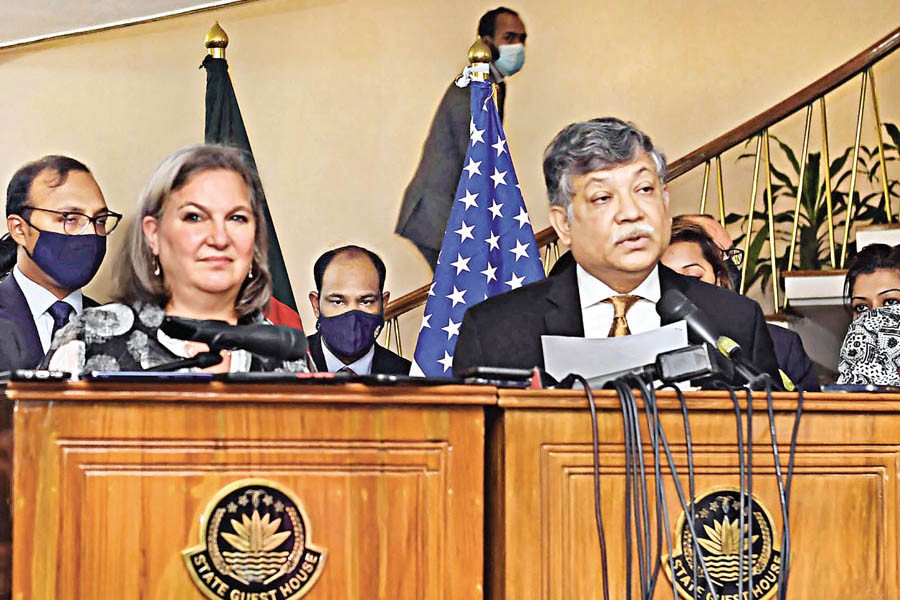
The crucial issue of US sanctions related to RAB was discussed, but left aside to deal with later, as Washington in Sunday's Dhaka meet underscored security affairs amid current geopolitical developments.
Officials said both sides at the 8th US-Bangladesh partnership dialogue decided to continue discussion on this matter of "deep concern" to Dhaka.
In an important development coming from the meeting, the rafts of two security-related deals were exchanged for perusal by both sides.
Talking to newsmen after the talks, US Under-Secretary for Political Affairs Ambassador Victoria Nuland said that they were aware of the concern of Bangladesh regarding the sanctions and there would be further discussion.
"This has been complicated and difficult issue here today. You know we have concerns about how the RAB has performed, about extrajudicial killing, about enforced disappearances We have seen progress in the last three months in mitigating these," she says.
According to Ms Nuland Bangladesh side briefed them that the government has 'zero tolerance' to such things, and about the efforts to ensure accountability and justice.
"We look forward to working together on these things because our cooperation on security and counterterrorism is very important to us"
However, the US delegation chief made it clear that the United States would not remain silent over violation of human rights anywhere in the world.
Foreign Secretary Masud Bin Momen, who led the host side in the dialogue, said they provided dossier on the Rapid Action Battalion or RAB.
The RAB, which was launched long back amid a wave of offences, is a multidisciplinary force armed with sweeping legal powers to deal with serious crimes.
"They will look into it and we will continue our discussion in several formats -- hopefully this issue will be resolved in due course," he told the press about the inconclusive talk on this major matter of embargoes.
Dhaka is considering Sunday's discussion as "the beginning of a rejuvenated robust engagement with its US friends", he adds.
"Bangladesh raised deep concern about the recent US treasury sanctions imposed on RAB and related individuals," Mr Masud told the press.
Bangladesh not only explained how this might affect the efforts of Bangladesh government to combat terrorism and transnational crimes but also elaborated on how the government has been addressing the challenges, he adds.
"We look forward to continuing our discussion in this regard. We also explained our position on issues like democratic practices, media freedom, labour rights and religious harmony."
The foreign secretary said there was also "in-depth discussion" on ways and means of enhancing trade and investment, and possible cooperation in Blue Economy.
"We exchanged our views on Indo-Pacific Strategy, and also shared our perspectives on national, regional and global security and geopolitical scenario," he adds.
The foreign secretary said in the area of economic cooperation, including trade and investment, they look forward to having further discourse in upcoming High-Level Economic Partnership Consultation in early June and possible next round of TICFA talks this year.
Bangladesh-US bilateral political, economic, security and people-to-people relations are based on this ideological pivot.
Both sides discussed the areas of 'excellent' mutual cooperation like Rohingya issue, COVID-19 vaccine support, US development assistance, capacity building in security sector, officials say.
The dialogue also covered areas of yet-untapped potential like exchange of high-level visits, investment, trade facilitation, connectivity, stronger defence and security cooperation and so.
"I think both sides also have taken this opportunity to better understand each other and explain respective positions on some issues."
"Finally, I would say, and in fact this is what we have told to our US colleagues today, that Bangladesh has high expectations from the Biden administration in terms of building a comprehensive partnership," the foreign secretary said.
Asked about progress on signing the proposed General Security of Military Information Agreement (GSOMIA) and the Acquisition Cross-Servicing Agreement (ACSA), the US delegation chief said drafts were passed on in the meeting and both sides were positive.
"Washington has proposed signing these two agreements considered "foundational agreements" for strengthening defence relationship.
About the much-talked-about Indo-Pacific strategy -- a latest focus in America's security paradigm -- she said the US wants more cooperation between the two countries on maritime security and there can be multilateral cooperation among community of countries in the region.
In the meantime, the United States has mooted a security-cooperation bloc called Quad so far rallying three other members from this belt -- Australia, India and Japan. China takes exception to this move, and urges other countries to stay away.
mirmostafiz@yahoo.com