
Ramadan, Eid offer bonanza for apparel makers in Keraniganj
Ismail Hossain | Saturday, 6 May 2017
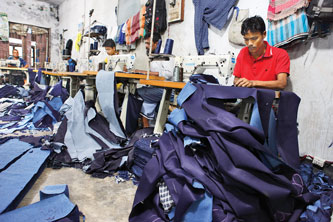
It is a busy time for apparel makers across the river Buriganga in Keraniganj in view of ensuing Ramadan and Eid-ul-Fitr, which is the largest sales festival for them.
Traders in Keraniganj sell 70 per cent of their annual turnover during Ramadan and their sales get momentum from Shab-e-Barat and last till 15th of the fasting month.
During the period, around 4,500 traders visit the market from all over the country every day, compared to just 300 on a normal day.
The wholesale hub is mainly popular for its denim products as it accounts for 50 per cent of the total readymade garment production in the area.
"This is our peak time for sales. Garments that are made in an increased number of production units in the area meet about 70 per cent of domestic demand with denim items accounting for 50 per cent," Shihab Mia, owner of Shihab Garments told the FE.
Garment makers in the locality said their products help save millions of dollars by reducing dependence on imports as the customers are now more interested in buying local products.
About 2,50,000 workers are employed in around 8,000 small factories and 6,000 showrooms in Keraniganj.
"Our target is to sell apparel products at least 20 per cent higher in this season than last year," said Bhuyian Fashion owner Mustafiz Bhuyian.
He said customers are now more attracted to local products than before because of the quality maintained by the garment makers in Keraniganj.
"I usually come to Keraniganj twice a month, but before Eid, I come every week," Delwar Hossain, a shop owner from Luxmipur, said.
He said the market offers reasonable prices for people of middle and lower classes in rural areas.
Prominent shopping centres of Dhaka also buy clothes made in Keraniganj.
Nandi's Fashion buys half of its cloths from Keraniganj. The rest of the products they display at their showroom are exported.
"I have been coming to Keraniganj every Monday for three years," Pramathesh Nandi said in front of Zahera Fashion.
He is a regular customer of Zahera Fashion.
Zahera Fashion owner Rafik Shikder, however, is not happy with the sales so far. Every year his factory makes 1,50,000 pairs of jeans targeting the Eid-ul-Fitr but he foresees a dull season this year.
Cost of production has also shot up significantly due to high rents. For his small showroom, he pays Tk 45,000 as monthly rent.
Wholesalers in the area sell a shirt for Tk 150 to Tk 800, a punjabi Tk 400 to Tk 900, three-pieces Tk 400 to Tk 3,000 and children's wear Tk 150 to Tk 400.
Apparel markers in the area design clothes collecting samples from India and China. Their fabrics come mainly from China, India, Thailand, the UAE and also local markets such as Islampur.
Holy Traders owner Maidul Islam said they sell normal jeans at Tk 250-Tk 300 per piece and quality jeans at Tk 550-Tk 2,500 per piece.
"The same products are sold at different outlets in the capital city at prices three to four times higher."
"Many of the exporters buy items from us on a contractual basis," he said adding that the difference now between foreign products and the local garments is very little.
The business model in Keraniganj is a little different from other wholesale markets.
Keraniganj traders usually sell bulk of their products on credit to attract retailers from across the country to do business with them.
Delwar Hossain, a shop owner from Luxmipur, said the credit system eases his business. The trading runs here on good faith.
bdsmile@gmail.com