
Rationalise corporate tax in upcoming budget
Govt urged at MCCI-ERF discussion
FE REPORT | Monday, 20 April 2026
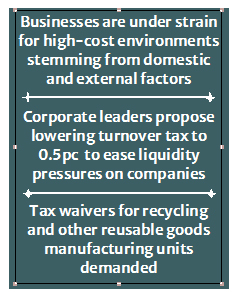
Corporate leaders on Sunday called for a rationalisation of corporate tax, saying that the businesses are grappling with high-cost environments stemming from both domestic and external factors.
They also proposed lowering the turnover tax to 0.5 per cent in the upcoming budget to ease liquidity pressures on companies and support their expansion.
The leaders further demanded tax waivers for recycling and other reusable goods- manufacturing units.
The demands were raised at a discussion titled National Budget 2026-27: Private Sector Priorities and Perspectives jointly organised by the Metropolitan Chamber of Commerce and Industry, Dhaka (MCCI) and Economic Reporters' Forum (ERF) in the city.
Dr Muhammad Abdul Mazid, former chairman of the National Board of Revenue (NBR), said such tax proposals prepared by the private organisations should have been submitted much earlier as the proposals are often finalised before receiving such proposals.
He urged the private authorities to place the proposals between December and January giving sufficient time for their review by the NBR authorities.
Dr. Mazid, however, stressed the need for greater accountability and transparency within the NBR along with simplification of tax policies for increased resource mobilisation.
He said establishing a separate policy wing distinct from implementation consisting of all revenue stakeholders, including the FBCCI, which would meet at least four times a year is a good move.
"All statutory regulatory orders (SROs) should be discussed within this policy wing before issuance," he said.
On revenue mobilisation, he said that the budget should clearly outline revenue targets along with their sources.
"Currently, the government does not provide a detailed picture, merely stating that revenue targets will be increased-sometimes by as much as Tk 1.0 trillion-without identifying the contributing sectors," he added.
Citing past experience, he referred to the 2018 budget, when provisions of the new VAT law were dropped at the last moment despite the NBR setting a Tk 200 billion collection target from it.
He said integrating national ID data with bank accounts, including fixed deposits, savings instruments and property ownership to widen the tax net and higher resource mobilisations.
"Ensuring quality public expenditure is a key, to my mind, to get higher revenues ", Dr. Mazid said.
The taxpayers will be more willing to comply with taxes when they will see effective service delivery at the expense of their money, he added.
"If public services such as education system improves, schools give proper education and no private coaching is required, then the people will pay taxes," he went on.
In his welcome address, MCCI President Kamran T Rahman said businesses are navigating a challenging period marked by high inflation and mounting pressure on small and medium-sized enterprises (SMEs).
Mr. Rahman said that although around 10 million Taxpayer Identification Numbers (TINs) have been issued, only about half are actively used in filing returns. He called for reducing taxes applied for both listed and non-listed companies by 2.5 per cent to attract new investments.
Mr. Rahman also urged simplification of VAT and customs procedures and stronger policy support for SMEs.
"A modern, technology-driven tax system would help boost revenue mobilisation and improve compliance", he added.
Mr. Shams Mahmud, managing director of Shasha Denims Ltd, a listed entity, said Bangladesh's export-oriented sectors are facing a slowdown in orders over the past nine months reflected in weaker export receipts, arguing that it might weigh on the macro economy.
He said the decline is partly due to new European Union regulations, including extended producer responsibility (EPR) rules.
ERF president Ms. Doulot Akter Mala and its general secretary Mr. Abul Kashem also spoke at the event, among others.
Md Shahadat Hossain, a past president of the ICAB, presented a keynote at the programme on the national budget 2026-27: private sector priorities and perspectives.
Corporate representatives from BSRM, Tanscom, Square Toiletries, Unilever and Apex Footwear, among other big corporate businesses also spoke at the event.
jasimharoon@yahoo.com