
Real estate and its future in Bangladesh
TANJIM HASAN PATWARY | Thursday, 30 July 2026
The scope of real estate in Bangladesh has expanded far beyond the conventional practice of buying and selling apartments. The sector now spans residential and commercial development, large-scale infrastructure projects, government-led ventures and public-private partnership (PPP) initiatives, and has become one of the country's most promising industries. Its weight in the economy is considerable: real estate and related activities contribute roughly 7.9 per cent of GDP, according to Bangladesh Bureau of Statistics data, while the country faces a housing deficit estimated at more than six million units.
A market of unusual scale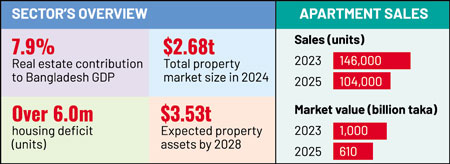 Statista Market Insights estimates the total value of Bangladesh's property assets at US$2.68 trillion at the end of 2024, roughly six times the country's GDP, with the residential segment at about US$2.05 trillion. It projects the figure could reach US$3.53 trillion by 2028, implying growth of just over 7 per cent a year. That number measures the value of the nation's entire stock of residential and commercial property, not annual sales, which amount to a few billion dollars a year. The gap shows how much of that wealth has yet to enter the formal market.
Three lean years
Recent performance has to be weighed against that promise. Apartment sales have fallen for three consecutive years, from roughly 146,000 units worth about Tk1 lakh crore in 2023 to around 104,000 units worth about Tk61,000 crore in 2025, according to industry figures, and registrations in the first half of 2026 were down by more than 40 per cent from the same period of 2023. Bangladesh Bank's policy rate stands at 10 per cent, inflation was still about 8.6 per cent in January 2026 and construction materials have become markedly more expensive, which erodes purchasing power and raises borrowing costs.
Even so, the demand appears postponed rather than lost. The housing deficit has not shrunk, urbanisation has not paused, and the sector's underlying drivers remain intact: remittances, infrastructure and countrywide diversification. When financing conditions ease, those buyers are likely to return.
Why ready apartments dominate
Ready apartments for residential or commercial use remain the most common form of real estate business in Bangladesh. A completed property gives the buyer immediate possession without the uncertainties of land acquisition, construction management, labour supervision and project delays. Professionals and corporate purchasers, who rarely have time to oversee construction themselves, consider this convenience well worth the premium paid, and the growing preference for ready flats reflects changing lifestyles as much as changing prices.
Investors also buy property for rental income, business operations or capital appreciation, while others purchase ready apartments as permanent homes, so the sector attracts investors and end-users alike.
Prices vary considerably across the country. Metropolitan areas are markedly more expensive than others owing to greater economic activity, infrastructure and employment, and prices differ within cities according to accessibility, security, amenities and neighbourhood quality. Properties in Gulshan or Banani command far higher prices than those in Mirpur or Motijheel.
The remittance engine
Of the macroeconomic variables that shape the market, remittances are the most underappreciated. Bangladeshi expatriates sent home a record US$35.56 billion in the 2025-26 fiscal year, up about 17 per cent on the year before, according to Bangladesh Bank. When earnings sent home rise, many households put part of those funds into land or apartments, and more of this record inflow could move into formal property investment if the right products and protections existed.
Infrastructure is redrawing the map
Infrastructure development has become another powerful catalyst. Dhaka has gained the metro rail, the elevated expressway and numerous flyovers in recent years, improving mobility, cutting travel times and enhancing the quality of urban life. Areas near metro stations are increasingly attractive to students, office-goers and business professionals, while new transport links have opened up previously less-favouredneighbourhoods, easing the concentration of demand in prime locations such as Gulshan, Banani, Baridhara, Bashundhara and Dhanmondi.
Beyond Dhaka, mega-projects are accelerating demand elsewhere. The Padma Bridge has transformed connectivity with the southern region, facilitating trade, infrastructure expansion and commercial activity. Businesses have followed, and demand for land and residential property has risen steadily, along with prices.
This countrywide growth is a blessing for middle-income households. As the industry spreads beyond Dhaka, families can buy in areas where prices are lower than in the capital, and people who cannot move to Dhaka or Chattogram can acquire personal or commercial spaces of their own, opening a new corridor of economic circulation.
The secondary market and the cost of buying
The secondary market has likewise gained prominence. A previously owned apartment can be judged from the experience of existing residents: utility services, transport links, building maintenance and security can all be assessed more reliably. Buyers should still conduct comprehensive due diligence, verifying ownership records, land titles, occupancy certificates and any outstanding legal issues.
A structural obstacle stands in the way: transaction costs. Registering a property costs roughly 6.5 to 10 per cent or more of its value once registration fees, stamp duty, local government tax and VAT are counted, among the highest rates in the region. Costs of that order push transactions into informal channels, encourage under-declaration of prices and suppress the formal secondary market. Mortgage finance is similarly thin, with housing loans at only about 3 to 5 per cent of GDP, so most purchases are still made from savings rather than long-term credit.
Lessons from Malaysia and Vietnam
Two Asian economies offer useful templates. Malaysia shows how to build housing finance. Its mortgage market exceeds 30 per cent of GDP, roughly ten times Bangladesh's depth, thanks largely to Cagamas, the state-backed national mortgage corporation established in 1986. By refinancing banks' housing loans, Cagamas lets lenders offer long-tenor mortgages at affordable rates without carrying the full liquidity risk. A comparable institution could transform affordability for Bangladesh's middle class.
Vietnam shows how to turn diaspora interest into recorded investment. Its 2015 Housing Law opened property purchases to foreigners and overseas Vietnamese, with safeguards including a 30 per cent cap on foreign ownership in any single building and 50-year renewable tenure, and channelled substantial overseas money into the formal market. Given remittances of more than US$35 billion a year, a clear, legally protected purchase channel for Non-Resident Bangladeshis (NRBs) is an obvious source of new demand.
Md Liton Ahmed, president of the US-Bangladesh Chamber of Commerce & Industry and founder and president of NRB Property Marketplace Limited, said: "Bangladesh's real estate sector has significant long-term growth potential. Continued urbanisation, expanding infrastructure, and rising demand from Non-Resident Bangladeshis (NRBs) are creating new investment opportunities. With greater transparency and digital innovation, the sector can become one of the country's strongest economic drivers."
"Millions of Bangladeshis living abroad want to invest in their homeland, particularly in real estate. By improving access to verified projects, legal support and financing, Bangladesh can attract greater diaspora investment that benefits both investors and the national economy," he added.
"The future of Bangladesh's real estate industry will increasingly depend on digital transformation. Online property marketplaces, virtual property tours, secure digital documentation and transparent transaction processes can improve efficiency and strengthen investor trust," Mr Ahmed said.
What the sector needs now
Five reforms would help realise that potential. First, a dedicated regulator for the industry, with mandatory project registration and escrow accounts that protect buyers' instalments until construction milestones are met. Second, deeper mortgage finance, ideally through a state-backed refinance window on the Malaysian model. Third, lower registration costs, so sales are recorded at true values. Fourth, fully digital land records, so title verification takes days, not months. Fifth, a legal framework for real estate investment trusts (REITs) alongside a simple, secure purchase channel for NRBs.
Real estate is already a pillar of the economy: a safe form of investment, a major employer and a stimulus to allied industries such as steel, cement and iron. With these reforms in place, it could become one of the country's strongest engines of growth.
tanjimhasan001@gmail.com