
Recent govt, BB steps to send positive signal to market
ICCB President Mahbubur Rahman tells Annual Council
FE REPORT | Sunday, 5 June 2022
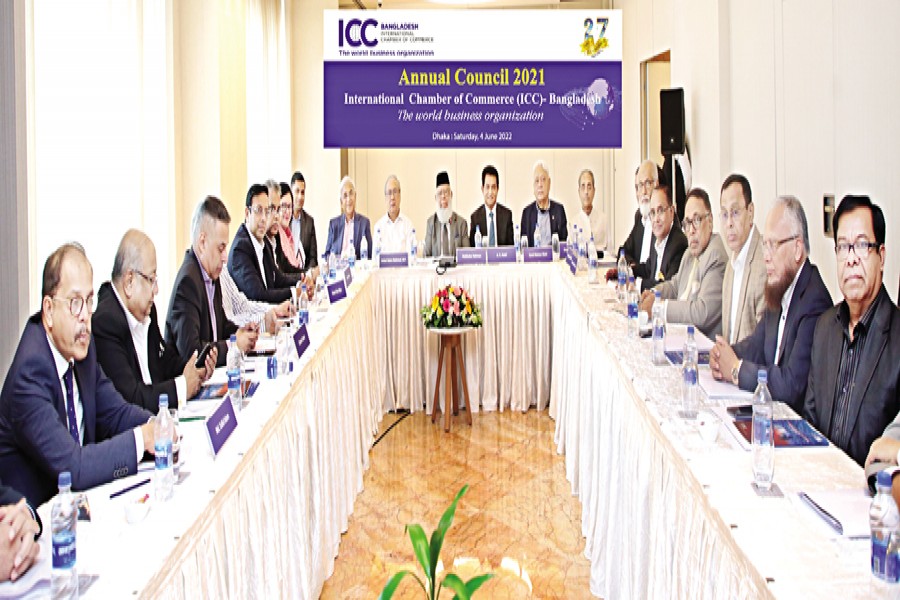
The recent austerity and regulatory measures taken by the government and the central bank would send a positive signal to the market and help curb inflation, Mr Mahbubur Rahman, ICCB President, said Saturday.
He was presenting the ICCB executive board report at the Chamber's 27th Annual Council in Dhaka.
The ICCB President noted that experts have identified three major economic challenges that the country is facing.
The challenges are higher rate of inflation, uptrend in exchange rate and deepening liquidity crunch in the banking sector.
He said the Russia-Ukraine war will also affect Bangladesh's economy as the country is already feeling the heat of the conflict in many ways, he observed.
The Executive Board of International Chamber of Commerce, Bangladesh (ICCB) highly appreciated the recommendation made by the Ministry of Finance (MoF) to help avoid hard loans and discourage luxury goods import as well as suspending implementation of high import-dependent projects as these would reduce pressure on the falling forex reserves.
He also reiterated the ICCB's support to the demands of businesses not to increase the power, gas and fuel oil prices, and to reduce corporate rate taxes during the upcoming budget, saying that "these will be helpful in containing the inflation".
If the war continues for a longer period, according to the board report, the impact that the country is feeling will intensify. "The country is feeling the impact through reduction in exports and rise in import bills. Being an oil-importing country, Bangladesh is already feeling the pressure through high import payments."
The report added that over the last two years, the pandemic has played a major role in shaping the global economy while many sectors have found themselves in difficulty and are still struggling, and the countries dependent on those sectors are now quietly trying to get back again.
Despite the strong economic recovery in 2021, the report said the financial difficulties are not over and may still cause economic slowdown.
In addition, many countries are faced with an increasing debt burden, high inflation and burning issues of the moment, and geopolitical tensions, which all play a major role, said the report.
It said the global economy is poised to be sent on yet another unpredictable course by the Russia-Ukraine war, which is a major humanitarian crisis, affecting millions of people and a severe economic shock for an uncertain duration and magnitude.
"The magnitude of the economic impact of the war is highly uncertain, and will depend in part on the duration of the war and the policy responses, but it is clear that the war will result in a substantial near-term drag on global growth and significantly stronger inflationary pressures."
The report observed that the war posed the most severe risk to developing Asia's economic outlook, and was already affecting economies in the region through sharp increases in prices for commodities such as oil and has heightened instability in global financial markets.
The COVID-19 continued to impact many parts of developing Asia, with some economies experiencing new surges in cases, it added.
The ICCB President said Bangladesh's journey of 50 years since its independence in 1971 has been tremendous and to many, it is a 'land of impossible attainment'.
The dominant narrative of the country has been of an economic miracle, he said and added: "Country's impressive score card is built on her success in terms of attaining a consistently high pace of economic growth and an impressive performance with regards to various development indicators, including those relating to the Millennium Development Goals (MDGs)."
The success in economic growth has led to Bangladesh's dual graduation - graduation from a Low-Income Country (LIC) to a Lower Middle-Income Country (LMIC) in 2015, according to the World Bank criterion and eligibility for graduation from the group of Least Developed Country (LDC) to the Developing Country (DC) status in 2018, according to United Nations criteria, the report mentioned.
Mr. Mahbubur Rahman said that, according to the World Economic Forum, since its founding in 1971 Bangladesh has emerged from overwhelming poverty to be proclaimed by the World Bank in 2020 as 'a model for poverty reduction'.
It achieved the highest cumulative GDP growth globally from 2010 to 2020 and is now on course to become a developed country by 2041, he said.
Bangladesh, like other countries, is facing the daunting challenge of fully recovering from the COVID-19 pandemic which has constrained economic activities and reversed some of the gains achieved in the last decade. "We have to remember that worldwide trade is a key tool of development that has led to globalisation.
Various research institutions and experienced economists citing post-graduation challenges, apprehended serious hurdles on its elevation if Bangladesh fails to devise smooth transition strategies for confronting the challenges posed by this transition.
The council approved the auditor's report of 2021and appointed auditor for the year 2022.
The meeting was attended, among others, by ICC Bangladesh Vice President AK Azad, Apex Group Chairman Syed Manzur Elahi, former Foreign Minister Barrister Anisul Islam Mahmud, FBCCI President Md Jashim Uddin, DCCI acting President Arman Hoque, MCCI President Md Saiful Islam, FICCI President Naser Ezaz Bijoy, BIA President Sheikh Kabir Hossain, BTMA President Mohammad Ali Khokon.
smunima@yahoo.com