
Recent market rallies echo August 2024 optimism, with a twist
The market was expected to stage a turnaround on the back of fundamental strength, good governance, the listing of profitable ventures, and an improvement in the macroeconomic scenario
Mohammad Mufazzal | Sunday, 15 February 2026
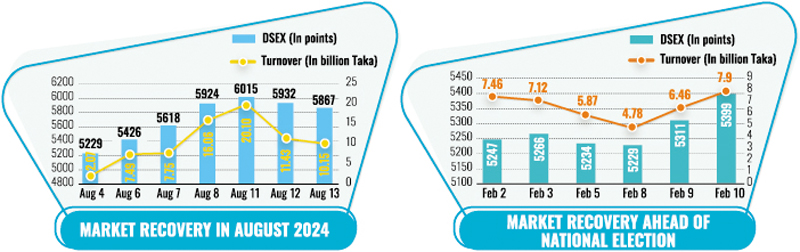
The Dhaka bourse witnessed a 3.77 per cent leap in its broad index to 5,426 points on August 3, 2024, as investor enthusiasm ran high over anticipated market reforms following the ouster of the previous regime.
That marked the biggest single-day gain in more than 43 months, resulting in a whopping 261 per cent surge in daily turnover to Tk 7.49 billion on the premier bourse.
The hyped market sentiment continued for four more sessions, adding 786 points to the DSEX by August 11 that year. The day's turnover hit a 23-month high of Tk 20 billion.
A majority of listed securities, including junk stocks, enjoyed significant appreciation at the time. However, price increases in fundamentally strong stocks - which had remained undervalued despite being market leaders - fuelled hopes among prudent investors.
The market was expected to stage a turnaround on the back of fundamental strength, good governance, the listing of profitable ventures, and an improvement in the macroeconomic scenario.
That expectation was reflected in the stock prices of fundamentally sound companies.
Stocks such as Grameenphone, British American Tobacco Bangladesh Company, and Square Pharmaceuticals climbed on the Dhaka bourse in the first and second weeks of August 2024 after years of stagnation due to a prolonged bear run and the imposition of a floor price.
Market-wide optimism also lured foreign portfolio investors into blue-chip stocks.
Market stakeholders at the time said they hoped for an end to market manipulation and exploitation following the exit of the previous commission led by Prof Shibli Rubayat Ul Islam.
However, the factors behind the market's elevation did not materialise.
The market soon retreated to its previous position due to its inherent weaknesses and the continuation of macroeconomic concerns.
"The recovery of the market didn't sustain as there was no improvement in liquidity supply," said Md Ashequr Rahman, managing director of Midway Securities.
That is why the trend of artificial rallies in junk stocks returned to the market, he added.
The new commission laid emphasis on reforms in rules and regulations and on enforcement actions through the imposition of penalties.
"But these were not done in a coordinated way. On the other hand, the market failed to see any growth in the absence of IPOs (initial public offerings)," said Mr Rahman.
The chief of the interim government also issued instructions for the listing of state-run and multinational companies and for the formation of a panel with foreign experts for market reforms.
Although the regulatory bodies organised several dialogues to encourage listings, not a single company entered the secondary market during the tenure of the interim government.
Ahead of the national election on Thursday, the Dhaka bourse again showed optimism through increased investor participation.
Alongside a rise in turnover value, 82 points and 87 points were added to the broad index on Monday and Tuesday respectively.
Stakeholders are now observing similarities between the changing pattern in market movements in August 2024 and ahead of the polls on February 12 this year.
After the fall of the Awami League-led regime in 2024, all blue-chip stocks displayed a rally. That has not been the case ahead of the national election.
Most of the stocks that propelled the market this February were banks.
Surprisingly, many weak banks experienced abnormal appreciation. Islami Bank, one of the most troubled banks, witnessed a 66 per cent price escalation between December 29 and February 3.
Another troubled bank, AB Bank, also gained 20 per cent in market value last week.
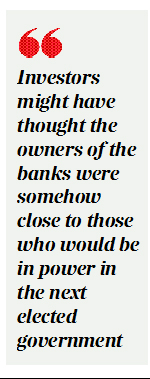
"Investors might have thought the owners of the banks were somehow close to those who would be in power in the next elected government," said Mr Rahman.
Non-banking financial institutions, which are under liquidation proceedings, also saw appreciation in recent sessions.
Perhaps investors thought those companies would eventually not be liquidated.
The election manifesto of the Bangladesh Nationalist Party (BNP) promised the development of the capital market through different initiatives, but the challenges remain the same as during the interim government and the previous administration.
In its manifesto, the BNP spoke about ensuring punishment for those involved in stock market manipulation.
The party that will form the government within the next two days also emphasised turning the regulatory body into an independent and autonomous institution through the appointment of qualified, honest and efficient individuals.
A special investigation commission would be formed to probe irregularities that took place over the last 15 years, the manifesto says. The BNP also vowed to ensure the appointment of qualified and efficient individuals to the boards of state-run banks.
Even if all these fronts are addressed, what is required more than anything else to elevate the market is investable stocks. Currently, they are so few that a qualitative change in the secondary market is not possible without the listing of new, well-performing companies.
mufazzal.fe@gmail.com