
Reducing the risks of tornadoes
Farid Hasan Ahmed | Saturday, 11 April 2015
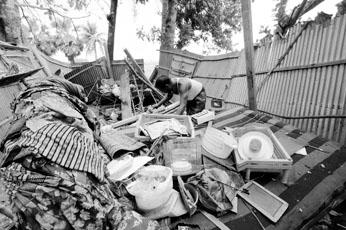
A total of 28 people were killed recently when nor'easter storms swept through some districts in the north-western part of Bangladesh. Many establishments were damaged and trees and light posts uprooted.
Tornados mainly occur in the pre-monsoon (March-May) and post-monsoon (October-November) periods. Tornados, brief in duration, are suddenly formed and are extremely localised in nature. It is the pre-monsoon period when most of the abnormal rainfall or drought conditions frequently occur. In Bangladesh, we have a long history of tornadoes. Lives, livelihood, assets and properties are destroyed.
A tornado hit Manikganj district (Saturia) on April 26, 1989. It was the deadliest tornado in Bangladesh's history that killed around 1,300 people.
There are severe local seasonal storms also, popularly known as nor'easters (kalbaishakhi). Severe nor'easters are generally associated with tornadoes. Wind-speed in these cases usually ranges between 113-130 km/hr (70-80 miles/hr), though sometimes the even speed exceeds 162 km/hr (100 miles/hr).
Since independence in 1971, Bangladesh has experienced several major tornadoes, killing on an average more than 100 people in each event and causing catastrophic damages.
Taking into account the risk and vulnerability of Bangladesh to the tornadoes, the following points are mentioned to address tornado risk reduction activities:
READINESS FOR QUICK RESPONSE: This refers to measures taken before a disaster which are aimed at minimising loss of life and reducing the extent of damages when a disaster occurs. It includes the formulation of workable tornado specific emergency plans, development of warning systems, maintenance of inventories and training of the volunteers. It may also include search and rescue measures as well as evacuation plans (if possible) for communities at risk.
Prior to any emergency situation, the contingency plan provides the basis to identify and further develop the response capacity. The contingency plan is the basis of readiness that covers: 1) analysis of the context, risk mapping and identification of likely emergency scenarios, 2) mapping of capacity, vulnerabilities, constraints and resources, tangible/intangible assets, 3) identification of other external organisations' capacity, constraints and resources in
the department/ministry/area/
country.
REDUCTION OF RISKS: It is expected that responsible authorities will act appropriately for reducing the tornado risks in line with the Disaster Management Vision of the government. The vision is to reduce the risk of people, especially the poor and the disadvantaged, from the effects of natural, environmental and human induced hazards to a manageable and acceptable level, and to have in place an efficient emergency response system capable of handling large scale disasters.
AREAS OF INTERVENTION: The major areas of intervention for reducing summer disaster risks could be:
1) The respective authorities at different levels should strengthen capacity-building initiatives of local government and communities at risk. A well-organised and coordinated effort is needed for further strengthening the local-level planning and implementing decisions. Resources should be allocated to local government bodies for undertaking tornado-proof housing programmes in the vulnerable locations. Proper resources from the government and others should be ensured by authorities and policy makers.
2) Integration of disaster risk reduction in existing development works and future initiatives of different government departments and non-governmental organisations (NGOs) is very important.
Concerned authorities should develop disaster data base which is very important to carry out detailed study and planning. The government authorities and NGOs need to redesign their disaster risk reduction programmes to ensure that they maximise disaster mitigation potential and incorporate appropriate structural and non-structural measures which are fit technically, environmentally and economically.
4) A lot of gaps and limitations are observed in the matter of forecasting tornadoes. Improvement of the forecasting system is essential. Though it is expensive and involves high technology, a tornado forecasting system is needed where Bangladesh Methodological Department (BMD) and Space Research & Remote Sensing Organisation (SPARRSO) could play a significant role. Technical support could be explored in line with the Global Disaster Risk Reduction System.
5) People should be encouraged and supported, both financially and technically, by the relevant authorities to build infrastructure considering the risks of tornadoes.
6) Infrastructure, particularly electric polls and bill boards, should be properly installed, monitored and maintained.
Reducing tornado risks in Bangladesh is a significant step towards protecting lives, livelihoods and properties. Effective initiatives in this respect from concerned authorities are essential for the betterment of large number of vulnerable people. A comprehensive approach, focusing on tornado risk reduction and emergency response management, is very much needed.
Understanding and enabling policies and actions like Disaster Management Act, Standing Orders on Disasters (SOD) and National Building Code, through political will, administrative diligence, appropriate resources and abilities, and accurate planning and monitoring mechanism are of utmost priority.
The writer, a disaster risk reduction and climate change adaptation practitioner, is a Fellow
of EPFL, Switzerland.
farid.hasan2008@gmail.com