
Reform commission to be formed for banking sector: Info minister
FE REPORT | Monday, 8 June 2026
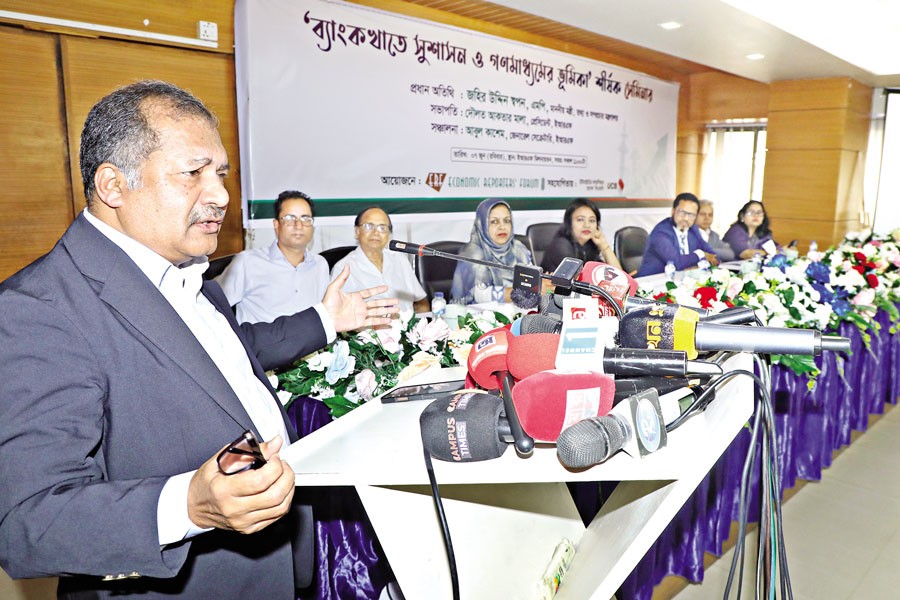
Information and Broadcasting Minister Zahir Uddin Swapon has said the government will take measures to bring the troubled banking sector under a reform commission to restore financial stability by addressing the longstanding governance weaknesses.
"Commissions have already been formed for media, anti-corruption, and administrative reforms. Why should a sector as important as banking remain beyond the scope of reform? We will certainly do it," he said while speaking as the chief guest at a seminar titled "Good Governance in the Banking Sector and the Role of the Media" on Sunday.  The Economic Reporters' Forum (ERF) arranged the event at its auditorium in the capital.
ERF President Doulot Akter Mala chaired the discussion, while its General Secretary Abul Kashem moderated it.
The information minister said the issue of governance in the banking sector could not be viewed in isolation.
According to him, discipline and accountability cannot be established in the sector solely through media scrutiny unless broader governance is ensured across the state and political system.
Swapon alleged the state-owned statistical agency, Bangladesh Bureau of Statistics, had been used as a political tool during the previous regime and information was manipulated and falsified to conceal the actual situation.
"Such changes to information and performance-related statistics would not have been possible without state patronage," he said.
Referring to the country's economic development, Swapon said the expansion of the private sector had taken place in continuation of the economic liberalisation initiated by former president Ziaur Rahman.
He also called for strengthening the capital market to reduce excessive dependence on banks as the primary source of financing.
The minister further alleged that the same groups responsible for misappropriating bank deposits had also siphoned off money from small investors in the stock market.
Speaking at the seminar, United Commercial Bank (UCB) Managing Director and Chief Executive Officer Mohammad Mamdudur Rashid said the country's banking sector remained under significant financial pressure, largely due to governance deficiencies.
"Like many other banks, UCB is also facing financial stress. The principal reason behind this pressure is the lack of good governance," he said, adding that institutions maintaining sound governance practices had been better able to withstand adverse conditions.
Editor of The Financial Express Shamsul Huq Zahid said good governance in the banking sector would not come alone unless it was ensured in the state administration.
If good governance was ensured in the state administration, he said, it would be transmitted to the central bank and then commercial banks.
"We are observing that the highest level of the government is trying to ensure good governance in the state machinery, but other team members of the government need to come up. Then we will see some outcomes," he said.
He also highlighted the importance of forming a reform commission for the banking sector like other areas.
"We will understand how serious the government is in terms of bringing good governance in the sector in the coming days."
Director General of Bangladesh Institute of Bank Management (BIBM) Dr Md Ezazul Islam said the national banking commission was formed in 1985 when the ratio of non-performing loans in banks crossed 40 per cent and various reform activities were taken in the early 90s when the BNP was in power.
The opportunity to bring necessary reforms to restore discipline in the sector had come to the party again, he said.
"I do believe this government will do it again as the finance minister repeatedly said the focus of the government was establishing accountability, deregulation, and institutional capacity buildup," he added.
Bangladesh Bank Deputy Governor Nurun Nahar said accountability, transparency, responsibility, and fairness were the four pillars for ensuring good governance and all the stakeholders needed to step up in this regard.
She said the banking sector was currently facing a difficult time because of the failure to perform responsibilities that were required.
Policy Exchange Bangladesh Chairman Dr Masrur Reaz, Professor Dr Md Shahidul Islam Zahid of the Department of Banking and Insurance at the University of Dhaka, and Professor Dr Sayema Haque Bidisha of the Department of Economics at the same university, among others, also spoke at the discussion.
jubairfe1980@gmail.com