
Regulator plans crackdown on non-compliant sponsor-directors
BABUL BARMAN | Tuesday, 10 February 2026
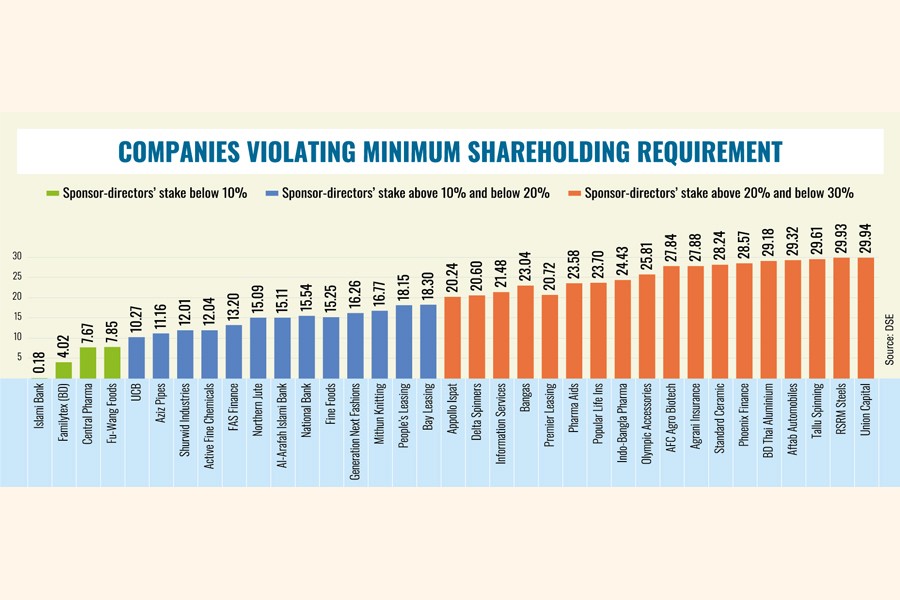
The securities regulator is set to take tough action against sponsor-directors who have yet to meet the minimum requirement of holding a 30 per cent joint stake in their listed companies.
The requirement was introduced after the 2010 market collapse to ensure greater involvement of sponsor-directors in the affairs of the companies they own. At the time, individual sponsor-directors were also mandated to hold at least a 2 per cent stake in their respective companies.
More than one and a half decades later, as many as 35 listed entities remain non-compliant with the joint shareholding requirement of sponsor-directors, according to data available up to January this year. The number stood at 23 in August 2024.
Meanwhile, some business entities increased ownership stakes to ensure compliance, while others newly entered the list of non-compliant companies as their combined sponsor-directors' holdings fell below the 30 per cent threshold.
Following the political changeover in August 2024, the newly formed securities commission issued a fresh reminder to the companies concerned, instructing them to comply with the regulatory requirement by December last year.
However, the issue has yet to be fully resolved.
Companies that responded to the directive by purchasing shares from the secondary market include Ring Shine Textile, Salvo Industries, Al-Haj Textile, Islami Insurance, Islamic Finance & Investment, and Sandhani Life Insurance.
"The commission [Bangladesh Securities and Exchange Commission] will no longer be lenient with the non-compliant companies," said Md Abul Kalam, BSEC spokesperson and director.
Non-compliant entities may face fines or enforcement action, he said, adding, "Hefty fines will be imposed on sponsor-directors this time."
The regulator has historically remained less stringent in enforcing the minimum shareholding rule.
In 2020, the then commission took its first punitive action by removing several directors from company boards for failing to maintain the required 2 per cent stake. Some firms responded by increasing sponsor-directors' shareholdings to the mandated level.
However, the trend did not last long. Over the past two years, many companies have experienced erosion in sponsor-directors' ownership stakes.
Recently, the BSEC has once again prepared to take action against violators of the shareholding rule. Some companies that have been performing well and distributing handsome dividends have also shown reluctance to comply with the regulatory directive.
For instance, Pharma Aids earned a profit of Tk 64 million in FY25 and declared a 30 per cent cash dividend for the year. However, the joint shareholding of its sponsor-directors has remained below 30 per cent for more than a decade.
When contacted, Md Humayun Kabir, company secretary of Pharma Aids, said the shareholding position fell below the minimum threshold after its founding director sold all his shares in 2013.
Currently, three sponsor-directors jointly hold 23.58 per cent of the company's shares as of January this year.
"The current directors are unable to comply with the regulatory directive due to a fund shortage," said the company secretary.
He explained that the existing sponsor-directors would need to purchase at least 0.2 million shares at a cost exceeding Tk 120 million, based on the prevailing market price, to reach the required shareholding level.
"We are planning to sit with general shareholders who have more than a 2 per cent stake in the company to include them on the board [of directors]," Mr Kabir said.
Some companies have remained non-operational for years, with sponsor-directors exiting after selling their stakes.
For example, sponsor-directors of Familytex (BD) offloaded their holdings long ago to exit the company, leaving the joint stake of owners at just 4.02 per cent-the lowest in the equity market excluding the companies that have experienced board restructuring.
Meanwhile, some companies' boards have been restructured in efforts to resume operations.
"When the shareholding of sponsor-directors shrinks in a company, they [sponsor-directors] don't care much about the business of the company. As a result, general investors suffer," said the BSEC spokesperson.
After the political changeover in August 2024, sponsor-directors of some companies left the country over alleged corruption, leading to a sharp decline in their joint shareholdings.
The Bangladesh Bank also removed many shareholder-directors from bank boards as part of sector-wide reforms following widespread scams and an unprecedented rise in non-performing loans.
Banks that came under the board restructuring initiative include Al-Arafah Islami Bank, First Security Islami Bank, Global Islami Bank, Islami Bank Bangladesh, and Social Islami Bank-all previously controlled by the S Alam Group-as well as United Commercial Bank, which was dominated by the family of former land minister Saifuzzaman Chowdhury.
Consequently, Islami Bank's sponsor-directors' shareholding fell to 0.18 per cent, United Commercial Bank's to 10.27 per cent, and Al-Arafah Islami Bank's to 15.11 per cent.
In these cases, sponsor-directors' shares were blocked, resulting in such low ownership levels, the BSEC spokesperson said.
babulfexpress@gmail.com