
Regulatory maze chokes growth of agro-processing industry
FE REPORT | Wednesday, 12 November 2025
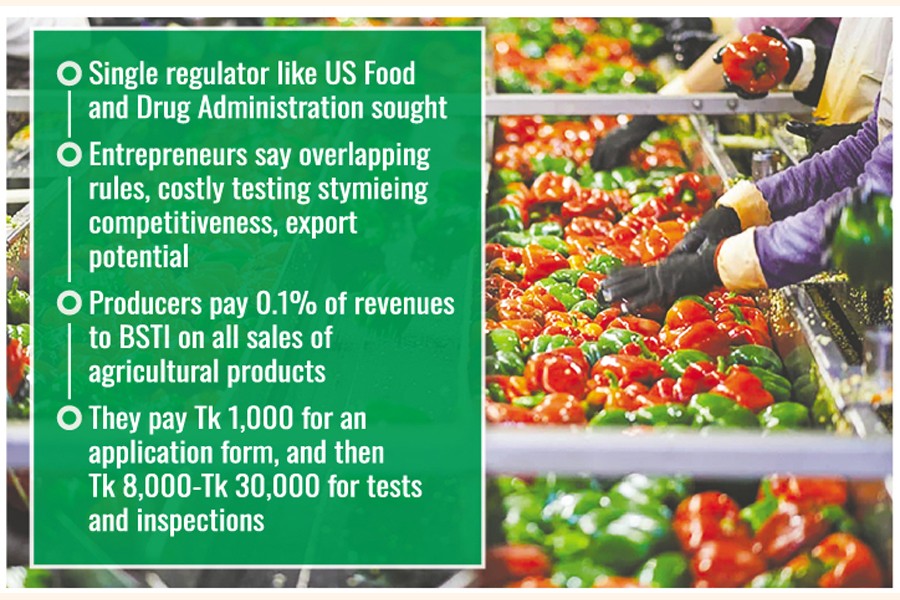
Bangladesh's agro-processing industry, one of the country's most promising growth sectors, is enmeshed in a web of regulatory tangles, costly testing requirements and weak coordination among government agencies, industry leaders say.
"Producers are forced to deal with multiple regulators to bring agricultural products to market," says Kamruzzaman Kamal, Director (Marketing) of PRAN-RFL Group.
"We have to pay 0.1 per cent of revenues to BSTI on all sales of agricultural products," he told reporters Tuesday.
"First, you need Tk 1,000 for an application form, and then Tk 8,000 to Tk 30,000 for tests and inspections," Mr Kamal adds, describing the financial burden of compliance.
Mr Kamal, a veteran marketer, was speaking to reporters covering the agriculture beat at a hotel in Dhaka.
The agro-processing entrepreneurs find BSTI certification prohibitively expensive, especially as weight variants of the same product require separate approvals.
Industry executives complain that the patchwork of regulators - Bangladesh Standards and Testing Institution (BSTI), the Directorate of National Consumer Rights Protection, Bangladesh Competition Commission, and Bangladesh Food Safety Authority - operate with limited coordination.
The overlap, they say, undermines policy efficiency and hampers both domestic production and exports.
"We produce huge volumes of potatoes and tomatoes each year but lack the capacity to process them for the agro-processing industry," Mr Kamal notes.
He says although BSTI offers around 160 laboratory tests, companies still need to send samples abroad for specialised analysis. "For certain standards, we send samples to Singapore and India."
Speakers, including Centre for Policy Dialogue (CPD) Research Director Dr Khondaker Golam Moazzem and journalist Reaz Ahmed, echoed the concerns.
Mr Kamal proposes the establishment of a single, unified regulator, modelled on the US Food and Drug Administration, to streamline approval and testing.
"A unified food and drug authority would cut duplication and reduce costs," he says to underpin the industry demand.
Participants also pointed to poor agricultural practices, excessive use of chemical fertilisers and pesticides, contaminated water, and the misuse of antibiotics in livestock as key factors behind unsafe food and milk residues.
"Heavy metals, chromium, and antibiotic residues have been found in some milk samples," Mr Kamal mentions, blaming unhygienic water supplies and indiscriminate antibiotic use.
"Farmers often do not know how long to wait before selling milk after administering antibiotics."
Other longstanding obstacles include fragmented landholdings, a shortage of high-yielding crop varieties, and inadequate storage and cold-chain facilities.
Dr Moazzem mentions that Bangladesh has only "a handful" of established agro-processing firms, calling it a worrying sign for a largely agriculture-based economy.
"Processors might take lessons from the clothing industry on scaling up," he suggests, stressing the need for skilled labour as the sector is labour-intensive.
The policy expert makes it clear that global buyers now demand not only food safety but also traceability and compliance with labour standards, including occupational health and safety and minimum wages.
"Exporters face requirements beyond basic food safety; they must demonstrate where products come from and that workers are treated fairly," he told the meet.
Journalist Reaz Ahmed urges policymakers to revisit the country's agro-ecological zoning and offer targeted incentives to encourage farmers to cultivate specific crops in suitable regions.
"We must think in terms of product-wide strategies and region-wide planning," he says.
jasimharoon@yahoo.com