
BEYOND ROTE LEARNING
Reimagining Bangladesh's education for Generation Alpha
TASNIMUL ISLAM AND SIMIN SORIA | Sunday, 22 February 2026
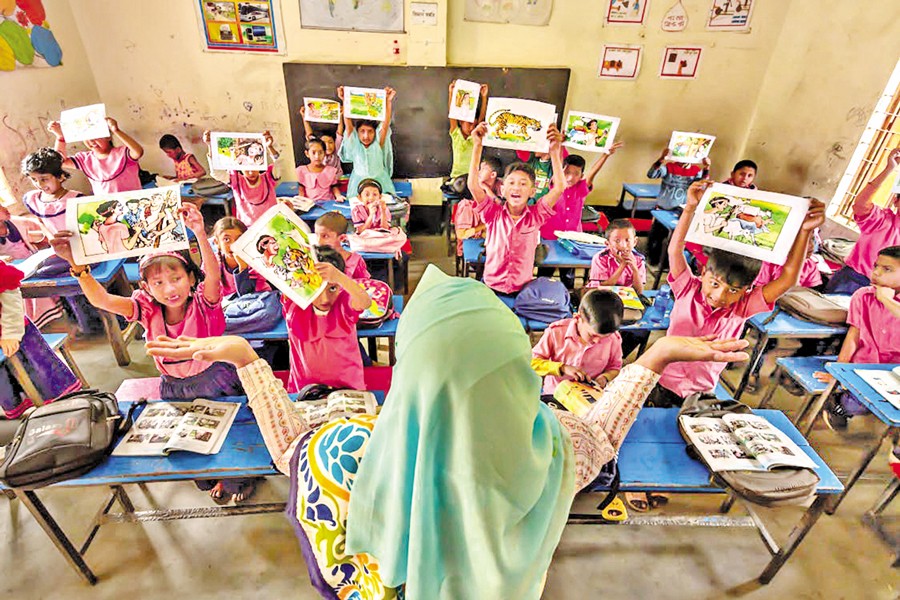
According to UNESCO (2023), 92 per cent of Bangladesh's Generation Alpha - born in 2010 and after - is the country's biggest and most technologically savvy group. Despite having enormous economic potential, children are taught using a mass-production, industrial-era educational system that views students as objects rather than people. A strategic transformation is necessary to unlock national human resources and harness the brilliance of this generation for an uncertain global economy. It is no longer a luxury to combine digital tools with the self-directed, experiential learning of the Montessori method; rather, it is a vital step in preparing resilient, creative citizens for a knowledge-based future.
The cognitive mismatch—children of the Information Age in schools from the Industrial Era: Despite Bangladesh's impressive numeric growth in education, there is still a significant qualitative divide. Standardised testing, rote memorisation, and passive information acquisition are given priority in the current system. The demands of the 21st-century "Cognitariat" - a workforce characterised by cognitive aptitude, inventiveness, and flexibility - are essentially out of line with this paradigm, which has been criticised for objectifying pupils to match hierarchical production systems.
Futurist Alvin Toffler asserts that encouraging "mentifacture" - mental innovation - is essential to teaching Generation Alpha. Around the world, it has been demonstrated that curiosity-driven learning improves memory, problem-solving skills, and brain connections, but systems that discourage inquiry reduce intellectual capacity. This leads to a lack of critical thinking in Bangladesh, where asking questions is frequently discouraged in both households and classrooms. The capacity to learn, unlearn, and relearn is a critical skill for a generation that is dealing with AI, climate unpredictability, and rapid upheaval. With its focus on self-directed inquiry, the scientifically supported Montessori approach offers a tried-and-tested foundation for developing this crucial cognitive agility and resilience.
In actuality, the Montessori approach is a carefully planned environment where children use specifically designed materials to participate in self-directed, intentional learning. Respect for a child's inherent psychological growth and motivation to learn is the foundation of this education. Its efficacy is supported by a substantial body of peer-reviewed research compiled by organisations such as the Association Montessori Internationale (AMI).
Key findings from recent studies demonstrate the relevance of the Montessori education system for building Bangladesh's future are described below:
Enhanced creativity and executive function:The foundations of sophisticated cognition — working memory, cognitive flexibility, and self-control — are executive functions in which Montessori pupils routinely do well. Neuroscience studies show that these educational experiences physically alter how the brain develops. Compared to their counterparts in typical schools, Montessori children exhibit distinct patterns of brain activity associated with mistake monitoring and creative problem-solving.
Academic and social-emotional benefits: Research has shown that Montessori children perform on standardised reading and maths tests at a level that is either equivalent to or better than other pupils. According to Lillard (2019), for example, Montessori children outperformed their counterparts in traditional schools in reading and arithmetic tests in the United States. Additionally, students report feeling more connected to the community, being more involved in school, and having better health as adults. According to Chattin and McNichols (1991), graduates also show increased creativity, responsibility, and problem-solving abilities in their adult lives.
Inclusive and equitable potential: Importantly, children from a variety of backgrounds benefit the most. Research on minority and low-income children enrolled in public Montessori schools demonstrates notable long-term social and academic improvements. The method's sensory-focused, customised, and structured environment fits a variety of learning needs, making it a promising approach for children with neurodevelopmental difficulties such as autism spectrum disorder (ASD).
Following are some ways Bangladesh can incorporate Montessori concepts into the regular educational system:
Teacher training as the fundamental investment:The teacher's function changes from dispensing information to acting as a qualified "guide". To do this, authorised Montessori teacher training institutions must be established, possibly in collaboration with groups connected to AMI. Investing in facilitator training pays off handsomely, as demonstrated by the British Council's popular Youth Connect programme, which upskills young people in leadership and green entrepreneurship using informal, interactive techniques. This development of human capital must be given top priority in the national education budget.
Curriculum and classroom redesign:To integrate fundamental Montessori ideas — such as mixed-age classrooms, unbroken work blocks, and tactile "practical life" and sensory materials — the national curriculum should be redesigned. In line with the "Curiosity Approach," education ought to capitalise on children's natural curiosity. Pilot projects that turn buildings into interactive learning labs incorporating regional culture and resources might begin in government primary schools and madrasas.
Public-private-community partnerships:This change cannot be spearheaded by the government alone. With their strong ties to the community, NGOs like BRAC are excellent pilot partners for low-cost, Montessori-style preschools in urban and rural communities. Research and model schools can be funded by the business sector. Importantly, parent education initiatives are required to change the cultural perspective from emphasising test results to emphasising creativity, curiosity, and resilience.
Making strategic use of digital integration: Generation Alpha are digital natives. Whilst the solid, sensory foundation of Montessori education is crucial for young children, older students can benefit from the deliberate integration of technology as a tool for study and production. Projects like the Digital Citizenship and Misinformation Resilience Project, which teaches college students how to think critically and examine facts, demonstrate how — when used in accordance with sound pedagogical principles — digital resources may help develop analytical minds rather than impede them.
The path forward—from idea to national proficiency: Bangladesh is experiencing a cognitive crisis: barely 19 per cent of Grade 5 children master fundamental maths. Vietnam benefited greatly from investments in education, but our workforce is still stuck in an industrial-era paradigm that is not suited to a knowledge sector worth $50 billion. The automation of 60 per cent of jobs in the RMG (ready-made garment) sector demands immediate change. Montessori and progressive approaches increase school readiness by 22 per cent, as demonstrated by BRAC's Play Labs. This is a strategic need rather than a pedagogical argument. Our future will be determined by curiosity rather than compliance. Now is the moment to take action. Whilst our rivals seize the industries of the future, each year we postpone commits another generation to economic oblivion. Since it is the only practical safeguard against national obsolescence, doubling the education budget to 3.0 per cent or more of GDP is not an extravagance.
Dr Tasnimul Islam is assistant professor and director, Centre for Research and Development (CRD) at Army Institute of Business Administration, Sylhet.
Email:drtasnim@aibasylhet.edu.bd
Simin Soria is a teacher at Frobel Play School, Gulshan, Dhaka.
Email:riokartagena@gmail.com