
Remembering Justice Murshed on his 47th death anniversary
Anwar A Khan | Friday, 3 April 2026
Life is for the living. Death is for the dead.
Let life be like music. And death a note
- Langston Hughes
On April 3 2026, the legal and moral landscape of Bangladesh paused to honour a giant: Syed Mahbub Murshed, Chief Justice of the then East Pakistan High Court from 1964 to 1967. Born on January 11 1911, and passing from this world on April 3 1979, Justice Murshed remains an enduring luminary—a paragon of intellect, integrity, and moral courage. His life, like an unfaltering torch, continues to illuminate the paths of law, justice, and conscience in Bangladesh and across South Asia.
Justice Murshed’s career unfolded during a period of immense historical turbulence: the decline of colonial authority, the rise of democratic aspiration, the emergence of Bengali nationalism, and the eventual birth of Bangladesh. In such times, the judiciary could have easily been an instrument of oppression, yet he ensured it remained a guardian of rights, a bastion of fairness, and a citadel of moral authority. He was, in every sense, a judge who understood his calling—not merely to adjudicate disputes, but to protect the dignity and liberty of every individual under his jurisdiction.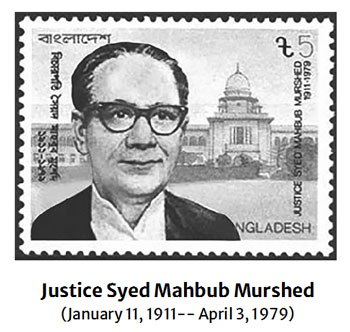 A judge, like an umpire, does not make the rules; he ensures they are observed. Justice Murshed internalised this maxim with profound humility. He respected the precedents of law, appreciated the insights of his colleagues, and administered justice with a rare synthesis of modesty and authority. Yet his modesty never diminished his courage. In a society beset with political turbulence and executive overreach, he was fearless in defending the rule of law. It was during the regime of Field Marshal Ayub Khan, a period marked by repression and political intimidation, that Justice Murshed famously granted bail to Bangabandhu Sheikh Mujibur Rahman. With unflinching authority, he declared: “Tell the Governor I am the law.” These words were not mere rhetoric; they were a declaration of principle, a reminder that justice is sovereign, and tyranny must bow before conscience.
Justice Murshed’s brilliance lay not only in his intellect but in his moral compass. He grasped the social realities of East Pakistan with keen perception, understanding that the law must serve the people, protect their rights, and advance good governance. He championed writ petitions in higher courts, curbed executive excesses, and safeguarded fundamental rights during a time when these principles were under constant threat. His judicial philosophy combined pragmatism with principle, courage with compassion, and legal acumen with profound ethical insight.
Justice Murshed was not a passive observer of events; he engaged with them, shaped them, and influenced the moral and legal consciousness of his society. In 1952, he actively participated in the Language Movement, facing arrest alongside his uncle, Sher-e-Bangla AK Fazlul Huq—a testament to his commitment to justice and cultural identity even at personal risk.
Beyond legal brilliance, Justice Murshed was a guardian of the Bar and a mentor to generations of lawyers. To him, the Bar was not merely a professional community; it was a spiritual home. He famously remarked, “The Bar is my professional home; even when I am dead, my disembodied soul shall hover around it.” He believed in nurturing excellence, integrity, and moral courage among young advocates, ensuring that the judiciary remained vibrant, principled, and worthy of public trust.
Justice Murshed’s impact was felt not only in the courtroom but also in cultural and national spheres. In 1961, he defied authoritarian constraints to organise Tagore centennial celebrations, asserting the primacy of Bengali culture at a time when it faced neglect and suppression from the central government in Pakistan. He understood that the law cannot exist in a vacuum and that cultural identity, language, and national consciousness are integral to justice and societal well-being.
Justice Murshed’s jurisprudence was visionary. He revitalised the High Court, modernised the Bar, and laid foundations for constitutional interpretation that would endure for decades. His judgments reflected clarity, courage, and an unwavering commitment to fairness. Even in confronting authoritarian rulers, he refused to compromise principle for expediency. He understood that legitimacy of the judiciary arises not from deference to power but from adherence to justice, morality, and reason. He symbolised the idea that law is not an abstract discipline but a moral force capable of shaping society. He taught that courage, intellect, and conscience must coexist for justice to prevail.
Justice Murshed’s life and work resonate deeply today, especially in Bangladesh, where the rule of law continues to face challenges from political and institutional pressures. His light endures still, illuminating the paths of those who seek justice not merely as a profession, but as a calling. In remembering him on the 47th anniversary of his passing, we honour not just a jurist but a moral giant—a man whose intellect, courage, and conscience reshaped the legal and ethical framework of Bangladesh. His was a life devoted to the service of law and people, a life that taught that authority is to be wielded with humility, power tempered by principle, and justice administered with unwavering fidelity. His legacy is eternal; his life, an enduring beacon.
Rest in peace, Justice Murshed—your light guides us still.
Anwar A. Khan, a 1971 freedom fighter and a political analyst.
[For contact: syedmmurshed@gmail.com]