
Remittance hits record $3.75b in March
SAJIBUR RAHMAN | Thursday, 2 April 2026
Bangladesh's remittance receipts touched a historic milestone in March, as expatriates funneled record volumes of foreign currency into the country to support families for the Eid-ul-Fitr festivities, even though regional conflict cast a long shadow over future inflows.
According to the latest data from Bangladesh Bank (BB), the monthly inflow skyrocketed to $3.75 billion-the highest level recorded since at least July 2019.
This represents a robust 14-per-cent year-on-year growth compared to the $3.29 billion received in March 2025.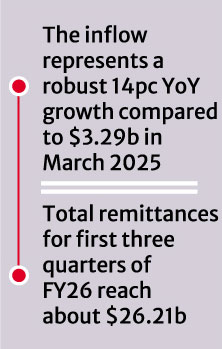 The March surge has significantly bolstered the country's external account during a period of macroeconomic volatility.
Total remittances for the first three quarters of FY 2025-26 reached about $26.21 billion.
This cumulative figure reflects a 20-per-cent spike over the same period in the previous fiscal year.
March's performance eclipsed February's $3.02 billion inflow, highlighting a seasonal push driven by religious celebrations.
Despite the stellar numbers, a "perfect storm" is brewing in the Middle East that threatens to derail this momentum. The escalating conflict involving the US, Israel, and Iran has placed the Strait of Hormuz-a critical maritime artery-under severe strain.
Iran's influence over the Strait is central to current economic anxieties, as the route facilitates one-fifth of global oil exports.
It also facilitates nearly one-third of global fertiliser shipments.
The fallout is already visible in the local economy. Prices for essential imports, including LNG, oil, fertiliser, and sulphur, have begun an upward climb, threatening to exacerbate domestic inflationary pressures.
The central bank's report and economists are sounding the alarm on a potential "remittance cliff." While the Eid season provided a temporary buffer, the prolonged crisis in the Gulf is expected to disrupt migration cycles and dampen economic activity in key host countries.
Industry insiders warn that if the regional instability persists, the "disruption of migration" and "economic uncertainty" could lead to a noticeable contraction in inflows in the final quarter of the fiscal year.
Dr Masrur Reaz, chairman of Policy Exchange Bangladesh, said the record $3.75 billion remittance inflow in March reflects both Eid-driven seasonal transfers and improved use of formal banking channels.
"Remittance remains the most critical buffer for our external account at a time of macroeconomic stress," he said.
However, he cautioned that escalating tensions in the Middle East pose downside risks.
"If instability in the Gulf persists, it could affect labour demand and migration flows, potentially slowing remittance growth in the coming months," he warned.
sajibur@gmail.com