
Removing graduation gaps of Asia-Pacific LDCs
Manzur Ahmed | Sunday, 2 November 2014
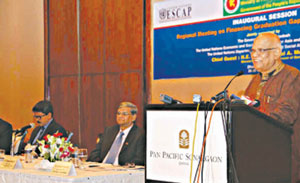
Bangladesh government and the United Nations Economic and Social Commission (UNESCAP) jointly organised on 28-30 October 2014 a regional meeting titled "Financing to close the Graduation Gaps of Asia Pacific LDCs". The important event took place in the wake of the Istanbul Programme of Action (IPoA) for least developed countries (LDCs), adopted with the aim of enabling half the number of these countries to fulfill the criteria for graduation by 2020.
The LDCs, with a total population of 880 million, represent the poorest and weakest segment of the international community. The share of the LDCs in world trade in goods at its present level is only 1.8 per cent, and is highly concentrated on a few export products. LDC's share in world trade in services remains at only 0.5 per cent.
Alongside the Istanbul Programme of Action (IPoA) broadly covering seven priority areas, there are parallel UN programmes such as Sustainable Development Goals (SDGs) setting 17 priority goals for the Post-2015 Development UN Agenda to be attained by 2030 (Zero draft 6/26/2014 SDG 2030) and the Millennium Development Goals (MDGs) adopted by the United Nations, to accomplish 8 goals under which there are 21 targets and 60 indicators with set targets to measure the progress of the goals.
In Bangladesh, the UN initiatives are also complemented by "Bangladesh Vision 21" adopted by the Bangladesh government. The Vision 2021 and the associated Perspective Plan 2010-2021 have set solid development targets to transform the socio-economic environment of the country from a low income economy to the first stages of a middle income economy by the end of 2021.
The important specific objectives relating to trade and economic development for LDCs as proposed in IPoA and SDG 2030, among others, are:
* Doubling the LDC share in global exports by 2020, including by broadening their export base;
* Achieving sustained and inclusive economic growth to at least the level of 7 per cent per annum by strengthening productive capacity and effective integration into the regional and global economy.
* Enhancing capacities in energy production including renewable energy development, trade and distribution ensuring access to energy for all by 2030;
* Promoting sustainable industrialisation and raising industries share of employment and GDP including doubling manufacturing share in LDCs by 2030;
* Ensuring transfer of technologies to LDCs through the implementation of UN global technology facilitation mechanism, and full use of the WTO Trade Related Intellectual Property Rights (TRIPs) Agreement relating to transfer of technology and compulsory licensing measures with flexibilities granted for LDCs;
* Operationalising the Technology Bank and STI Capacity Building Mechanism for LDCs by 2017;
* Attaining conservation and sustainable use of marine resources, oceans and seas, increasing scientific knowledge, and developing research infrastructure and capacities to enhance the contribution of marine biodiversity to the development of developing countries, in particular of SIDS and LDCs.
* Concluding the Doha Round of trade negotiations successfully with an ambitious, comprehensive, balanced and development-oriented outcome for LDCs;
* Ensuring enhanced financial resources and their effective use for least developed countries' development, including through domestic resource mobilization, ODA, external debt relief, foreign direct investment and remittances.
The terms of implementing the IPoA are:
* IPoA for LDCs is to be implemented in partnership with the United Nations system, including the Bretton Woods institutions, other multilateral institutions and regional development banks, within their respective mandates.
* The ownership of and the leadership and primary responsibility for their own development lie with the respective LDCs. Each LDC will translate policies and measures in the Programme of Action into concrete measures by integrating this Programme of Action into the national and sectoral development strategies -- (i.e., Bangladesh's Vision 2021 and the associated Perspective Plan 2010-2021).
* LDCs have the right and responsibility to formulate and execute their own coherent economic and development policies and strategies and identify their own national priorities, including striking a balance in the allocation of resources between economic and social sectors.
* Development partners should support LDCs in the design and the implementation of their development strategies.
* National efforts of the LDCs should be complemented by supportive global programmes, measures and policies aimed at expanding the development opportunities of LDCs and responding to their evolving national priorities
The IPoA assigns the development partners specific areas of action to integrate them into their respective national policy frameworks, programmes and activities to ensure enhanced, predictable and targeted support to the LDCs. Actions by the development partners as envisaged in the IPoA will be, among others, along the following lines:
* Provide enhanced financial and technical support to LDCs to develop productive capacities in line with least developed countries' priorities;
* Support LDCs with enhanced financial and technical support for infrastructure development and management;
* Support private sector investment through public-private partnerships and grant/loans blending for infrastructure development and maintenance in communication and multimodal transport such as railways, roads, waterways, warehouses and port facilities;
* Support LDC's efforts to develop the energy sector in generation, distribution and energy efficiency, including in renewable energy through financial and technical assistance in accordance with national priorities and needs;
* Support efforts aimed at increasing agricultural production and productivity;
* Support LDC's efforts to establish or strengthen safety nets such as access to agricultural finance, insurance and other risk-mitigation tools;
* Provide technical and financial support to national and regional projects that are aimed at increasing the Connectivity, productivity, competitiveness and diversification of LDC economies, including through strengthening the capacity of their trade in goods and services and to integrate them with international value chains;
* Facilitate LDC's access to required resources from different environment and climate funds, including the Global Environment Facility (GEF);
* Support LDCs to address the challenges of livelihood and food security and health of the people affected by the adverse impact of climate change;
MOBILISING FUNDS FOR THE IMPLEMENTATION OF IPOA: Bangladesh should call upon the development partners to fulfill their commitments to undertake to operationalise and notify annually the IPoA funding scheme by ensuring simple and time-bound procedures to be followed for disbursing such funds and shall also specify the financial and technical assistance resources that they are going to be made available in predictable and sustainable manner to implement IPoA goals and targets in accordance with recipient country's development needs, policies and strategies.
Funding mechanisms or modalities should ensure comprehensive, predictable, sustained, simple and time-bound funding programmes and procedures. Financial and technical assistances should be ensured to realise the broad goals in respect of trade and employment of the Perspective Plan for a transformed Bangladesh by 2021, described briefly as follows:
* Change the sectoral composition of output with the shares of agriculture, industry and services approximating 15 per cent, 38 per cent, and 47 per cent respectively by 2021.
* The government has set a priority to arrange over 10,000 acres of land for industrial plots across the country in the next three years. The government will set up five special economic zones and seven specialised industrial areas across the country during the period.
* Generate 8,500 MW of electricity by 2013, 11,500 MW by 2015, and make provisions to meet the expected demand for power of 20,000 MW by 2021, in order that it ensures per capita energy consumption to rise to 600 kwh.
* Reduce unemployment rate to 15 per cent; change the shares of agriculture, industry and services in employment to 30 per cent, 25 per cent, and 45 per cent respectively by 2021
* According to UNDP-Bangladesh Bank joint statistics, out of nearly 90 million eligible workers of Bangladesh 35 million are out of employment which is appalling and we, at all levels, must be ever vigilant against this.
FUNDING BANGLADESH'S DEVELOPMENT NEEDS: In addition to the above IPoA action programme, Bangladesh's development needs, according to the World Bank estimates, are as follows:
* Bangladesh will require between $74 billion and $100 billion between 2011 and 2020 or 7.38 per cent to 10.02 per cent of its gross domestic product to improve infrastructure to serve its growing population.
* Bangladesh needs to spend between $36 billion and $45 billion for expanding its communication network.
* The power sector will require an investment between $11 billion and $16.5 billion to take credible electricity to the poor in the country where about half of the population is still not connected to the national grid.
* Improvement of water supply and sanitation will need an investment of $12 billion to $18 billion, solid waste management $2.1 billion to $4.2 billion, telecom $5 billion, and irrigation $7.7 billion to $11.6 billion until 2020.
Bangladesh also needs financial and technical support for the following:
* Setting up of five special economic zones and seven specialised industrial areas across the country during the period.
* Implementation of the fast-track projects of the government including the Padma bridge, Dhaka-Chittagong four lane project, deep-sea port at Chittagong, the metro rail in Dhaka city, 1,320-megawatt Rampal Power Plant, 1,000MW Rooppur Nuclear Power Plant and the LNG Terminal Project for importing liquid gas will certainly help towards infrastructure development and economic development as well.
* Implementation of various "Trade Facilitation Projects" of the government with the objective of effectively operationalise the WTO Trade Facilitation Agreement.
* Development and harmonisation of standards and technical regulations applied on priority products of Bangladesh with regional and global trading partners leading to MRAs.
* Establishment of accredited bodies/agencies/laboratories and certifying bodies in Bangladesh under PPP in collaboration with the international accredited bodies.
* SMEs and small scale businesses should be strengthened and integrated with the domestic, regional and with the global market value chains.
* Bangladesh should take up an action programme to conduct studies for the development of National Trade Policies on specific sectors of trade in services (50 per cent of GDP), prepare offer and request list and schedule of commitments and negotiate market access in mode 1,3 and 4 under GATS LDC Modalities 2003.
To expedite the implementation of the IPoA and other UN Agenda, developed countries are obliged to:
* disburse annually 0.7 per cent of GNP as committed to realise their agenda for poverty reduction and sustainable development as agreed under United Nations Resolution 2626 (XXV) October 24, 1970: "Each economically advanced country will progressively increase overseas development assistance (ODA) to the developing countries."
* ensure speedy conclusion of an ambitious, balanced, comprehensive and development-oriented outcome of the Doha Development Agenda of multilateral trade negotiations to improve market access for agricultural, fisheries and industrial exports of LDCs with a view to doubling their share of exports in global markets as targeted in the IPoA
* All WTO DDA agenda related to the LDCs including duty and quota free market access in goods and services (mode 1, 3and 4) under Paragraph 36 of WTO Hong Kong Ministerial Declaration and GATS modalities exclusively for LDCs, should be immediately operationalised as follows:
1. Duty free and quota free market access for all goods originating from all LDCs under paragraph 36 of Annex F of the Hong Kong Ministerial Declaration should be operationalised prior to the next Ministerial Conference in a manner that ensures stability, security and predictability.
2. Duty-Free, Quota-Free Market Access for the LDCs on a lasting basis for 100 per cent products originating from all LDCs including products already covered under any unilateral or mutual preferential market access schemes including GSP schemes should be provided prior to the next WTO Ministerial Conference.
3. Members shall not be construed to be "facing difficulties" or "not in a position to provide" duty-free, quota-free market access in respect of products already in trade under any preferential scheme or RTA or FTA or EPA or customs union and or all other preferential or duty-free market entry facilities.
4. Members shall notify duty-free and quota-free schemes for LDCs, including all existing unilateral DFQFMA including GSP Schemes extended to LDCs, under the terms of paragraph 36 of Annex F of the Hong Kong Ministerial Declaration.
TRANSFER OF TECHNOLOGY: Industrialised countries shall fulfill their obligation and notify annually the implementation of Article 66.2 of the TRIPS Agreement ensuring free transfer of technology by reporting on the actual transfer of technology to the LDCs.
Environmental technology, machinery and equipment, goods and services must be made available, as grant and on concessional terms, to facilitate adoption and implementation of projects, purchase of goods, the implementation of projects, the acquisition and transfer of technologies, and the contracting of environmental services by the LDCs.
DOMESTIC RESOURCE MOBILISATION: The government has set macro-economic targets under the Medium Term Macroeconomic Framework (MTMF 2014-18). The annual GDP growth was projected at 7.6 per cent in the fiscal 2013-14, 8.3 per cent in fiscal 2015-16 and 9.1 per cent in fiscal 2017-18 under the five-year MTMF ( from 2013-14 to 2017-18). The investment target set at 34 per cent of the GDP by 2017-18 will not be achieved. Private investment had been projected at 25.6 per cent and the public investment at 8.5 per cent for the year. Domestic saving was projected to increase to 24.2 per cent of the GDP by 2017-18 fiscal from the present 20.9 per cent and national savings to 33.3 per cent by 2017-18 fiscal from present 27.6 per cent of the GDP.
The MTMF projected revenue generation at 16.4 per cent of GDP by 2017-18 fiscal from present level of 13.4 per cent. The target of public expenditure was set at 20.6 per cent of GDP by 2017-18 from the present 18.1 per cent. Most of these targets are likely to remain immaterialised given the course of the economy at present.
To mobilise domestic resource for productive investment, following areas should be explored:
a) Privatisation of state owned power and industrial enterprises in PPP format under the Company's Law.
b) Facilitating investment of 30-35 per cent of GPD by ensuring single digit interest rate with a maximum spread of 3 per cent from the computed cost of fund along with duly notified rational services charges by reforming and streamlining the existing Banking regulations and practices.
c) Establishing industrial zones and take up infrastructure and trade facilitation development projects under PPP format with public and private sector including FDI collaboration.
EXTERNAL DEBT SERVICING: External debt servicing involved $1.40b in 2013-14 fiscal for repayment of the principal amount of external loans and another $269 million for payment of accrued interest charges on them.
The total outstanding amount of the country's public sector external debts rose from $ 973.80 million in FY 1974-1975 to about $ 23.54 billion in FY 2011-2012. The total amount of outstanding external debt liabilities of Bangladesh, on a cumulative basis, stood at 20.12 per cent of the country's gross domestic product (GDP).
LDCs should strongly propose that their debt servicing obligations have compelled them to use limited resources to finance debt re-payments and this, in turn, prevents them from financing remedial measures for climate change, trade facilitation, increased productivity, infrastructure and capacity building activities. The amount payable as debt service by LDCs should, therefore, be converted into additional annual fund as grant.
The writer is Trade Policy Advisor, FBCCI.
mahmed019@hotmail.com