
Renewable wind energy towards an eco-friendly Bangladesh
Rana Dutta | Thursday, 26 March 2015
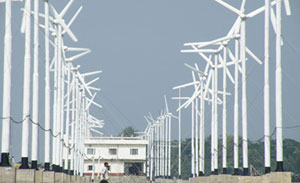
Bangladesh is facing daunting energy challenges. Security concerns over growing fuel imports, limited domestic energy resources for power generation and projected demands for electricity will exceed domestic supply capabilities within a few years. By acknowledging the potential of renewable energy resources, the country could possibly meet its mounting energy demand, thus increasing electricity accessibility to all and securing energy security.
The integration of renewable energy technologies in the power sector through national energy planning would, therefore, be a step in the right direction, not only for sustainable development of the country but also for fulfilling Bangladesh's responsibility toward the collective global task of environmental protection.
Even though the earth continues evolving, the resources used by humans will eventually become scarce. Over decades, fossil fuels were and are still being used as the major energy source for households, industries service providers. However, due to the limited amount of fossil fuels, energy is becoming more and more expensive, and the consequence of their consumption is leaving a serious impact on our environment and climate. The major impact is called the Greenhouse Gas Effect, which is in other words "gases that trap heat in the atmosphere"
Wind power is a relatively mature technology. It competes with other energy sources in terms of price, environmental effects and usability. With the exception of hydro power, wind power is closer to commercial profitability than any of the other renewable sources, though improved project economy is a vital challenge for wind power. Wind energy is widely applicable because wind resources are available in most countries. Among the renewable energy technologies, wind energy is relatively mature and many countries have resolved cost and technology challenges. Moreover, humans have harnessed the energy in wind for thousands of years, both for sailing boats on water and powering wind mills on land. This energy source is interesting because of its renewability and its availability. Potential for development is huge, and the world's capacity is far larger than the world's total energy consumption.
Presently, the known alternatives to energy production from fossil fuels are renewable and nuclear energy. There exist many social and environmental complications with nuclear energy. Renewable energy sources are desirable because of their contribution to greenhouse gas reduction and national security of energy supply without the complications of nuclear energy. Formal definitions of renewable energy sources vary from country to country, but there is broad agreement that wind energy, photovoltaic, and solar thermal energy is considered to be renewable. Other sources that are often considered renewable include hydropower and biomass.
Operation of wind power has zero emissions of harmful substances. It does not add to global warming The "fuel" is free, and is quite evenly distributed around the world. The energy needed to produce and install the turbine amounts to three months of turbine production. But, as with the other sources of energy, wind power does have an environmental impact. The impact on wildlife is likely low compared to other forms of human and industrial activity. However, negative impacts on certain sensitive species are likely, and efforts to mitigate these effects should be considered in the planning phase. But broadly speaking, wind power has many environmental benefits. Primarily, wind energy does not cause water or air emissions, and does not produce any kind of hazardous waste as well. Moreover, wind power does not make use of natural resources like oil, gas or cause and therefore will not cause damage to the environment through resource transportation and extraction.
Wind energy is not only a favourable electricity generation technology that reduces emissions (of other pollutants as well as CO2, SO2 and NOx), it also avoids significant amounts of external costs of conventional fossil fuel-based electricity generation. More and more use of wind energy should be made in order to prevent the problem of global warming. Wind energy plants are considered a green power technology because it has only minor impacts on the environment. Wind energy is an ideal renewable energy because:
ll It is a pollution-free, infinitely sustainable form of energy.
ll It doesn't require fuel.
ll It doesn't create greenhouse gases.
ll It doesn't produce toxic or radioactive waste
Wind power is the conversion of wind energy by wind turbines. The power is directly proportional to the velocity of the wind. Large scale wind farms are connected to the local power transmission network with small turbines used to provide electricity to isolated areas.
Bangladesh is in the midst of a severe energy and power supply crisis, one of the worst in South Asia. Bangladesh has a 724km long coastline and many small islands in the Bay of Bengal, where strong southwesterly wind and sea breeze blow in the summer months and there is a gentle northeasterly wind and land breeze in the winter months. Along the coastal area of Bangladesh, the annual average wind speed at 30m height is more than 5 m/s. Wind speed in northeastern parts in Bangladesh is above 4.5 m/s while for in the other parts of the country wind speed is around 3.5 m/s.
As wind energy is a free and renewable resource, no matter how much is used today and there will still be the same supply in the future. Wind energy is also a source of clean, non-polluting, electricity. Wind turbines convert the kinetic energy in the wind into mechanical power. This mechanical power can be used for specific tasks (such as grinding grain or pumping water) or a generator can convert this mechanical power into electricity to power homes, businesses, schools and the like.
Wind turbines, like aircraft propeller blades, turn in the moving air and power an electric generator that supplies an electric current. Simply stated, a wind turbine is the opposite of a fan. Instead of using electricity to make wind, like a fan, wind turbines use wind to make electricity. The wind turns the blades, which spin a shaft connected to a generator and makes electricity.
Modern wind turbines fall into two basic groups; the horizontal-axis variety, like the traditional farm windmills used for pumping water, and the vertical-axis design, like the eggbeater-style variety. Most large modern wind turbines are horizontal-axis turbines. Horizontal turbine components include:
ll Blade or rotor, which converts the energy in the wind to rotational shaft energy;
ll A drive train, usually including a gearbox and a generator;
ll A tower that supports the rotor and drive train; and
ll Other equipment, including controls, electrical cables, ground support equipment, and interconnection equipment.
Wind turbines are available in a variety of sizes, and therefore power ratings. The largest machine has blades that span more than the length of a football field, stands 20 building stories high, and produces enough electricity to power 1,400 homes. A small home-sized wind machine has rotors between 8 and 25 feet in diameter and stands upwards to 30 feet and can supply the power needs of an all-electric home or small business. Utility-scale turbines range in size from 50 to 750 kilowatts. Single small turbines, below 50 kilowatts, are used for homes, telecommunications dishes or water pumping.
Development of wind turbines started from 1973 and the main achievement of this development lies in the improvement of aerodynamic efficiency and reliability, leading to lower costs per kWh generated.
A great deal of information has been gathered in the past two years on the wind energy potential along coastal Bangladesh. The potential of wind energy in the coastal areas of Bangladesh is very high but this cannot be determined accurately until sufficient good quality data on wind speeds over at least twelve months of the year are available at different locations.
Even though the cost of wind power has decreased dramatically in the past 10 years, the technology requires a higher initial investment than fossil-fueled generators. Roughly 80 per cent of the cost is involved in the machinery.
If wind generating systems are compared with fossil-fueled systems on a "life-cycle" cost basis (counting fuel and operating expenses for the life of the generator), wind costs are much more competitive with other generating technologies because there is no fuel to purchase and minimal operating expenses. Stated below are some interesting wind energy facts:
ll Wind power involves turning energy from the wind into other forms of useful energy.
ll Wind energy is clean and renewable.
ll The large blades of wind turbines can interfere with some radar systems used by weather stations or air traffic controls, at times being mistaken for planes or various weather patterns.
ll The United States currently has 61,110 MW of installed wind project capacity; comprising 5.7% of total U.S. installed electric generating capacity.
ll Wind mills have been in use since 2000 B.C. and were first developed in China and Persia.
ll Wind power is currently the fastest-growing source of electricity production in the world.
ll Iowa and South Dakota generated more than 25% of their energy from wind during 2013.
ll A single wind turbine can power 500 homes.
ll In 2013, the roughly 168 million megawatt-hours generated by wind energy avoided 95.6 million metric tons of carbon dioxide (CO2) - the equivalent of reducing power-sector CO2 emissions by 4.4 per cent or removing 16.9 million cars from the roads.
ll There's enough on-shore wind in America to power the country 10 times over.
ll In 2013, 12 states accounted for 80 per cent of U.S. wind-generated electricity: Texas, Iowa, California, Oklahoma, Illinois, Kansas, Minnesota, Oregon, Colorado, Washington, North Dakota, and Wyoming. Source: U.S. Energy Information Administration March Electric Power Monthly report.
ll Most wind turbines (95 per cent) are installed on private land.
ll Modern wind turbines produce 15 times more electricity than the typical turbines did in 1990.
ll American wind power is a $10 billion a year industry.
ll Unlike nearly every other form of energy, wind power uses virtually no water.
ll By 2030, U.S. wind power will save nearly 30 trillion bottles of water.
ll At times, wind power produces as much as 45 per cent of the electricity in Spain.
ll Wind energy became the number-one source of new U.S. electricity-generating capacity for the first time in 2012, providing some 42 per cent of all new generating capacity.
ll As of May 2014, the United States is home to 46,000 operating wind turbines.
As Bangladesh is striving for energy security, wind power energy technology stands out as one of the prospective sources to meet its unprecedented energy demand. However, one of the challenges in using wind power is that it is intermittent and does not always blow when electricity is needed. Wind cannot be stored (although wind-generated electricity can be stored, if batteries are used), and not all winds can be harnessed to meet the timing of electricity demands. Further, good wind sites are often located in remote locations far from areas of electric power demand (such as cities). To mitigate these issues, it is important to conduct research on how best to make use of wind power in the country.
The writer is Sr. Assistant Secretary, BKMEA
ranaduttabkmea@gmail.com