
Restoration of political stability, boosting economy biggest challenges in FY \\\'15: MCCI
FE Report | Thursday, 15 May 2014
Restoration of political stability and boosting the economic growth and investments will be the biggest challenges for the government in the upcoming fiscal year, the Metropolitan Chamber of Commerce and Industry, Dhaka ((MCCI), said Wednesday.
Rebuilding the image of the readymade garment sector that accounts for nearly 80 per cent of the country's total exports will be another gigantic task.
"The most important challenge for the government is to restore political stability, without which gross domestic product (GDP) growth will falter and it will be difficult to reap full gains from the global economic recovery," the MCCI said in its review of Bangladesh economic situation during January-March, 2014 (Quarter 3 of FY 14).
The MCCI said growth prospect of the economy is being badly hurt by political uncertainty. Entrepreneurs, whether local or foreign, are not encouraged to make any new investment in the turbulent political environment. Foreign investors have adopted a 'go-slow' strategy in making fresh investments since 2013.
Loan default is increasing and bankers are unwilling to take risks, the MCCI said.
All donor agencies, the World Bank, the Asian Development Bank and the International Monetary Fund have lowered their growth projection well below 6.0 per cent, due mainly to political instability but also partly to weaker external demand.
"The government is doing its best to heal the economy from the destruction caused by the political turmoil, restore the growth momentum, and rebuild the confidence of local industrialists and businessmen as well as foreign buyers and investors," the leading chamber of the country said.
Employment generation, infrastructure development, inflation control, reducing inequalities in income, poverty alleviation and environment issues would be the major areas to focus.
The external environment is also turning favourable with the recovery of the country's major trade partners. After long five years, the World Bank is likely to extend budgetary support to government in the next fiscal, which demonstrates the multilateral donor's renewed faith in the Bangladesh economy. Besides, the World Bank has recently expressed interest in investing in the country's infrastructure.
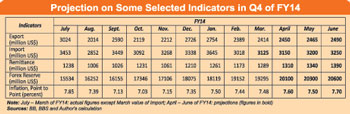
The MCCI assumed that the peaceful post-election political situation will continue and export, import, remittances and foreign exchange reserve will increase. The rate of inflation can be expected to fall in May as the supply situation will very likely improve with further improvements in the political environment but then it will go up because of increased demand during the Holy Ramadan.
The agriculture sector performed well in the quarter under review, but continuous government support with inputs and finance will be needed to sustain the sector's growth.
The performance of manufacturing and services sectors will need to be improved by removing all bottlenecks in physical infrastructure and the persistent crisis in power and energy sectors.
The MCCI also stressed the need for close surveillance of macroeconomic developments, and for creating policy space by pressing ahead with tax reforms, harnessing concessional external resources and improving public expenditure management.
to attain the status of a middle income country by 2021," the leading chamber said.
The Sixth Five-Year Plan (2011-15) targeted at achieving an eight per cent GDP growth rate by its terminal year. This would require the economy's total investment to grow from the present 26-27 per cent of GDP to reach 32.5 per cent by fiscal 2015.
"All-out efforts will, therefore, be needed to encourage private investment, enhance public investment and attract foreign direct investment (FDI)," the MCCI said.