
Revised rules put dividend-deficient mutual funds at liquidity risk
Mohammad Mufazzal | Thursday, 8 January 2026
Many pooled funds risk liquidation under the revised mutual fund rules if they fail to pay dividends for a third consecutive year.
Under the Bangladesh Securities and Exchange Commission (Mutual Fund Rules, 2025), trustees may convene a meeting of unitholders to decide whether they prefer liquidation of a listed or non-listed fund, or the conversion of a listed fund into an open-ended one, following non-payment of dividends for three consecutive years. Any such decision will be final if three-fourths of the unitholders give their consent.
Due to a prolonged bearish spell in the secondary market, many mutual funds failed to pay dividends for FY24 and FY25. As a result, they must distribute at least a nominal dividend in FY26 to avoid conversion or liquidation.
The performance of a mutual fund largely depends on the equity market. The rules require mutual funds to invest at least 60 per cent of their assets in listed securities, including stocks and bonds. In practice, however, most funds have invested up to 80 per cent of their assets in equities.
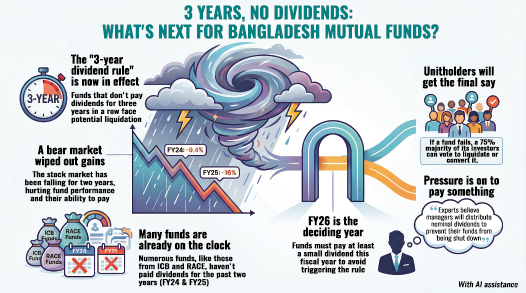
At least five mutual funds managed by ICB Asset Management Company have failed to distribute any dividends over the past two fiscal years. These are ICB AMCL Unit Fund, ICB AMCL Pension Holders' Unit Fund, Prime Finance First Mutual Fund, Bangladesh Fund, and ICB AMCL Islamic Unit Fund.
Of these, Prime Finance First Mutual Fund is a closed-end fund whose tenure will end in 2029, while the others are open-ended funds.
Several funds managed by other asset management companies, including RACE, have also failed to distribute dividends during the past two years. For instance, RACE's First Janata Bank Mutual Fund last paid dividends in FY22.
Trustees usually convene meetings of unitholders for two reasons-conversion or liquidation of a fund.
Most closed-end funds, whose portfolios are heavily weighted towards equities, failed to generate any return for unitholders in FY24 and FY25. They suffered significant erosion in value during these periods.
The broader equity market also witnessed sharp declines. The benchmark DSEX index fell by 9.4 per cent, or 502 points, in FY24 and declined further by 16 per cent, or 1,015 points, in FY25.
Md Abul Kalam, spokesperson of the securities regulator, said the revised rules created a framework for fund liquidation. "It would entirely depend on the consent of three-fourths of the unitholders," he said.
Iftekhar Ul Azim, a mutual fund investor, said the market price of fund units would fall sharply if fund managers skipped dividend payments for a third consecutive year. He added that the new provision would prompt asset management companies to distribute at least nominal dividends this year.
"Otherwise, the operational scope of many asset managers will be squeezed," Azim said.
Meanwhile, an increasing number of open-ended funds have seen unitholders surrender their units. The financial position of these funds could come under pressure if the equity market fails to stage a meaningful recovery during the ongoing year.
mufazzal.fe@gmail.com