
Right-size admin, spend public money prudently
FE Report | Friday, 17 April 2015
The aggregate size of the national budget for the coming fiscal year (FY) , 2015-16, should preferably be kept at the level, not exceeding Tk 2.75 trillion, to make it ‘realistic’ and implementable in the present economic context, suggested Dr Mirza Azizul Islam, former adviser to the caretaker government.There will still be some challenges before the government for meeting the overall budgetary expenditure even at this level, but the government will then get ‘fiscal space’, particularly considering the current price trends about oil in the international market and other relevant developments, he observed.
“Payments of subsidies to the Bangladesh Petroleum Corporation (BPC) would come down due to decline in the global oil prices. The government’s non-development expenditures, however, might go up in fiscal 2015-16 because of the implementation of the proposed national pay scale, increased allocation for law and order, expansion of targeted social safety nets and development of human resources etc.,” Dr Islam said.
He made the observations at a pre-budget discussion arranged by the Institute of Cost and Management Accountants of Bangladesh (ICMAB) in the city Wednesday.
Speakers at the discussion stressed the need for right-sizing the government in the context of the needs for ensuring better delivery of public services, by forgoing effective links between spending of budgetary resources with outcomes, following the value-for- money approach and the realities of the present situation.
Ambitions are welcome to realise the aims and objectives of the national socio-economic agenda but setting overambitious budgetary targets by ignoring the realities of the present situation will hardly demonstrate fiscal wisdom, they pointed out.
They also proposed for a cut of the existing corporate tax rates in a realitistic manner, as has been done by some regional neighbours like- India, to help attract investment.
They laid emphasis on taking pro-active fiscal moves for making the stock market vibrant.
The discussants at the meeting also underscored the need for building institutions with efficiency embedded in them, strengthening economic governance (as part of overall governance), enhancing the level of human skill and synchronising monetary and exchange-rate polices, noting that the annual budget alone, without coordination or coherence with all relevant policies or overall economic policy-related matters, will not help achieve the national objectives and goals.
AHM Moazzem Hossain, Editor of the Financial Express (FE), Dr Khandaker Golam Moazzem, Additional Research Director of Centre for Policy Dialogue (CPD), Abu Ahmed, a noted economist and Chowdhury Amir Hossain, member (international taxation) of the National Board of Revenue (NBR) were the discussants on the occasion.
President of ICMAB ASM Shykhul Islam, FCMA, delivered his address of welcome while Abdur Rahman FCMA, secretary general of ICMAB, offered the vote of thanks.
FE Editor Moazzem Hossain said an objective review of sixth five year plan is important for finalising the seventh five-year plan.
“In terms of per capita income, it will not take more than a couple of years for Bangladesh to become a low middle income, going by the World Bank’s categorisation under the Atlas method for national income accounting,” he said.
But that will not be enough for Bangladesh to graduate itself from the category of a least income country under the set-standards of the United Nations, he added.
Improvements of the situation in areas of nutrition, stunted growth of its child population, human resource development etc., have to be made for the purpose, he pointed out.
He termed Bangladesh ‘a paradox of development’, noting its commendable successes in many areas over the years, despite its troubled polity and its knock-on effects on the economy.
He expressed the hope that the Financial Reporting Act (FRA) would be tabled in the coming budget-session of parliament while noting that its enactment was, perhaps, delayed because of differences of views between the two representative bodies of the chartered accountants and cost & management accountants.
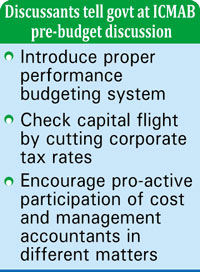
He made strong pleas for introducing proper performance budgeting system and forming a properly manned Budget Analysis Unit in the Budget wing of the Ministry of Finance for conducting periodic economic analyses and to suggest necessary adjustment measures from time to time.
“Expansion of tax net is necessary. Currently, taxmen are imposing tax burden on large taxpayers without doing much for expending the net, he said.
“The government will, as usual, opt for an expenditure-induced, largely in the nature of current one, on an annual incremental basis,” he noted.
Economist Abu Ahmed stressed the need for enactment of FRA at the earliest for preparing proper financial reports with accurate net profit data and cost analyses.
He suggested that the government should check capital flight by cutting corporate tax rates as high tax rate never brings higher revenues. In this context, he strongly pleaded for handling the issues of transfer pricing or misprinting of externally traded items.
“Companies are not coming to the stock market due to high rate of taxes. Shareholders ownership of existing operational multinational, even to a limited extent, is important to inject dynamics in the capital market”, he pointed out.
NBR member Amir Hossain said the government is on the right track in its effort to raise the tax- GDP (gross domestic product) ratio and to help achieve the goal and objectives of the national economic strategy, despite the fact that it is now bearing one major brunt of political unrest, particularly in areas of tax collection.
“We are trying to reach people. There is need for focusing on skill development and specialisation in the field of taxation through consistent endeavours to help develop expertise,” he observed.
“Skill development and enhancement of efficiency is not an issue of consequence for government officials alone. These have wider ramifications and concern most areas in the country”, he added.
There are several tax-incentive related issues related to attracting foreign direct investment (FDI) but their outcome and impact cannot be assessed in the absence of a proper study, he said.
Additional Research Director of the CPD Dr Moazzem said despite having the advantage of an otherwise stable macro-economic situation, the country has not been able to take its advantage to attract investment, both local and foreign.
The next budget needs to focus on minimising the loss of political unrest and providing some form of support for the affected sectors.
“The political situation would determine the volume of investment inflow next year. The government should take appropriate measures, providing scope for inclusive politics and giving proper attention to institution-building efforts”, he observed.
He said it is important to assess the outcome of fiscal incentives for the individual sector in the outgoing fiscal and to put a biffing emphasis on employment generation through the national budget for the next fiscal.
Dr. Moazzem pointed out that the national budget for the next fiscal would coincide with the launching of the country’s seventh five-year development plan. As such, it would draw a special attention from all concerned, he added.
He highlighted the need for putting a sound rationale in place for sectoral allocation of public resources, mobilisation of funds, collection of taxes and duties and efficient uses of public expenditure, while taking a realistic view of the overall economic situation.
Reaching the status of a middle income country within the stipulated time-frame, alleviation of poverty, provision of infrastructural support facilities, upgradation of skill, development of human resources, promoting exports, maintenance of remittance flows and improvement of the state of things in social sectors through an inclusive growth process at an accelerated pace are the country’s priorities at this stage, he added.
Earlier in his address of welcome, the ICMAB president said that the government should encourage pro-active participation of cost and management accountants in different matters of consequence like transfer pricing, alternative dispute resolution (ADR), etc.
He also urged the taxmen not to put the senior citizens into unnecessary troubles and any sort of harassment, without having quite specific and substantive evidence about any irregularity concerning tax-related matters. Such citizens should be excluded from the troubles and hassles of hearing as far as possible, he observed.
He pleaded for extension of tax holiday facility for the next 10 years for IT sector under the fiscal measures for FY 2015-16 budget.
Speaking as the chief guest, Dr Azizul Islam suggested for limiting the number of banks, setting the rate of value added tax (VAT) between 8.0 per cent and 10 per cent under the new law and making more-concerted efforts for export diversification through policy actions in the next fiscal year.
While delivering the vote of thanks, Abdur Rahman said the number of taxpayers would go up to 5.0 million within the next five years as the revenue authority has framed measures to check the use of fake taxpayers’ identification number (TIN).
Speakers at the discussion meeting suggested that the government should expedite its efforts for institutional development and reform activities in the next budget.
Proposals were made on behalf of the ICMAB in the meeting for focusing on the country’s poor people and youth force in the upcoming national budget. Creation of more employment opportunities, encouragement of local and foreign investment, empowerment of women, development of public private partnerships, support for efforts to high pace of industrialisation, along with uninterrupted supplies of power and gas, promotion of good governance, transparency and accountability were also suggested by the Institute.
It mentioned that if all the indicators of economy are in proper shape, it would be possible for Bangladesh to achieve the status of a middle-income country before 2021.
Chief Guest Dr. Azizul Islam mentioned that the coming budget should give a special emphasis on proper implementation of Annual Development Programme within the stipulated time-frame. He also called for taking appropriate steps to reduce the income gap between the rich and the poor.
doulot_akter@yahoo.com