
Rising inequality in Bangladesh: wasteful spending in weddings provides an index
Mahmudul Islam | Sunday, 23 November 2025
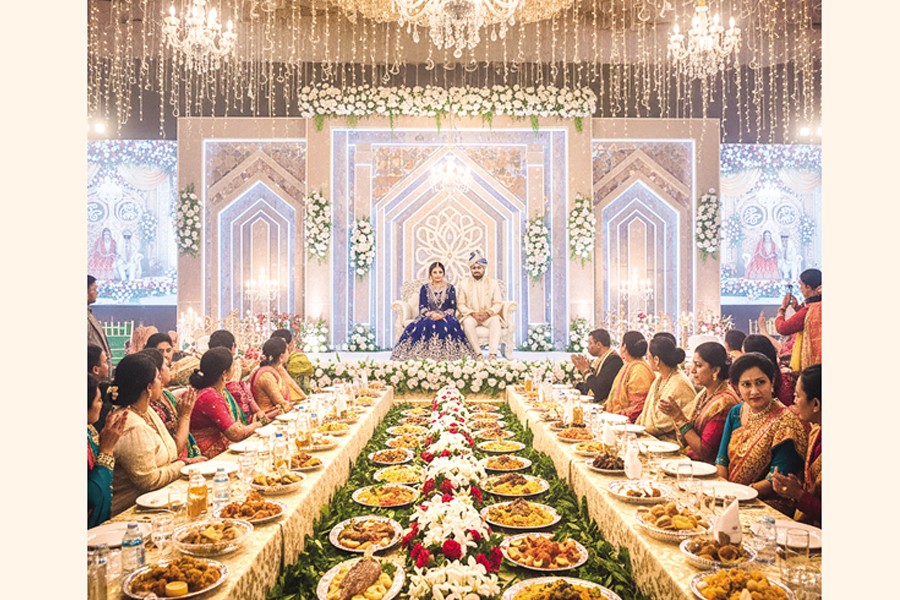
 It was a wedding that would put many extravagant ones to shame. As reports run, the groom and the bride are from two opulent families in Bangladesh, a country struggling to come out from the world's poor-country club, that is, LDCs. Tanveer Ahmed Mostafa, son of Bangladeshi business-tycoon Mostafa Kamal, and Sameera Rahman, daughter of another mogul, Mohammed Mahtabur Rahman, wed at Atlantis, The Palm in the UAE, in January 2023. As many as 9,000 people from nearly 70 countries attended the event at one of the most iconic and luxurious resorts nestled between the calm waters of the Arabian Gulf and the stunning Dubai skyline.
The wedding guests included business magnates, politicians, bureaucrats, and other distinguished individuals. They feasted on 35 delicacies in the gaye holud - a pre-wedding celebration where the bridegroom and the bride are splashed with turmeric - and on 30 items on the big day. The exact cost of the entire arrangement is not known.
However, it would not be wrong to assume that the figure is colossal, given the scale of the programme. Besides, both the bride and the groom come from very wealthy families. Tanveer is a director at Meghna Group of Industries, an upstart conglomerate built by his father. It operates over 55 industrial units and enjoys an annual turnover of around $3.0 billion.
Sameera is a director at the UAE-based Al Haramain Perfumes company which produces over 1,000 types of perfumes and does business in more than 100 countries. It is the flagship entity of Al Haramain Group, which has invested more than 1.0 billion dirhams in the UAE over the last 40 years. Her father is the chairman and managing director of the group, which also has presence in tea, banking, education, healthcare, and hospitality sectors.
The magnificent wedding of Tanveer and Sameera is not limited to just another attention-grabbing news report that amuses an average Bangladeshi. It prompts feelings and actions that have far-reaching psychological and financial implications. To begin with, the lavish wedding triggers positional concerns by altering the frame of reference for the class that is immediately below the Mostafa-Mahtabur cohort in the income-distribution paradigm in Bangladesh.
Robert H Frank, professor emeritus of economics at Cornell University's Johnson Graduate School of Management, argues that the frame of reference governs people's spending behaviour to a great degree, though standard economic models do not take it into account. He says everyone's spending depends in part on what others spend in society, and that people spend more when their friends and neighbours do so. This is commonly known as keeping up with the Joneses, but he describes it as expenditure cascades.
This is how expenditure cascades work in housing. The rich build large houses because they have more money. There is nothing wrong with building such houses, but they change the frame of reference for the near-rich, triggering positional concerns among them. This group then builds bigger houses as they feel their existing ones are not adequate compared to community standards.
But when they do so, they again shift the frame of reference that defines what an adequate house size is for the upper-middle -class families. This prompts the upper-middle group to build bigger houses. The cascades continue all the way down the income ladder.
In his book "Falling Behind: How Rising Inequality Harms the Middle Class," Robert explains that the cascades are driven by context, not envy. Concerns about relative ranks are hardwired in human brains. The middle class does not necessarily envy the mansions built by the rich, but they feel the pressure to upgrade their houses when the upper-middle class goes for larger abodes.
Similar pressure is felt by men and women from families that are almost as rich as the Mostafa-Mahtabur cohort when it comes to wedding. The wedding of Tanveer and Sameera changes the frame of reference for them. They then arrange elaborate weddings, thinking the events would otherwise fall short of the community spending norms. But the additional spending has little to do with completing the required marriage rituals. The cascades then impact middle-class weddings.
Even in the late 90s and early 2000s, a Bangladeshi middle-class wedding was ordinary at best. It was about two individuals starting a new union, which also joined their families, and arranging the feast under marquees in the yard or on the rooftop. The emphasis was more on family members, relatives, friends, and neighbours coming together, having their fill of merrymaking, and wishing the newly-wed couple a good and happy life.
The gaye holud would also be arranged modestly. Neither it nor the wedding would usually feature live bands or professional videography. Family members, relatives, or friends owning film cameras would typically be requested to capture photos. It was not the smartphone era.
Middle-class urban weddings have now become as elaborate an affair as they can be. They feature a number of ceremonials carried out over several days that jack up the expenditure. The package broadly includes engagement, bridal shower, mehndi night, haldi ceremony, wedding, and wedding reception.
The wedding/wedding reception venue first shifted from the yard/rooftop to party centres, commonly known as community centres, and then to large banquet halls featuring splendid stages and elegant décor. There are, nowadays, additional allocations in the budget for professional photography, including pre-wedding photo shoots, cinematic videography, and often live music. After all, it is the social-media age, and sharing the wedding diary online satisfies the cravings for digital likes and comments that have made people dopamine addicts. The more impressive the wedding would look in high-resolution photos and high-definition videos, the greater the possibility that the comment box would be filled with lavish appreciation.
What is essentially a social occasion to mark the official uniting of two souls and the celebration of their love has become a carefully orchestrated manifestation of extravagance. Having an elaborate wedding is now a status symbol, much like possessing a magnificent house or a luxurious car. The grander the ceremony, the higher the prestige - or at least people perceive it that way.
This is the result of them caring about not only how they judge the wedding but also how their peers will do so. In a way, it is now more about competition than celebration, and nobody wants to trail. Not arranging an elaborate wedding might make your peers see you as worse off and incapable of meeting the standards. Nonetheless, there is little research-based evidence that a lavish wedding automatically translates into greater levels of happiness, attaining which is a key objective of marriage.
The average American wedding now costs $33,000, almost twice as much as in 1990. However, no one believes that couples who marry today are happier because weddings cost so much more, Robert notes. Nehal Karim, a retired sociology professor at the University of Dhaka in Bangladesh, concurs with him.
"There is no guarantee that an expensive wedding will fill your life with happiness. People arrange such weddings primarily because they want to flaunt their wealth. They even dazzlingly illuminate the street leading to their house using string lights. This does not make for happiness," he says. He also stresses that marital happiness largely depends on the level of understanding between the husband and his wife.
There is no official data on the average cost of a Bangladeshi wedding. Veteran matchmaker Pakhi Bhai, who has become a household name with over five decades of experience in the trade, says it is not possible to flawlessly compare wedding expenditures in the 90s with that today because there are many subtleties.
"For example, I have had cases where the grooms' families willingly bore the costs of both sides. Certainly, their expenses were disproportionately higher," says Pakhi, who runs the matrimonial agency Ghotok Pakhi Vai Pvt Ltd.
"The general assumption is that if you are a multimillionaire businessman, your wedding expenditure will be much higher than what you would spend as a mid-level banker. It can also happen that you are rich but will arrange a less-expensive wedding than someone who has attained more material prosperity than you. I cannot give you an average figure," adds Pakhi, whose real name is Kazi Ashraf Hossain.
There has been no study on the link between wedding expenses and marriage longevity/quality in Bangladesh. But a 2014 study of over 3,000 persons in America found that marriage duration was either not associated or inversely associated with spending on the engagement ring and wedding ceremony. "Overall, our findings provide little evidence to support the validity of the wedding industry's general message that connects expensive weddings with positive marital outcomes," the study authors says.
They have also said the evidence suggests the types of weddings associated with a lower likelihood of divorce are those that are relatively inexpensive. Moreover, if wedding expenditures are indeed associated with debt stress, it is possible that such expenses raise the likelihood of marital dissolution. On the other hand, high wedding attendance and having a honeymoon (regardless of the cost) are generally positively associated with marriage duration. 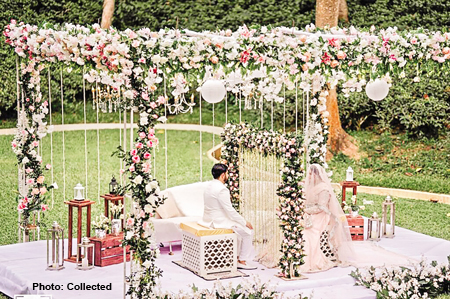 This raises the million-dollar question: What is the point of a grandiose wedding if it does not necessarily make a couple happy or is not positively associated with the longevity of their conjugal life? Robert explains when everyone spends more on "special" celebrations, it merely raises the bar that defines "special." Beyond a certain point, extra spending on housing, celebrations etc is purely positional and a relatively inefficient source of extra utility. As much of the spending in today's economy is positional, it is wasteful in the same way military arms races are so.
Nehal agrees, reiterating that expensive weddings are a complete waste of money. On the other hand, Pakhi says wedding costs have certainly gone up as the accessories have become dearer.
"Yet, much of the extra expenditure is nothing but ostentatious gestures. People often spend a lot to splendidly decorate their houses just to impress others. Grooms even hire helicopters to fly to brides' places. It is a total waste of money," he notes.
Pakhi, who takes pride in making around 22,000 matches, further says couples should use money productively, such as by investing in appreciating assets, to ensure future security instead of wasting it on wedding extravaganza.
In the domain of wedding, the rising cost of meeting the standards for "adequate" that is resulting in wasteful spending has disproportionately disadvantaged the middle class. People like the Mostafa-Mahtabur cohort can comfortably arrange a big, fat wedding for their children because they have an astronomical amount of money. Besides, they have unlimited earnings potential and make exceedingly more than the middle class via their multiple streams of income. So, even though the grand wedding in Dubai cost them a fortune, they were not financially stretched.
But the middle class, with their limited income and high dependence on savings, cannot avoid financial strain when they arrange elaborate weddings. Many drain their savings and also borrow from relatives or friends without carefully considering how they will repay. There are also banks in Bangladesh that offer marriage loans, such as this and this. It is a no-brainer that the majority of the clients of such loans belong to the middle class.
For this group, using up savings or going into debt when starting a major chapter in life through a grand ceremony is the tangible cost of acting on the altered frame of reference. This is how positional concerns, which are purely psychological, create concrete knock-on effects on finances that are difficult to avoid. According to Robert, more spending by the people who can afford it at the top ultimately creates pressure for more spending on the people who cannot afford it at the bottom.
Such wasteful spending could apparently be prevented by exhorting people to be more responsible financially and not act on positional concerns. But Robert argues that measures are first needed to address income inequality, which lies at the root of the problem. Highlighting the case of his country, he says expenditure cascades got going in earnest in the US when inequality began to widen several decades ago.
Income growth in America was balanced across income categories from World War II up to the 70s. Growth became uneven thereafter, with the middle quintile gaining a little bit but the top one seeing a substantial increase. Higher income at the top led to more spending there, eventually raising the cost of achieving goals that most middle-class families regard as basic, Robert explains.
The spectre of income inequality has also haunted Bangladesh. The rich witnessed a significant surge in their earnings since independence in 1971. The richest 10 per cent held 28.4 per cent of the income in 1973-74, which jumped to 40.92% in 2022, according to the Household and Income Expenditure Survey 2022 published by the Bangladesh Bureau of Statistics. But the share of the earnings of the fifth and sixth deciles from the bottom - which mostly constitute the middle class - fell from 7.1% to 5.81% and from 8% to 6.92%, respectively, in this period. Moreover, the income share of the poorest 10% also decreased from 2.8% to 1.31%.
In other words, the rich grew richer and the poor poorer while the middle class, which already lagged behind the upper class by a large margin after independence, lost ground further in 50 years. Bangladeshi economists have repeatedly voiced their concern about rising inequality, underscoring that the remarkable economic growth that the country has enjoyed has not been inclusive. They say weak policies and corruption fuelled inequality, which resulted in increased income concentration at the top.
Because of growing inequality, the significant gain in income and the corresponding increase in spending in the upper echelon have put the squeeze on the Bangladeshi middle class in different aspects of their lives, including wedding. Their frame of reference keeps shifting, but they cannot catch up financially, which often prompts them to take on debt. Unless income inequality is reduced, there will be more and more regal weddings like that of Tanveer and Sameera at the top of the ladder and expenditure cascades will continue to result in wasteful spending on this "special" celebration in the rungs below, with the middle class set to bear the brunt.
Nehal squarely blames it on capitalism. He says this is among the inevitable consequences of living in a capitalistic society with stark class divisions. "Of course there are exceptions, but those do not define the norms."
The writer is a journalist. r2000.gp@gmail.com