
QIMA REPORT
Rising uncertainty pushes global supply chains to diversify in 2026
MONIRA MUNNI | Monday, 26 January 2026
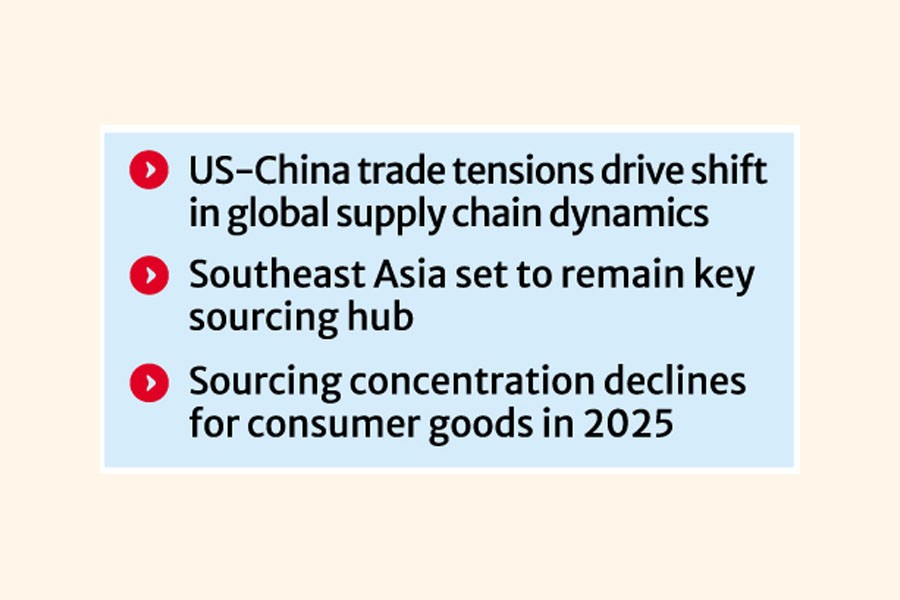
Uncertainty driven by trade tensions and geopolitical pressures is prompting both buyers and suppliers to accelerate diversification strategies, aiming to bolster resilience in 2026, which is expected to be a more volatile year, according to a new report.
The study, conducted by Quality Inspection Management (QIMA), highlighted that global supply chains remained resilient in 2025 despite challenges such as US-China trade tensions, tariff shocks, and shifting demand patterns.
Data from QIMA's inspection and audit services revealed significant diversification trends, including major regional sourcing shifts across the Asia Pacific and Mediterranean, alongside thriving South-South trade links.
"New trade partnerships and the strong performance by emerging economies opened meaningful opportunities for diversification, helping global procurement avoid the worst-case disruption scenarios. In 2026, buyers will continue expanding multi regional supplier networks to mitigate risks and maintain agility," it predicts.
The QIMA report, published on January 15, also pointed out a notable decline in sourcing concentration for consumer products such as apparel, toys, and homewares across major markets.
For North American buyers, the combined share of the top three supplier countries (China, India and Vietnam) fell from 61 per cent to 54 per cent in a single year of 2025, according to the report.
Western European brands saw a slower but steady shift, with the top three suppliers (China, Vietnam and Bangladesh) accounting for 70 per cent of inspections and audits in 2025, down from 77 per cent in 2021.
In both regions, reduced business with China was the main driver, but much of the volumes redirected from China landed beyond the second and third-biggest supplier markets.
On the supply side, Chinese exporters focused more on emerging markets.
In 2025, Southeast Asia strengthened its position as one of the main growth engines in global trade, with sourcing activity increasing in every quarter.
QIMA data showed inspection and audit demand in the region rising over 24 per cent year-on-year, led by Vietnam (30 per cent) and Thailand (44 per cent). Indonesia (13 per cent), Cambodia (16 per cent), and the Philippines (13 per cent) also recorded strong growth.
Inspections from the US and European buyers grew at the same pace as the regional average, while demand from Latin and South American clients surged 61 per cent Year-on-Year in 2025. This trend suggests that Southeast Asia is poised to remain a critical sourcing hub in 2026, with the region's capacity to absorb more orders as Western supply chains continue to diversify and emerging markets drive new business.
While US demand for inspections and audits in China fell by 18 per cent YoY in 2025, the drop was partly balanced by other Western buyers.
QIMA data showed that many European brands still rely on China for textiles and apparel, with notable Q4 increases from Italy, Spain, Austria, the UK, and the Netherlands.
Beyond Europe, inspection demand also grew in Canada (9.0 per cent YoY), Australia (2.0 per cent YoY), and New Zealand (38 per cent YoY).
Faced with fluctuating conditions at home and an unpredictable trade environment abroad, QIMA inspection and audit data suggested that European buyers are poised to maintain existing supplier relationships while hedging risks through diversification.
China remained an important sourcing partner for products such as toys and electricals, but the fastest growth in inspection demand came from Southeast Asian hubs, including Vietnam (12 per cent), Thailand (23 per cent), and Cambodia (6.0 per cent).
"Looking ahead, regional sourcing is likely to keep playing a key role in resilience strategies," read the report.
In the past year, nearshoring and reshoring reached a record 14 per cent of EU sourcing, with the Mediterranean region recording strong growth of 25 per cent YoY.
Munni_fe@yahoo.com