
Risk of future Nepal-India earthquake increases
Friday, 7 August 2015
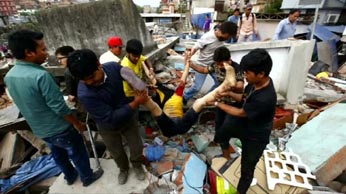
There is an increased risk of a future major earthquake in an area that straddles the west of Nepal and India, scientists warn.
New data has revealed that the devastating quake that hit Nepal in April did not release all of the stress that had built up underground, and has pushed some of it westwards, a news agency report said.
The research is published in the journals Nature Geoscience and Science.
Its authors say more monitoring is now needed in this area.
Prof Jean-Philippe Avouac, from the University of Cambridge, told BBC News: "This is a place that needs attention, and if we had an earthquake today, it would be a disaster because of the density of population not just in western Nepal but also in northern India, in the Gangetic plain."
The 7.8 magnitude earthquake that struck Nepal earlier this year killed about 9,000 people, and left many thousands more injured and homeless.
It occurred in a geological collision zone, where the Indian tectonic plate pushes north into the Eurasian plate, moving the ground an average of 2cm a year.
Over decades, stress built up along a stretch of the fault line, which is called the Main Himalayan Thrust fault, close to Nepal's capital Kathmandu.
The boundary between the two plates in this area had become locked - stuck together by friction, and so immobile - building up energy that only a major earthquake could release.
However, the quake on 25 April only released part of this pent-up pressure.
"If the earthquake had ruptured all the locked zone all the way to the front of the Himalayas, it would have been a much larger earthquake," said Prof Avouac.
Instead, the researchers believe that some of this stress has shifted west, to an area stretching from the west of Pokhara in Nepal to the north of Delhi in India.
A major earthquake there is already long overdue: the last happened in 1505 and is estimated to have exceeded M8.5. The researchers say the new stress that has moved there could already be adding to the tension that has been building up over five centuries.
-SS