
RMG export at risk for Ctg port strike
FE REPORT | Tuesday, 3 February 2026
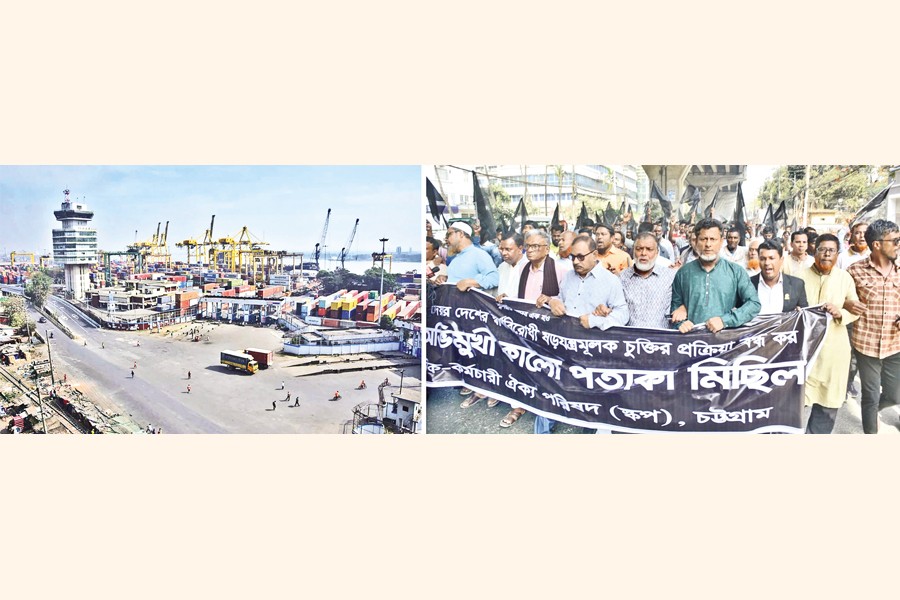
Operational activities at Chattogram Port, the country's prime seaport, remained at a standstill for a third consecutive day on Monday as port workers continued their protest against the planned lease of the New Mooring Container Terminal (NCT) to Dubai-based DP World.
The ongoing suspension of all cargo handling activities at the port has created a severe crisis for the country's import-export operations, particularly for the ready-made garment (RMG) sector, industry leaders warned. They also called for urgent action to resolve the deadlock and restore normal port operations.
The work stoppage at the port began on January 31, resulting in the complete paralysis of port operations. Loading and unloading of goods, including containers and bulk cargo, have been suspended for three days. Workers at all levels of the port-dock workers, terminal staff, and truck drivers-have joined the strike.
Expressing grave concern over disruptions to port operations, BGMEA Acting President Selim Rahman, in a letter to Chattogram Port Authority Chairman Rear Admiral S M Moniruzzaman on Monday, urged immediate steps to restore smooth operations.
The disruption has nearly halted the import and export operations of the RMG sector, which is time- and season-sensitive, Rahman said in his letter, noting that timely import of raw materials, production, and shipment within buyers' lead time are critically important. Failure to meet these deadlines exposes exporters to significant financial losses.
The BGMEA letter said that the ongoing protest by port workers has created deep uncertainty, putting current export orders at risk and raising fears of further delays.
In response to the growing crisis, BGMEA urged the authorities to take immediate steps to resolve the situation, including holding talks with all stakeholders involved to bring an end to the protests and restore normal port operations in order to ensure the uninterrupted flow of RMG-related imports and exports.
Meanwhile, the Port Protection Movement Committee, which is spearheading the strike at the Chittagong port, on Monday called an additional 24-hour work stoppage for today (Tuesday) to press home their demand.
The workers are demanding that the government halt the process of lease agreement, which they say threatens the interests of the port and its workers by allowing a foreign company to manage a vital part of the country's primary seaport.
In the port city, the police intercepted a 'black-flag' procession organised by the Sramik Karmachari Oikya Parishad (SKOP) in support of the work stoppage.
Hundreds of activists gathered at Agrabad Badamtali area and began marching towards the port, but were stopped near the Jamuna Building by the law enforcers. In response, protesters staged a sit-in and announced plans for a port blockade at 11 am on Tuesday.
Leaders of SKOP, including Comrade Tapon Dutta, Iftekhar Kamal Khan, and Nur Ullah Bahar, led the procession.
At a press conference in Chattogram on Monday, Humayun Kabir, Coordinator of the Port Protection Movement Committee, said workers had "spontaneously" ceased work in all areas of the port, including jetties and the outer anchorage.
"No goods or containers have been loaded or unloaded, and no vehicles have entered the port since January 31. The workers have joined the protest programme spontaneously. But instead of engaging in dialogue with the workers, the administration is issuing one repressive transfer order after another," he said.
The committee's planned 24-hour work stoppage will continue from 8am to 4pm on Tuesday, and they have warned that the protest will extend beyond that if the government does not halt the process of handing over the NCT to a foreign operator.
Speaking to The Financial Express, BGMEA Director Rakibul Alam Chowdhury said that resolving the crisis caused by the suspension of port operations and restoring normal import-export activities has become extremely urgent.
He emphasised that Chattogram Port is the largest gateway for the garment sector, with both raw material imports and exports of finished garments and other products fully dependent on the port.
"If import activities are disrupted, the entire production chain is affected, which directly impacts exports. That is why uninterrupted and normal import and export operations are absolutely essential," Mr. Chowdhury said.
According to him, the ongoing work stoppage has already put exporters' running shipment orders at risk, exposing them to significant financial losses.
He warned that the situation could further damage Bangladesh's image in the international market, especially at a time when global competition is intensifying and export orders are already under pressure.
The BGMEA director also pointed out that port charges have recently been increased. Given the current operational paralysis, he said the enhanced charges, including demurrage and detention, should be temporarily waived or suspended; otherwise, businesses will face additional financial strain.
He cautioned that prolonged disruption could lead to severe container congestion in the future. With export operations currently limited to a short window-from 4:00pm to 10:00pm-the logistical pressure is expected to intensify further.
"If shipments cannot be completed within the stipulated time, exporters may be forced to resort to air shipments, which would significantly increase production and logistics costs," he said.
Fazle Ekram Chowdhury, Chairman of the Chittagong Port Berth Operators Association, said, "Efforts to book workers for assignments have failed as labourers continue to refuse work. Meanwhile, employees are observing a 'pen-down' strike, halting administrative processes, resulting in a complete standstill of port activities."
Meanwhile, the Chittagong Port Authority (CPA) has transferred a total of 16 workers to the Dhaka Inland Container Depot (ICD) and Narayanganj's Pangaon terminal.
newsmanjasi@gmail.com
nazimuddinshyamol@gmail.com