
RMG export loses ground in American market
Vietnam, Cambodia continue to expand their market shares
MONIRA MUNNI | Thursday, 11 June 2026
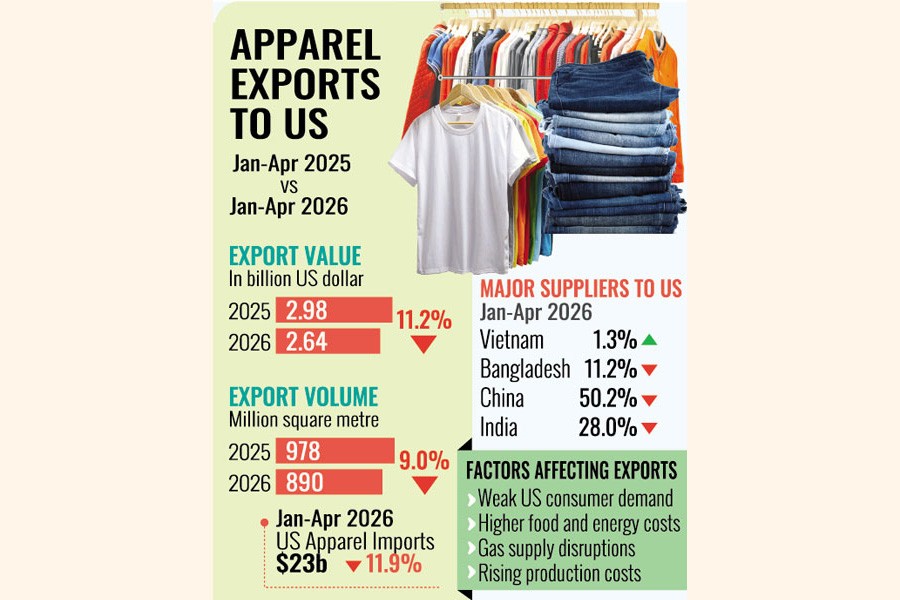
Bangladesh's apparel exports to the United States, its single-largest export destination, suffered a deeper setback during the first four months of this year.
Shipments from the country showed double-digit negative growth during the period while major competitors, particularly Vietnam and Cambodia, continued to strengthen their positions in the market.
Bangladesh exported garment products worth US$2.64 billion during the January-April period of 2026, registering an 11.21 per cent decline from US$2.98 billion earned during the corresponding period of 2025, according to data released by the Office of Textiles and Apparel (OTEXA) on Tuesday.
In volume terms, Bangladesh shipped 890.17 million square metres of apparel, about 9.0 per cent lower than the 978.32 million square metres exported during the same period last year.
Apparel exports to the United States have faced headwinds since the beginning of the year, recording growth rates of less than 1.0 per cent in January, followed by declines of 17.18 per cent and 8.08 per cent in February and March respectively.
In April 2026, exports again fell sharply, declining 17.21 per cent to US$627 million from US$757.37 million in April 2025, according to an analysis of the OTEXA data.
Asked about the reasons behind the downturn, AK Azad, Managing Director of Ha-Meem Group, one of Bangladesh's largest garment exporters to the United States, said rising geopolitical tensions and economic uncertainty had weakened consumer demand.
He said the US-Iran conflict had driven up food and energy prices, forcing American consumers to prioritise essential spending and reduce purchases of apparel, resulting in lower demand for garments.
Mr Azad noted that Vietnam remains ahead of Bangladesh in the production of higher value-added and man-made fibre (MMF)-based garments, which command better prices and benefit from shorter lead times due to stronger domestic and Chinese fabric supply chains.
By contrast, Bangladesh remains largely concentrated on basic cotton-based products, while sourcing orders are increasingly being distributed among competing suppliers, including India, whose competitiveness has been improving.
Bangladesh is also losing competitiveness because of several domestic challenges, including higher energy costs, inadequate gas supply, rising bank lending rates and increasing labour costs, all of which have pushed up overall production expenses, said Mr Azad, a former president of the Bangladesh Garment Manufacturers and Exporters Association (BGMEA).
"Buyers now want garments with designs developed by suppliers themselves, supported by their own fabrics, patterns and product development capabilities," he said, adding that Bangladesh continues to lag behind major competitors in these areas.
"Bangladesh now needs to focus more on MMF-based garment manufacturing, improve productivity and worker efficiency, reduce wastage and strengthen design capabilities to increase its share in the global market," he said. He also urged the government to provide the necessary policy support to help reduce production costs and sustain competitiveness.
Speaking to the FE, M Masrur Reaz, Chairman and CEO of Policy Exchange Bangladesh, attributed the continued decline in garment exports to major markets, including the US and the EU, to uncertainty surrounding US tariff policies, the Iran conflict and disruptions in gas supply that have affected production, particularly in the knitwear sector.
He said global demand had weakened because of these external pressures, while production capacity had also fallen following the closure of hundreds of factories.
The OTEXA data also revealed notable shifts in global apparel sourcing patterns.
Vietnam remained the top-performing supplier among major exporters during the January-April period, recording a 1.33 per cent increase in export value to US$5.15 billion and a 2.69 per cent rise in volume to 1.52 billion square metres.
Meanwhile, China, which slipped to third place among apparel exporters to the US market, experienced a steep 50.16 per cent decline in export value to US$2.17 billion, while export volume fell 38 per cent to 1.51 billion square metres.
India also faced challenges, with exports declining 28 per cent to US$1.43 billion and shipment volume dropping around 23.49 per cent to 422 million square metres during the period under review.
Overall, US apparel imports contracted by 11.90 per cent year-on-year to US$23 billion during the first four months of 2026, reflecting persistent softness in demand amid elevated inflation and cautious consumer spending.
Munni_fe@yahoo.com