
RMG industry in transition to circular economy for greater sustainability
Says BGMEA president
Monday, 28 August 2023
The readymade garment industry of Bangladesh is increasingly focusing on the transition from linear business model to circular economy for greater environmental sustainability coupled with economic growth, said Faruque Hassan, president of Bangladesh Garment Manufacturers and Exporters Association (BGMEA), reports UNB.
He said: "To what extent climate change will change the world is still unclear, but one thing is certain: businesses can no longer grow at the cost of the environment. The decisions taken now and in the coming years will affect the planet."
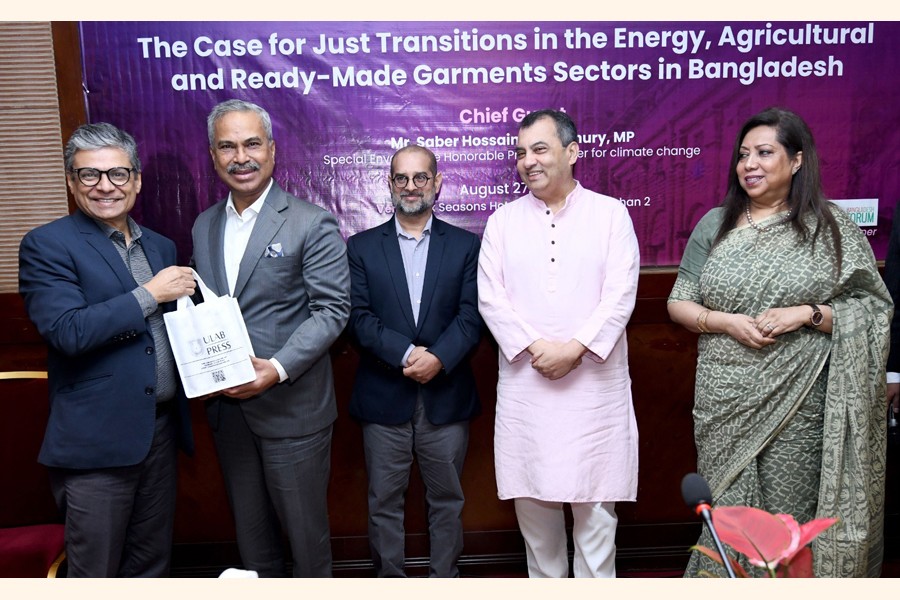
He made the observation while speaking at the launching of a report titled 'The case for just transitions in energy, agricultural and RMG sector in Bangladesh' held in Dhaka on Sunday.
Saber Hossain Chowdhury, special envoy to the Prime Minister for Climate Change, and Chair of Parliamentary Standing Committee on Ministry of Environment, Forest and Climate Change, inaugurated the event as the chief guest.
Professor Imran Rahman, vice-chancellor, University of Liberal Arts Bangladesh (ULAB), Zafar Sobhan, editor of Dhaka Tribune and Dr Sultana Afroz, former CEO of Public Private Partnership (PPP) Authority of the Prime Minister's Office, also spoke at the event.
The BGMEA chief highlighted the progress made by Bangladesh's RMG industry in the area of environmental sustainability.
"Bangladesh's RMG industry has seen an impressive growth in the number of green garment factories. The total number of LEED certified green garment factories in Bangladesh is now 200, of which 73 are platinum. These green factories are equipped with all the eco-friendly features and emit 40 per cent less carbon than a conventional factory," he said.
He also mentioned the series of initiatives taken by BGMEA for protecting environment under its Sustainability Vision 2030.
"The vision aims to reduce 30 per cent carbon emission, 50 per cent use of sustainable raw materials, 50 per cent reduction of groundwater usage, 100 per cent use of ZDHC chemical usage, 30 per cent reduction of energy usage, 20 per cent use of renewable energy and 30 per cent reduction of deforestation," he added.
The BGMEA president said: "Climate change is not a future threat, it's happening now. The best way one can make an impact in this regard is "doing-our-bits" to curb carbon emissions and reduce environmental pollution."
"When the brands are setting ambitious targets, it is their responsibility to make sure that no one is left behind in the supply chain," he remarked.