
Rohingya as a test case of global moral failure
Matiur Rahman | Friday, 10 April 2026
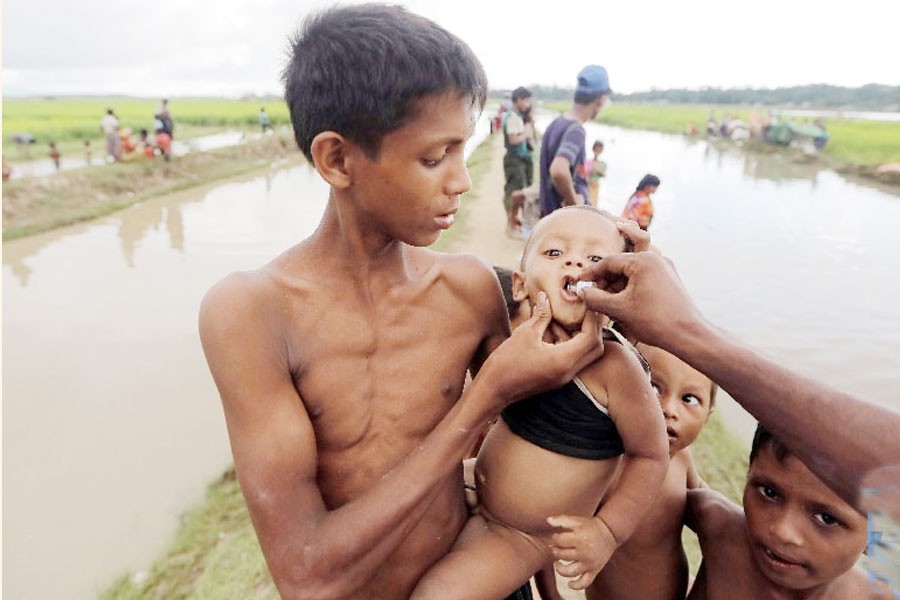
There is a concept in political philosophy that the Italian theorist Giorgio Agamben spent decades developing — one that, read in a library or a seminar room, feels like an intellectual exercise, but read against the daily dispatches from Cox’s Bazar in 2026, feels like prophecy. He called it ‘bare life’: the condition of biological existence stripped of political protection, of a human being reduced to a body that can be harmed but cannot seek justice, fed but cannot earn, sheltered but cannot own. Agamben borrowed the idea from Roman law’s figure of ‘homo sacer’ — the person who existed outside every legal category, who could be killed but not sacrificed, who occupied a juridical void where neither the state nor custom extended its protection. The Rohingya of Bangladesh are not a philosophical case study. They are 1.2 million flesh-and-blood human beings, and what is being done to them — and what is being permitted to happen around them — constitutes the most consequential and least examined experiment in the global politics of bare life currently underway.
Eight and a half years after Myanmar’s military carried out what the United States formally designated a genocide, the refugee camps in Cox’s Bazar remain among the largest in the world, housing nearly 1.15 million registered refugees. The word “temporary” has haunted every institutional description of their presence in Bangladesh. But temporariness, when sustained across nearly a decade without a credible resolution, ceases to function as a descriptor and hardens into a social condition of its own. Sociologists have a term for this: permanent temporariness. It describes the condition of a population warehoused indefinitely — systematically denied the legal personality that would allow them to work formally, own property, access domestic courts, or enrol their children in any nationally recognised education system — while remaining fully exposed to every form of violence that their physical surroundings can produce. They are geographically inside Bangladesh. They are legally outside it.
When Agamben describes the refugee camp as the defining political architecture of modernity, he does not mean that camps are aberrations. He means the opposite: that the suspension of rights is not an accident of camp life but its organising principle. The Cox’s Bazar camps illustrate this with uncomfortable precision. The Rohingya face pressure and violence from armed groups and criminal gangs, including sexual violence, abductions, forced recruitment, and extortion. Many victims report a near-total lack of access to protection, legal assistance, and medical care. These are not crimes at the edges of a functioning humanitarian system. They are the predictable and structural output of a designed environment in which a community has no access to legal recourse, no mechanism to hold perpetrators accountable, and no institutional standing to report abuse to any authority with the power to act.
There is no criminal justice system available to refugees in the camps. Security forces have failed to address a culture of impunity surrounding sexual violence, where women, girls, and other vulnerable groups are often targeted. The violence inside is not spontaneous disorder — it is organised, territorial, and escalating. Killings of refugees by militant organisations rose from 22 in 2021 to 90 in 2023, while abductions increased nearly fourfold, with over 700 kidnappings recorded in the first nine months of 2023 alone, compared to approximately 100 in 2021. The Arakan Rohingya Salvation Army is among at least ten armed factions documented as operating inside the camps, each exploiting the institutional vacuum to maintain coercive control over a population with nowhere to turn to. More than 100,000 Rohingya have arrived in Bangladesh since early 2024, fleeing renewed fighting and abuses by both the Myanmar military and the Arakan Army.
Fire has become the most visible symptom of what happens when extreme density meets armed conflict and institutional indifference. Between May 2018 and December 2025, 2,425 documented fires struck the settlement, affecting over 100,000 individuals and destroying more than 20,000 shelters. The February 2026 fire in Camp 11, like dozens before it, was not a natural disaster in any sociologically meaningful sense. The 33 camps in Cox’s Bazar cover just under 24 square kilometres, with an average population density of 47,000 people per square kilometre — more than four times that recommended by international humanitarian standards. In spaces designed for impermanence rather than human habitation, fire is not an accident.
The funding framework constructed to keep this population from the worst outcomes is now in advanced collapse. This is not a gradual deterioration. It is a deliberate withdrawal. Programmes to support the Rohingya were only around half funded in 2025, and as of 2026, stand at a mere 19 per cent of the required levels. The World Food Programme has responded by introducing a tiered rationing system that will reduce already inadequate allowances further. Currently, 1.2 million Rohingya receive twelve dollars per person per month — an amount the community has long warned is barely enough for survivable. Some households will now receive even less than that. The figure of 19 per cent funding is not a statistic in the ordinary sense. It is a declaration by the wealthiest nations on earth that the continued biological survival of the Rohingya is no longer a political priority. It is the international community converting a refugee crisis into a managed disappearance.
The reduction of United States foreign aid in 2025 contributed to a severe funding shortfall; UNICEF reported a 27 per cent loss in its budget, leading to the closure of roughly 2,800 schools in June 2025. The consequences of school closures do not remain contained within the domain of education. The closure of schools has contributed directly to a surge in kidnapping, child marriage, and child labour. When protection infrastructure is systematically dismantled, vulnerability cascades through every dimension of life simultaneously. Each closed school is not merely a lost classroom. It is a removed layer of protection, a widened avenue for armed recruitment, a gateway into trafficking networks.
Understanding this crisis fully requires going beyond Agamben’s framework. The French theorist Michel Foucault’s concept of biopolitics — the modern state’s management of populations through the control of bodies, nutrition, space, and reproduction — finds one of its most literal expressions in the camps of Cox’s Bazar. International agencies determine the number of calories a Rohingya child will consume, the square footage in which a family will sleep, and whether a mother will receive prenatal care. The entire population has been converted into a subject of global biopolitical management rather than a community of rights-bearing persons. Hannah Arendt, writing about statelessness in the aftermath of the Second World War, observed that the fundamental human right is the right to have rights — the prior political condition that makes all other rights meaningful. The Rohingya embody Arendt’s argument with unbearable literalness: without citizenship, without a state willing to claim them, every universal declaration of human rights becomes a document that does not apply.
The question of repatriation — the official answer rehearsed by governments and diplomats — has descended into a form of institutionalised dishonesty. Bangladesh authorities continued to advocate for the repatriation of over one million Rohingya refugees in 2025, even though conditions for safe, voluntary, and dignified returns to Myanmar did not exist. The military establishment that carried out the 2017 atrocities continues to wage war across Myanmar. By 2025, more than 3.5 million people had been internally displaced inside Myanmar as a result of ongoing post-coup violence. Repatriation into that landscape is not a humanitarian solution. It is a rhetorical mechanism that allows international actors to signal concern while avoiding the financial and political commitments that genuine solutions would require.
It would be dishonest, and indeed unjust, to place the entirety of this failure at Bangladesh’s feet. Bangladesh has hosted this population under extraordinary constraints, in a densely populated, resource-limited country that was itself navigating a political crisis. The moral weight of this failure belongs primarily to the international donor community that built the aid architecture, extracted the soft-power returns of humanitarian virtue signalling, and is now withdrawing quietly — and to Myanmar, which produced the crisis and has never been held to adequate account. But specific policy choices within Bangladesh — the complete denial of work rights, the prohibition on higher education outside the camps, the absence of any pathway toward legal status — have measurably deepened vulnerability. These are not natural conditions. They are administrative decisions, and they can be revisited.
If the Rohingya were permitted controlled economic participation — access to small enterprise, regulated labour markets, skills training — the incentive structures that make armed recruitment and drug trafficking attractive would weaken. Self-reliance is not simply a development preference. In conditions like these, it is a security strategy.
On the dusty roads of Cox’s Bazar, barbed wire on both sides, bare life is not a theoretical proposition. It is the daily reality of 1.2 million people whose food assistance has been slashed once more, whose children’s schools have been shut, and who are legally barred from the work that could allow them to feed themselves. The Rohingya crisis in 2026 poses a question not about geopolitics but about something more foundational: whether the international order retains any genuine commitment to the idea that human life, regardless of citizenship, carries inherent value and demands institutional protection. The answer, so far, is being written in funding spreadsheets and campfire statistics. It does not read well.
Dr. Matiur Rahman is a researcher and development professional.
matiurrahman588@gmail.com