
Rohingya crisis to go if BNP voted to power
Says Mirza Fakhrul
Tuesday, 5 September 2023
FE REPORT
The Bangladesh Nation-alist Party (BNP) has vowed to resolve the Rohingya crisis if voted to power.
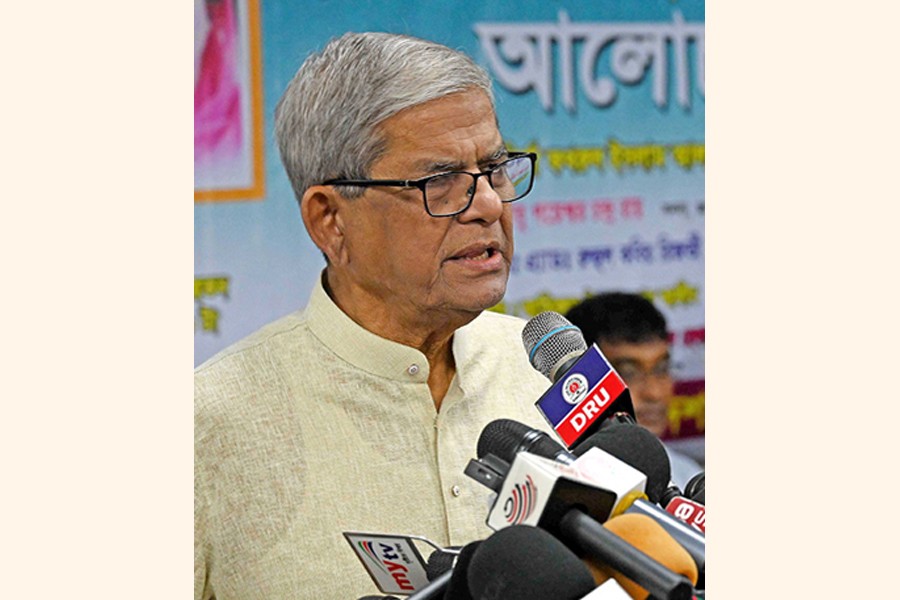
BNP secretary general Mirza Fakhrul Islam Alamgir made the comments at a seminar styled 'Rohingya Crisis and Repatriation' hosted at a city hotel on Sunday.
"The government has no strength, so it can't say anything strongly on the repatriation of Rohingya refugees internationally. So, this problem won't be solved without dethroning this government."
The country has no least democracy. There are laws, judiciary and courts, but that are only for a particular political party, according to Mr Fakhrul.
"The incumbent government puts the country in a panicky state. The Rohingya problem is not only our problem, but it has also posed a threat to the world."
Representatives from 15 countries, including the United States, UNDP, USAID, Japan International Cooperation Agency (JICA), Japan, Korea, Australia, Canada, Germany, Sweden, Iran and the Netherlands, joined the event.
BNP standing committee member Amir Khashru Mahmud Chowdhury presented a keynote at the seminar where standing committee member Dr Abdul Moin Khan, Dhaka University teacher Shahidul Islam and Nagorik Oikya joint secretary Dr Zahidur Rahman were also present.
BNP organising secretary Shama Obaid moderated the programme.
The Rohingya refugees are mostly referred to as forcibly displaced Myanmar nationals living in two registered refugee camps in Bangladesh.
The Rohingya people have experienced ethnic and religious persecution in Myanmar for decades.
Hundreds of thousands have fled to other countries in South-East Asia, including Malaysia, Indonesia and the Philippines.
But a majority of the Rohingya has entered Bangladesh.
According to the UN Refugee Agency (UNHCR), more than 723,000 Rohingya have fled to Bangladesh since 25 August 2017.
On 28 September 2018, at the 73rd UNGA, Prime Minister Sheikh Hasina said there were 1.1 million Rohingya refugees then in Bangladesh.
Overcrowding from the recent population boom at Rohingya refugee camps has placed a strain on the country's infrastructure.
An August 2018 study estimated that more than 24,000 Rohingya were killed by Myanmar military and local Buddhist militia since the "clearance operations" started on 25 August 2017.
talhabinhabib@yahoo.com