
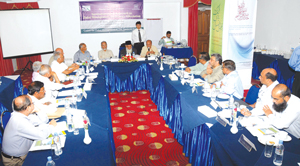
ROUNDTABLE CONFERENCE On Institutionalised Approach to Zakat Management for Poverty Alleviation
Friday, 13 June 2014
Introduction:
Zakat and sadaqah as instruments of charity occupy a central position in the Islamic scheme of poverty alleviation. Zakat is the third among five pillars of Islam and payment of zakat is an obligation on the wealth of every Muslim based on clear-cut criteria. Zakat has been variously described by scholars as a tool of redistribution of income, a tool of public finance, and of course, as a mechanism of development and poverty alleviation. Rules of Shariah are fairly clear and elaborate in defining the nature of who are liable to pay zakat and who can benefit from zakat. The first and foremost category of potential beneficiaries is the poor and the destitute.
Justice Abdur Rouf, Former Chief Election Commissioner:
According to Islam owner of all wealth belongs to Allah. Zakat is a concept of cleanliness. Zakat refines property. It has been said that to every man's asset, a portion of another person's asset has been tagged. Until and unless a person separate this tagged property, his/er wealth will not be refined. This refining can be accomplished by zakat. That is one individual is not paying zakat from his own property. He is paying zakat from another person's property that has been tagged by Allah with his property.
The selection process of zakat receiver is extensive. It cannot be paid to any commoner. There is a question of selection of zakat receiver according to certain criteria to practice it properly. Allah himself has given us the list of zakat recipient according to the order of their right to have it. This is the institutional approach lies inherent in the system of zakat. In the total principles of zakat what we can see is a pure institutionalized approach. That is why those who will collect and manage zakat can be salaried from zakat fund even if they are billionaires. Sometimes we mix up the idea of zakat and sadaka (charity). All zakat is charity but all charity is not zakat. Zakat is compulsory for every Muslim. Giving zakat means you are removing other person's property from your asset and making yours refined.
Now we have to think how we can institutionalise zakat to alleviate poverty in our country. There are many methods for poverty alleviation in the world at present. But most of these are based on interest. At first we need to think why has Allah prohibited interest. Who takes benefit of interest? Of course the wealthier person. And who pays the interest? The poorer person obviously who is already leading a poverty reddened life. So there is no chance of bringing about any sustainable change in this method. After the second world a German economist showed in his research in 1975 as far I can remember that interest does not help savings. Rather it instigates irrational expenditure. It instigates poverty and instability. This is why Allah has prohibited interest and legalised business. Yes there are also some codes of business in Islam about what a Muslim business man can do and what s/he can't do. Since, everybody is not capable of doing everything. This is what is called institutionalisation.
Institutionalisation of zakat means those who work for zakat management should take this responsibility as ibadat (prayer). The cost of zakat management and collection has to be decided through research projects. We can take the cost from zakat fund but how much should we take? My conscience tells me it never should be more than 20% of the total zakat fund. OIC has fixed a rate that is 12.5%. I don't know upon which standards they have fixed this percentage. We should make concrete research to fix the amount that we can draw from the zakat fund to run the managerial expenditure.
Mirza A B Azizul Islam, Former Adviser to the Caretaker Government:
While working to establish zakat we have to face some realities set by our surroundings. Those who are present in this conference more or less give zakat personally. Most people give zakat to their poorer relatives or neighbours or to the familiar ones. But the problem with this it does not bring any sustainable change and zakat becomes merged with charity.
In our culture a person likes to offer financial help to his known individuals. When a person will give zakat to an institution like CZM and they will spend the money for a project in Chittagong or elsewhere, the person will not be able to see how the money is being spent. This kind of institutionalisation may work as a negative influence. CZM needs to address this issue.
It is another reality that we live in a state and it has certain laws and we have to pay income tax. I don't know if there was any taxation system when zakat was introduced. Probably there wasn't any modern taxation system at that time. Now if the amount of my zakat payable is deducted from my income tax due will it be okay according to Islam? It can be a topic of research.
Another point is government has been encouraging corporate social responsibility. Big corporations have been getting tax release up to Tk. 10 crore for their CSR. I had introduced it although I must confess that I didn't introduce it keeping in mind the principles of zakat. However, if any corporation pays its business zakat that is institutionalisation of zakat and in that case is it possible to reduce their income tax due to their zakat payment. There can be two options. One is they can be offered tax exemption up to the certain amount that they have paid as zakat or the tax which would be due on this property can be rebated.
Professor Dr. Shamser Ali, Former VC, South East University:
The fact is the entire system of zakat management evolves from only one thing and it is trust. It is not the trust of government rather it is the trust of people. The Western people say that nothing is free. Islam has this practice in it. Those who will work for the proper distribution of zakat will be salaried from the zakat fund itself so that the process can be made corruption free and the workers can work with contentment for the sake of Allah.
Now a goal of CZM should be human resource development. They should build manpower that is knowledgeable and skilled in this sector. Developing this knowledgeable and skilled manpower is the first phase of work that should be done by CZM.
One of my recommendations will be before initiating large projects with zakat fund we should focus on smaller projects. If we can take some families from below poverty level and develop their economic condition is such extent that they become self sufficient for their livelihood then we shall be able to start our future projects with them. These developed families will be the workforce of our further programs.
Professor Abu Ahmed, University of Dhaka:
I really appreciate this initiative taken by Centre for Zakat Management. But now the challenge is how to make this organization a big and reliable one. The ability of this organisation should be so immense that it can collect and distribute zakat fund worth of billions of taka. But to gain such capability the organisation has to be registered as a legal organisation under the legal provisions of Bangladesh government so that nobody can raise legal questions against it. In the trusty board of the organization trustworthy people have to be placed so that people get inspired by seeing their name and rely on the organisation's transparency. Government officials or policy makers should be involved with the organisation so that no particular government develops enmity with the organisation.
The capacity of the organisation has to be enhanced greatly. The projects of this organisation should be bannered as zakat funded so that people can be informed about the positive impacts of zakat. Many rich people of our country are eager to pay zakat and if they find trustworthy organization like CZM they will pour their money on it. But the task that has to be done by CZM is to gain people's trust as a reliable and capable organisation. Besides working they can inform people about their activities through media and publicity even why not through billboards?
Dr. Manowar Hossain Former Chairman, BIDS:
I believe that zakat has been designed explicitly to remove poverty. I have studied the Quran and noted the verse regarding zakat. It is quite clear that Zakat should be established for poverty eradication. When zakat management will be institutionalised then it will become a giant organization like Islamic Foundation or so. But when institutionalisation of this kind happens, bureaucratic problems and lots of difficulties step in. In that situation decentralisation is the right concept. I had a proposal for the institutionalisation of zakat through setting up a non banking financial institutions. Zakat should be used in this platform to generate profit for the stakeholders by utilizing the capital. And the economic theories will make you believe that interest is much less than profit. Interest based banking systems lend huge amount of capital to the big industries. The industries make huge profit out of this loan but the bank receives only 18% interest. So profit is always greater than interest and profit is allowed in Islam where interest is not. Another point is the whole process should be administered in smaller areas to ensure transparency and to show people how and where the money is being spent. CZM could publish its financial statements of its activities to ensure this transparency.
Salahuddin Kasem Khan: Managing Director, AK. Khan & Co.
Institutionalisation of zakat means how to make it operational. Now the historical background has been described explaining the reason why the concept of zakat and waqf has been removed from this country. It's the colonialism and we have to admit this reality.
But still there are some countries like Turkey who have Waqf system still intact and they have a director general under the ministry to look after the waqf. We need more researches in this sector.
I want to see my zakat how it is spent. So it has to be decentralised. Not only in the national level we need to go to the district, divisional, Upazila and right to the word level. Because, the zakat-payers want to see where and how my money is being spent.
We have actually forgotten these concepts of zakat, waqf and Islamic charity. We have to revive these as institutions and present these to our people and policy makers. In Malaysia if you can prove that you have been paying zakat through a banking system then you will get a credit like CSR system. If we see the tax burden of average Bangladesh it's quite a high amount of taxation we are paying. So if we can get tax concession for CSR then why not zakat? Because that money if it goes to the government coffer we don't know how it is going to be spent. But if it is supervised by an Islamic institution they will be very careful about its expenditure. So transparency, credibility and reliability of the institution and the people behind it are very important.
Sadek Khan, Senior Journalist and Columnist:
The purpose of zakat is actually social security. It's not poverty alleviation; poverty alleviation is a modern concept. If we change the purpose of any specific action it creates some distortion in the total activities. It has been stated in the paper that poverty is a dangerous factor that leads human being to infidelity and malpractices. I don't think it's an Islamic concept. Poverty has not been shown in such negative way by Islam. Rather it has been said that everybody has the right to earn property. The concept of equal distribution of property exists in Islam. What we can see in this world the larger crimes are being committed by the richer ones not by the poorer. So should we say that poverty is a dangerous factor?
It has been said that zakat is part of the Islamic economic system not only a social welfare. If it is a part of an economic system then we should treat it as it is. In the research conducted, the project has been shown partially as charity based system. We should think originally and we should keep in mind the purpose of zakat. Keeping in mind the purpose we should innovate our own ways of implementation. For poverty alleviation we should not rely solely on zakat. We can encourage other forms of charities which have provisions in Islam. For institutionalisation I think we need more comprehensive approach to zakat management.
Niaz Rahim, Chairman Centre for Zakat Management:
I would like to thank everyone for participating in this program. CZM is your organisation and I think it is part of your religious duty to support it because of the activities it has been doing. We hope that we will receive many wise suggestions from you and by the will of Allah you will see those suggestions taken into consideration and implemented.
Mr. Shahiduzzaman Khan, Executive Editor, The Financial Express:
We are proud to be involved with the Centre for Zakat Management in organising this round table conference. Your wise deliberations and resolutions will be published in The Financial Express as a supplement. I hope that this round table conference will contribute a lot to adopt an institutionalised approach to zakat management for poverty alleviation.
Dr. Muhammad Mahbubur Rahman, Former Secretary to the GOB:
While discussing on zakat we should encompass the broader concept of the Islamic vision of overall development. Since we have to pay zakat by the order of Allah regardless of whatever the government is; we need to find out the government representatives who are sympathetic to this practice. Without the legal instrument we shall not be able to work. So we must make friends in the government bodies. We need to share our experience with the countries like Malaysia, Sudan, Indonesia, etc.
From the academic point of view there are several stages of development. The first stage is an inactive organisation in the next stage the organisation has to be activated. CZM is now an active organisation. Now through research based activities CZM has to be interactive and proactive. CZM is still working on small scales but when it will become a big organisation problem will start to arise. The main reason different projects fail in Bangladesh is that we don't have capacity. CZM has to face this challenge effectively by developing institutional capacity and by developing human capacity. Those who are involved with CZM must update their knowledge level, skill level and attitude level regularly to improve their capacity.
Dr. Mohammad Ayub Miah, Keynote Paper Presenter, CEO, Centre for Zakat Management:
The Islamic approach to poverty alleviation is more inclusive than the conventional one. It provides the basic conditions of sustainable and successful microfinance, blending wealth creation with empathy for the poorest of the poor. However, Islamic strategies, like zakat or awqaf has not been incorporated in any policy document of the government. Even no NGO, or development thinkers or academics put attention to consider accommodating zakat or awqaf in Bangladesh's poverty alleviation strategy. As a result zakat has been entirely left out as a voluntary private charity work.
The responsibility of institutional Zakat management lies with the government. Even a Muslim Government may assign it to corporate organization. In absence of state initiative private sector organisations should take initiative for mobilization and distribution of Zakat management in a collective manner. In that case the following criterion should be addressed: (1) Establish the organization with legal identity; (2) Organisational structure with skilled manpower; (3) System of accountability & transparency in decision making & fund management; (4) Shariah supervision of all functional activities; (5) Targeting the real right-holders; (6) Integration of awqaf & other charities for its program for poverty alleviation; (7) Networking with social organizations & local community; (8) Monitoring & evaluation methodology; (9) Scope for research & study on Zakat; (10) Macro & micro-level operational strategy for collection & disbursement; (11) Linkage & coordination with the government agencies; and (12) Customize the programs with national policy framework.
In Bangladesh, according to the assessment made by some scholars, Zakat funds could have contributed up to 40% of the Annual Development Plan (ADP) equivalent to BDT 25,000 crore. If Zakat funds are properly managed, these funds could be better utilized for social safety net programs of the government.
To be a credible entrepreneur in promotion of efficient Zakat system in society and demonstration of the process of sustainable poverty alleviation program through appropriate utilization of the Zakat fund, CZM has been applying pragmatic strategies. The strategies includes a number of integrated and mutually reinforcing development activities like group formation, collective responsibility, accumulation of savings, access to business capital, healthcare, education, water & sanitation, training and moral education.
Mr. A K M Nurul Fazal Bulbul, Chairman, EXIM Bank Foundation:
Among all the banks in Bangladesh only seven Islamic banks have been paying their zakat. But NBR is not deducting our zakat from our tax. But each year we have been paying zakat worth of 200 or 300 crore. After the Rana Plaza collapse we have given 87 crore TK for the victims from the association of Banks. Among these Banks the seven Islamic Banks have paid 19 crore Tk from their zakat fund. Only Bank Asia has paid from their charity fund. Last year from EXIM Bank we have paid 22 crore Tk as our zakat. Zakat of IBBL is much more than ours as it is 5 times larger than ours. So we can see that a property worth of 100 or 200 crore can be obtained as zakat from a particular sector. Since it has no legal provision like income tax, what a person or organisation will do this huge asset completely depends on his personal ideology.
Now you have been talking about the institutionalisation of zakat. Before doing so you must gain trust of people like Rahimafroze which is one of the largest and credible conglomerates of Bangladesh who never evade tax and zakat. In the last conference I had raised a proposal that let's launch a zakat fund together with all the Islamic banks. It can be called waqf fund. The history of Bangladesh is actually the history of Waqf. Dhaka University has been established on the waqf property. Our education and culture has been established on the waqf properties of Haji Mohsin and Shah Waliullah. But then the British rulers have seized these Waqf estates. Waqf is the basis of Indian sub continent. Even Bishwabharati of Rabindranath Tagore was established by the donations given by the Nizam of Hyderabad from his waqf estates. But these concepts of waqf, zakat, sadaka are being removed from our society. We should conduct research to find the reasons behind these realities.
Ershad Mazumdar, Journalist and Columnist:
I cordially support all the initiatives of CZM from the bottom of my heart. If more help is required I will do it eagerly. But the value of zakat has to be established inside the family. Regarding zakat nobody has any objection. But such Muslims are rare who implement zakat properly in their personal life. Our state system is so peculiar that we have to pay all sorts of taxes and we will pay zakat also. However, the reality is most of these people don't pay the 2.5% zakat and they employ highly paid lawyer to evade government tax. So my request is establish zakat in our society and make our fellow Muslims as Zakati Muslims.
Dr. M Mahbubur Rahman, North South University:
Many people think that just giving the zakat money to the poor is all about establishing zakat. But it is not at all zakat. Some people think it is at least better than giving nothing at all. But again it is not actually the concept of zakat. So through our researches we need to explore why this sort of mentality get hold in our society.
Now the institutionalised approach of zakat made by CZM is very much appreciable. But the heads and hands behind this effort has to be presented before the people. We see there are several religion-based political parties who also collect zakat. We can see positive and negative opinion among people regarding this zakat collection by these parties. So we must reveal all the processes regarding zakat management to our people and the government to ensure transparency and we should conduct study on the existing practices of zakat collection and management. I am pretty sure that paying tax to the government cannot be equivalent to zakat because there is no certainty that government will spend your money to those eight categories of recipients of zakat. So paying tax to the government cannot be equivalent to zakat.
For institutionalised approach CZM must prove itself as a trustworthy organisation. For example in the keynote paper we didn't get much information about the initiation of CZM. It can publish its organizational detail in the website. It can also publish its detail financial statement in the website for the public. Otherwise you cannot object people for not paying zakat to any particular organisation. My request is we must organize publicity campaign not to promote CZM but to inspire people to give zakat. This sort of campaign whether through billboard or by any means is now essential for popularizing zakat based economy in our society.
Professor Md. Muzahidul Islam, University of Dhaka:
In 1998 an international conference on zakat was organized in Dhaka where I had presented several proposals regarding the establishment of zakat. One of my proposals was to establish a relationship between zakat and the huge government fund allocated each year for social safety net programs. If government manages this fund from zakat source and exempt these sources from tax then ultimately the income of government will be increased, the people will not evade zakat but they will evade tax. So ultimately government's income will be increased.
Economic system is all about supply and demand. Zakat can influence supply and demand. In a capitalist society when price of commodity reaches at its equilibrium stage at that time poor people have to buy inferior goods. In capitalist society the person who has more collateral support can take more loans. But zakat refers to the reciprocal process. The person who has 90% ability will receive 10% zakat and who has 10% ability will receive 90% zakat. So from this zakat we can help the marginal producers to sell their goods along with the big producers. Thus zakat can increase the demand and supply which will ultimately strengthen the economy.
Dr. Monzur Elahi, National University:
The keynote paper which has been presented here is based on experience and has been submitted here as the first institutionalised approach to zakat in Bangladesh. The paper has noting contradictory to Quran and hadith. But something more can be added to this paper. Along with the practical experience some related verses from Quran and Hadith can be added to this paper to make it more trustworthy to the readers.
Some people identify religion as one's private duty and thus regard Islam as a private belief. But in fact Islam entirely is an institutionalised approach. From the very beginning salat which has to be conducted in jamaat inside a mosque has become an institution of Islam. Mosque is a fully fledged institution despite the fact that we have released mosque from many of its tasks. Hajj is also a greater and international institution. Similarly the approach to establish has to be institutionalized. The main objective of Islam is to ensure benefit of whole mankind. So we need to uphold the spirit of welfare through our activities.
Research on zakat has been given priority. At present we have lots of economic activities. How can we relate zakat with these activities? How should we pay zakat? There is a lot of confusion among business society. How a businessman can pay zakat if he is in debt? How a real estate businessman can pay zakat? There is a lot of question that requires valid answer. If we can't answer these questions clearly we shall not be able to receive zakat from these sectors.
In this regard we should take collective approach to solve these answers to gain more credibility. Another step that has been neglected totally in Bangladesh is that we can translate the zakat relation resolutions of OIC into Bangla. Last year I visited the Kwait Zakat House. They have arranged many international conferences on zakat. We can request them to organise an international conference on zakat in Dhaka. They have many resolutions and articles on zakat. We can also translate them into Bengali which will save us from conducting many lengthy researches. CZM is actually an organisation of zakat collection and disbursement. We can also think of establish another organization for zakat related research or to establish a separate wing under CZM for this purpose.
Shabel Feroz, Country Director, Islamic Relief Worldwide:
Regarding the figure of the amount of zakat that can be collected from Bangladesh which is about Tk 30,000 crore which is according to my calculation is 3 billion US Dollar a year. This is exactly the same figure that has been agreed upon recently by one hundred NGOs of Bangladesh.
Currently there are 60 million families in Bangladesh who are living in extreme poverty. With this 3 billion US Dollar more than 500 dollar can be invested to this 60 million families each and their extreme poverty will be eradicated within a year. CZM has already set up examples by launching livelihood projects. In this project Islamic relief has provided asset support to two hundred thousand households to get people out of extreme poverty. This activity is similar to what is being done by CZM.
I think CZM should not stay focused on pilot projects like those in Chittagong. Enough capacity and experienced manpower is available in Bangladesh to run large development projects as many of these kinds have been run by DFID, USAID etc. Bangladesh government has been also working to eradicate extreme poverty. If CZM can launch bigger projects and assure the government that their work will help to eradicate extreme poverty I hope government will come forward to work with the CZM. Once a role model can be presented in the society establishing and institutionalising zakat will face no more difficulty.