
SAARC: from nostalgia to a new narrative for South Asia
Muntasir Tahmeed Chowdhury | Wednesday, 1 April 2026
For many of us who grew up in the 90s, SAARC was not just an acronym--it was a feeling. It was the pride of seeing Bangladesh take the lead in bringing South Asia together. It was school atlases marked with neighbouring flags that somehow felt familiar, not foreign. It was the idea-simple but powerful--that our region, with all its diversity, could still sit at one table. In many ways, SAARC felt like our version of the United Nations; closer, more relatable, and somehow ours.
But somewhere along the way, that feeling faded. The flags remained, the institution survived on paper, but the sense of purpose quietly eroded. Summits stalled, cooperation thinned, and SAARC gradually slipped from being a symbol of regional possibility to a reminder of unrealised potential. What was once a source of collective pride became, for many, a distant memory--more nostalgia than reality.
Today, as Bangladesh cautiously pushes to revive SAARC, the conversation is no longer about restoring the past, it is about testing whether South Asia can finally act in line with its own potential. From an analytical standpoint, the paradox is striking. South Asia has the geography, the demographic weight, and the economic momentum to emerge as a formidable regional bloc. With a combined nominal GDP exceeding $5.6 trillion in 2025 (IMFpredictions), the region is among the fastest-growing globally. Yet it lacks, almost entirely, the institutional architecture to function as one.
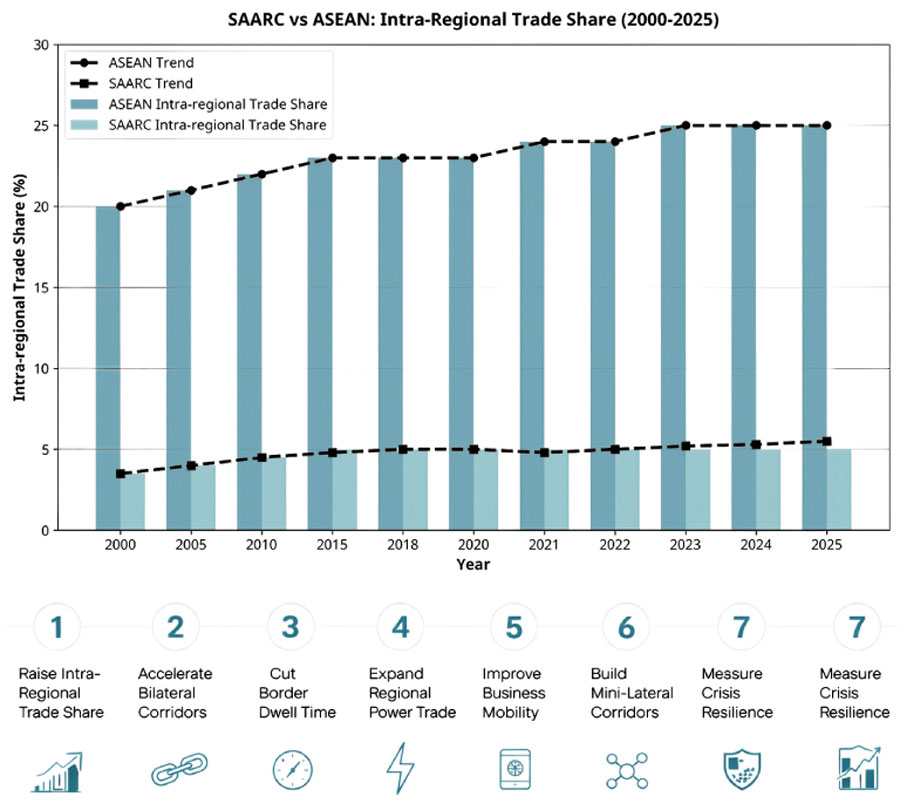
If this potential were translating into real regional integration, it would be most visible in trade flows within the region-- one of the clearest indicators of economic interconnectedness. However, the evidence points in the opposite direction. As illustrated in the figure below, benchmarking SAARC against ASEAN highlights a stark divergence in regional integration outcomes over time. ASEAN has steadily deepened its intra-regional trade from around 20 per cent in 2000 to nearly 25 per cent today, reflecting consistent institutional and policy alignment. In contrast, SAARC has remained largely flat, moving only marginally, reflecting systemic underperformance. The disconnect becomes even sharper when we look at the absolute scale: intra-regional trade in South Asia hovers at around just 5 per cent of total trade--dramatically lower than ASEAN's 25 per cent. This is strikingly meagre for a region with such geographic proximity and shared cultural and economic linkages.
This stagnation carries a growing cost in an increasingly volatile global environment. As external shocks, from energy disruptions to geopolitical conflicts, intensify, the absence of functional regional mechanisms leaves South Asia more exposed than it needs to be.
The divergence between South Asia's potential and its outcomes is not incidental. It is rooted in how the region's cooperation framework has evolved. When SAARC was established in 1985, its founding principles -- sovereign equality and non-interference -- were essential to bring all member states to the table. In a region marked by historical sensitivities, this approach enabled cooperation to begin. However, over time, these same principles also limited the organisation's ability to evolve. By keeping bilateral tensions outside its formal scope, SAARC had no internal mechanism to manage the very frictions that most directly affect regional cooperation.
As a result, political developments outside the institution repeatedly shaped outcomes within it. The most visible example remains the India-Pakistan dynamic, which has stalled progress at critical junctures. The pause in summit-level engagement since 2014 is not just a diplomatic gap, it reflects how quickly regional cooperation can be disrupted when there is no cushioning within the system itself.
At the same time, the economic framework struggled to translate intent into outcomes. Agreement such as SAFTA was designed to reduce barriers and expand trade, but its impact remained limited. A significant portion of trade continues to sit outside liberalisation commitments due to "sensitive lists," while additional charges such as para-tariffs further dilute the spirit of openness.
Yet the deeper constraint lies beyond formal policy. In practice, businesses across South Asia continue to face slow border processes, inconsistent standards, fragmented logistics, and limited regulatory transparency. These frictions increase the cost and uncertainty of trading within the region, often making it easier to trade with distant markets than with neighbouring countries. As the World Bank has consistently highlighted, the challenge is not just about tariffs, but about the absence of functional systems that enable trade to move efficiently across borders (World Bank, South Asia Regional Integration reports).
This is where the ASEAN comparison becomes particularly relevant. ASEAN's progress was not driven by perfect political alignment, but by a sustained focus on practical cooperation-- harmonising procedures, enabling mutual recognition, and improving trade facilitation over time. These steps gradually built trust and made regional trade a default, rather than an exception.
South Asia, by contrast, has yet to build that operational backbone. The result is what the data already shows: a region with strong fundamentals, but without the institutional depth required to convert proximity into economic partnership.
If the foregoing explains why SAARC underperformed, the question now is what meaningful revival would actually look like. Restoring summits may signal intent, but it does not by itself constitute progress. The real test is whether diplomatic momentum can be translated into measurable economic outcomes-- whether systems, procedures, and commercial cooperation can begin to deliver what political trust alone has not achieved over the past four decades. To move beyond symbolism, SAARC's progress must be assessed against a set of clear, outcome-oriented benchmarks:
RAISE INTRA-REGIONAL TRADE SHARE: The first benchmark is trade itself. Intra-regional trade should rise from about 5 per cent toward 10 per cent within five years and 15 per cent over a longer term. Reaching that level will require abandoning the fiction that all progress depends on full political consensus. SAARC needs a "variable geometry" model, allowing willing members to move first on trade facilitation, energy connectivity, payment systems, logistics, and related areas of practical cooperation. This is the sort of flexibility that has helped sustain ASEAN despite its own internal political frictions.
ACCELERATE VIABLE BILATERAL AND SUBREGIONAL CORRIDORS: The second benchmark is whether commercially viable corridors grow faster than global trade. India-Bangladesh must remain central, but Bangladesh-Sri Lanka and other promising links should also be tracked closely. The objective is not to wait for an all-member breakthrough, but to deepen corridors that already have commercial logic and can demonstrate visible gains. Stronger border infrastructure, more reliable transit, standards harmonisation, customs digitisation, and mutual recognition of certifications should form the practical agenda. These are the tools most likely to produce near-term results and create confidence in wider integration.
CUT BORDER DWELL TIME AND CUSTOMS DELAYS: A third benchmark is operational efficiency. Border dwell times and customs clearance delays must be systematically measured and reduced. Trucks waiting at borders, inconsistent documentation requirements, poor coordination between agencies, and unreliable clearance systems impose real costs on trade. A revived SAARC should therefore focus on measurable reductions in delays and should create protocols that ring-fence transit, trade flows, and humanitarian logistics from bilateral political crises. Without such safeguards, every diplomatic shock will continue to interrupt economic cooperation.
EXPAND REGIONAL POWER TRADE IN REAL TERMS: Regional electricity trade, LNG coordination, and renewables integration are no longer optional add-ons; they are strategic necessities in an era of oil shocks, supply disruptions, and fragile global shipping routes. This is especially urgent for Bangladesh as an import-dependent economy exposed to external volatility.
IMPROVE BUSINESS MOBILITY AND PRIVATE-SECTOR CONNECTIVITY: The fifth benchmark concerns mobility and ease of doing business across borders. Multi-entry business visas issued, truck turnaround times at land borders, and uptake of digital customs systems should all be tracked as core indicators. At the institutional level, SAARC needs a business council with real agenda-setting authority. Without a serious private-sector mechanism, cooperation will remain government-heavy and commercially thin.
BUILD MINI-LATERAL CORRIDORS WITHIN THE SAARC SPACE: Bangladesh-India-Nepal-Bhutan power and transport links, Bangladesh-Sri Lanka services connectivity, and a Bangladesh-Pakistan trade normalisation track can all create practical gains without waiting for a grand regional bargain. These coalitions are likely to be the real engines of integration in the near term.
MEASURE CRISIS RESILIENCE AND INSTITUTIONAL ACCOUNTABILITY: SAARC should track the proportion of essential imports sourced regionally, the extent of intra-regional FDI and co-investment, and the availability of alternative transport and payment corridors. To make such monitoring meaningful, the SAARC Secretariat must be modernised and required to publish annual public scorecards. A bloc without data discipline becomes a platform for speeches; a bloc with transparent metrics becomes at least partially accountable.
The economic case for SAARC revival has always been strong. What has been weak is the political willingness to treat economics ahead of politics. Bangladesh's initiative is therefore a necessary starting point, but not a sufficient condition for success. Whether SAARC can escape the gravity of its own dysfunction will ultimately depend on whether the region's largest economy, and the bloc as a whole, are prepared to recognise the inadequacies within the system and mend it for the mutual benefit of all members.
Muntasir Tahmeed Chowdhury is Managing Director, Inspira Advisory & Consulting Limited. muntasir.tahmeed@inspira-bd.com