
SAARC Summit concludes: electricity grid deal signed
Friday, 28 November 2014
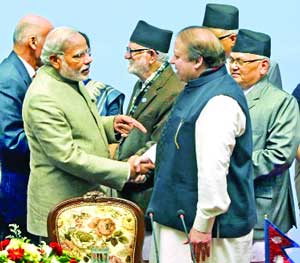
KATHMANDU, Nov 27 (Agencies): With all the eight nations signing a last-minute deal to create a regional electricity grid and Indian Prime Minister Narendra Modi and his Pakistan counterpart Nawaz Sharif shaking hands after the first-day tension, the 18th Saarc Summit concluded here Thursday.
The Summit came to an end in the afternoon with the adoption of a 36-point Kathmandu Declaration 2014. Nepalese Prime Minister and Chairperson of the 18th Saarc Summit Sushil Koirala declared the Summit's conclusion, terming it a success.
Koirala also declared that the 19th SAARC summit would be held in Islamabad in 2016.
After the signing ceremony, Koirala said the transport ministers of the SAARC countries would sit within three months to finalize the SAARC Agreement on Motor Vehicle and the SAARC Agreement on Railway Service.
In his concluding speech, Koirala expressed profound appreciation and gratitude to all the heads of state and government for their cooperation in holding the Summit as well as their presence.
Koirala said the Saarc nations should decide what types of Saarc they actually want and what kind of reform it requires?
The foreign ministers of the eight countries signed the electricity deal at the closing session of the Summit.
Afghan President Ashraf Ghani, Bangladesh Prime Minister Sheikh Hasina, Bhutanese PM Tshering Tobgay, Indian PM Narendra Modi, Maldivian President Abdulla Yameen Abdul Gayoom, Pakistani PM Nawaz Sharif and Nepalese Prime Minister Sushil Koirala witnessed the signing at the City Hall.
The SAARC Framework Agreement on Energy Cooperation for a common grid to share power was signed in presence of leaders of the eight member states.
Earlier, Nepal's Foreign minister Mahendra Bahadur Pandey told Reuters that the deal will allow creating a seamless electricity grid.
The agreement is expected to lead to greater cooperation in the power sector, besides improving power availability in the region, Sumon Mahbub, travelling with Prime Minister Sheikh Hasina, says from the Nepalese capital.
The summit at the opening session had sought the signing of two pacts on road and rail connectivity besides the regional electricity agreement.
Pakistan was blocking the deals citing the lack of internal processes being in place, according to analysts.
But on Thursday, it agreed on the pact after a retreat of South Asian leaders at Dhulikhel, 20 kilometres off Kathmandu, they said.
Sources at SAARC Secretariat confirmed that the deal, which had hit snags earlier, was the outcome of an unscheduled meeting between Indian Prime Minister Narendra Modi and Pakistani Prime Minister Nawaz Sharif during the retreat.
Another report adds, at the SAARC retreat hosted by Nepalese Prime minister Shushil Koirala in Dhulikhel for all heads of state and government of Saarc nations, Indian Prime Minister Narendra Modi and his Pakistan counterpart Nawaz Sharif finally exchanged pleasantries.
Koirala apparently played the role of a mediator between Indian and Pakistani Prime Ministers, reports The Himalayan quoting a source.
It was being widely reported that Koirala eased the much strong tension between Modi and Sharif and his attempts resulted in Modi and Sharif shaking hands and exchanging pleasantries.
However, it is said that the exchange took place more as a formality as both Modi and Sharif did not want to dismiss the effort Koirala was making.
At the Summit inauguration on Wednesday, the two leaders had apparently refrained from meeting each other. While Sharif was returning from the podium after his address, Modi was seen looking on a magazine. Modi, however, had invited Sharif along with all leaders from the Saarc nations at his inauguration on May 26 this year. It was reported that Modi had gifted a shawl to Sharif's mother then.
The Pakistani Prime Minister, in return, had gifted Modi's mother a sari in the week that followed.