
Saga of hapless migrant workers
Syed Fattahul Alim | Monday, 26 January 2026
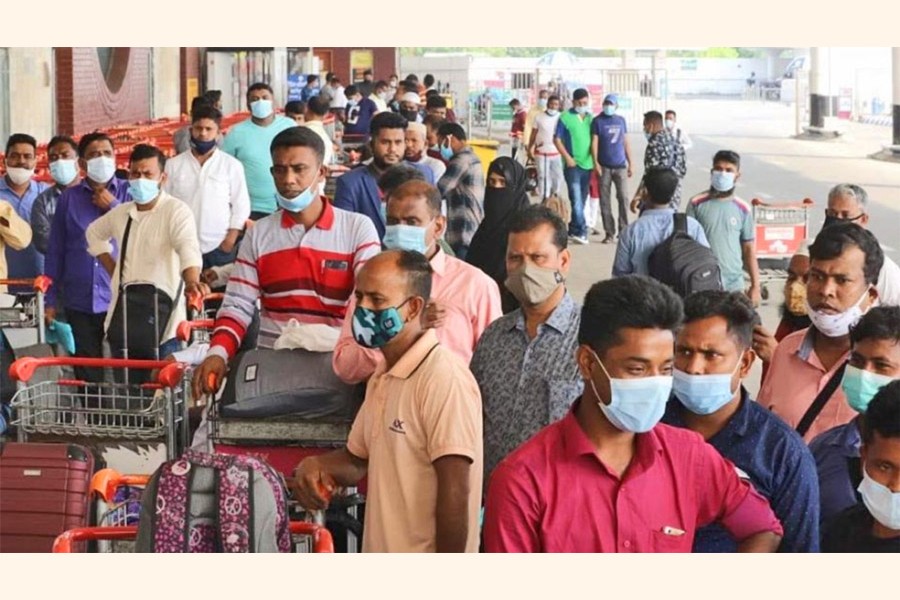
Past and present governments of Bangladesh have traditionally been very effusive in praising the hard work the migrant workers do abroad and send home their precious dollars. But they have not been equally concerned about what these foreign-bound job-seekers go through once they are in the hands of the recruiting agents, both genuine and fake, and then what happens to them either at home or when they reach their host country. It is not that the government and the public are not aware about reports on how migrant workers are pushed around from the very beginning of the recruiting procedures till they reach their foreign destinations and meet their employer. In fact, each step of their journey is slippery and except the lucky ones, the migrant workers, in overwhelming numbers, are at best subjected to exploitation and at worst to outright fraudulence. According to a recent report, two Bangladeshi migrant workers, on behalf of 93 of their compatriots, filed a case with the Malaysian police against their employer, a gloves manufacturing company named Medicerem. The allegations were about serious violation of labour laws and breach of contract. Their employer, the allegation went, illegally confiscated their passports and failed to renew work permits. Mediceram terminated 170 workers as the latter held protest demonstrations against these instances of injustice. The employer also cancelled visas of 16 workers and influenced the Malaysian authorities to deport them to Bangladesh.
It was further reported that since the beginning of their recruitment in that factory, they were deprived of their wages month after month. Their work permits oftentimes faced inordinate delays. But each of these workers had to pay from Tk 450,000 to 600,000 to get the job. Instances of such maltreatment of Bangladeshi migrant workers in host countries abound. There are other cases where migrants workers were victims of digital scams. They found job opportunities from ads on their smartphones. The job offers appeared too good to be true, but they still believed and fell for those. Seeking jobs overseas through fake online recruitment schemes, falling into betting traps, becoming victims of identity theft through mobile apps, messaging platforms, social media and so on became widespread between 2022 and 2024. More than 48,000 Bangladeshi migrant workers entered Malaysia during this period. Many of them were victims of online recruitment scam. As noted in similar cases in the foregoing, they paid from Tk450,000 to Tk600,000 for jobs that were nonexistent. In fact, a syndicate was involved in trafficking those workers to Malaysia where it (the syndicate) engaged the workers into forced labour. In this way, the syndicate made billions of dollars through ripping off the hapless overseas job-seekers. Many rural youths with poor level of digital literacy, especially less familiar with mobile financial services and digital banking, fall prey to cybercriminals. Digital fraudulence apart, the very recruiting system itself is a veritable minefield of informal channels that include personal connections and brokers or dalals.
Even jobs are offered on the basis of verbal assurances. The job-seekers are so desperate to get a job that they agree to any conditions. So, a lack of experience to distinguish between a fake and a genuine job source, digital or otherwise, land them in trouble . Moreover, the very eagerness to get an overseas job by hook or by crook make the youths, mostly from rural backgrounds, fall into the hands of fraudsters. Even the US-based news agency Bloomberg recently (on January 23) published a damning investigative report on how the corruption-ridden, syndicate-controlled recruitment channels are trapping Malaysia-bound Bangladeshi migrant workers into cycles of exploitation through forced and debt bondage. The Bloomberg report narrated the fate of a Bangladeshi worker named Shofiqul who fell prey to such a gang of scamsters, lost US$4,400 in the hope of getting a construction job in Malaysia and landed in a 'run-down building outside Kuala Lumpur'. His contact person dropped him at that dormitory and vanished. The promised job was not forthcoming. With no means to survive in a foreign land, Shofiqul ultimately died in that dormitory after suffering from convulsions. He was one of more than 80,000 Bangladeshi workers who had been duped over the last one decade into accepting job offers in Malaysia.
But in many cases, the job promises were fake. The Bloomberg report, as could be learnt, was based on the interviews of '100 people including current and former government officials, labor analysts, recruitment agents and Bangladeshi migrants'. The report dwells in detail on the recruitment process that is 'shaped by entrenched corruption and designed to extract as much money as possible from desperate workers often leading to debt bondage, forced labor and human trafficking.' Worse yet, the report added that people at the highest levels of government were aware of these incidents, but did not address them because 'the recruitment fees line pockets of everyone involved. Bangladeshi migrant workers, who make up 20 per cent of Malaysia's foreign labourers, are the easiest victim of the fraudulent recruitment racket. As found out through Bloomberg report, people at high places in both Malaysia and Bangladesh know about this. But nothing has been done so far to alleviate the sufferings of victim migrant workers like Shofiqul. Even UN human rights experts in Geneva (according to a report published on 21 November, 2025) did express concern about what they said, 'fraudulent recruitment and the exploitation of migrants remain widespread and systemic in Malaysia'. The UN human rights experts further noted that a small number of recruiting agencies operate as a closed syndicate sustained by corruption, lack of transparency, and systemic corruption. At the same time, the UNHCR experts reminded the governments of both Bangladesh and Malaysia that they (the governments) had an obligation to ensure that labour migration was governed in a rights-based, transparent, and accountable manner.
Malaysia is but one of the destinations of Bangladeshi migrant workers. The largest number of them, however, work in the Middle East. Few are interested to know about the untold stories of sacrifice the foreign-bound workers make for their families and the state. The government should not limit itself to only counting the dollars the migrant workers remit. Their stories of misfortune need also to be heard and a mechanism devised for redress.
sfalim.ds@gmail.com