
Sagarlata, sand dunes disappearing from Cox's Bazar beaches
OUR CORRESPONDENT | Sunday, 12 June 2022
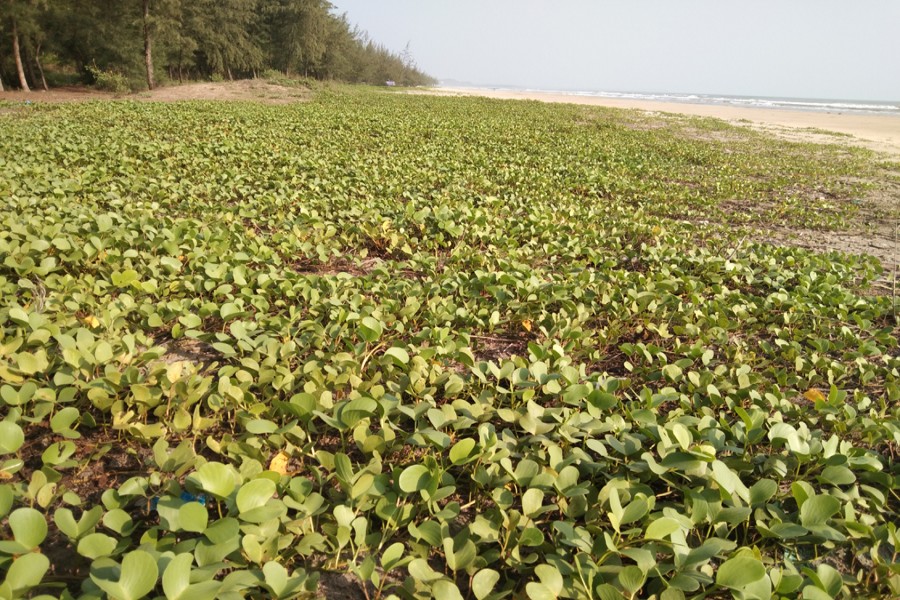
COX'S BAZAR, June 11: Railroad vine, locally known as Sagarlata, grows naturally on sand dunes of Cox's Bazar sea beaches.
A key component of the beach ecology, Sagarlata, is disappearing fast from the beaches of Cox's Bazar due to uncontrolled movement of tourists, unplanned construction and pollution along the beach.
The bright green foliage and their lavender flowers spreading out on the sand used to be an impressive sight for tourists. The vine not only keeps the beach ecologically healthy but also it is important to control dune erosion.
Even 10 years ago, the vine with blooming flowers used to be found on the beaches from Cox's Bazar city to Teknaf, recalled a group of local people.
"The beaches then had a different kind of beautiful environment. And we now miss that beauty," said one of them.
This plant is also known as the 'sand maker' because it builds large sand dunes on the beach, and prevents soil erosion and dry flying sand.
The sand dunes, considered as natural shields against tidal waves, can rarely be found nowadays, which were, however, a common sight on Cox's Bazar sea beaches some decades ago. Rezaul Karim Mohammad Tareq, an associate professor of Cox's Bazar Government College's Department of Botany, said, "Large sand dunes were a common sight on the beach even 20 years ago. And around these dunes, various herbs and plants, including Sagarlata, could easily be spotted. But due to unplanned tourism and pollution, coastal dunes can no longer be seen on the beach."
According to a research, Sagaralata has been proven to be good for environmental restoration and prevention of soil erosion in the beach area. It can grow in minimally nutritious sandy soils. Its water requirement is also less. Besides, it can tolerate high saline soil. Its roots can go more than three feet deep in the sand. And it is a fast growing plant. Without any outside interference, the vine can continue to grow all around and trap the soil by spreading nets in the sand dunes.
Environmentalists believe that the survival of other marine animals, such as crabs and birds, is highly linked to the existence of Sagarlata. It creates an ideal environment for other fauna, including beneficial bacteria in the subsoil.
Environmental scientist Ansarul Karim said, "Once there were huge sand dunes around 20 to 30 feet high along the beach from Cox's Bazar to Teknaf. And the main plant of these dunes was Sagarlata."
"Since we had to lose most of our sand dunes and Sagarlata, more than 500 metres of land on the beach have so far been lost to the sea in past 30 years," he added.
Bangladesh Environment Movement (BAPA) Cox's Bazar District Branch President Fazlul Quader Chowdhury said, "We should restore the beauty of Cox's Bazar beaches."
"For the sake of tourism, it is necessary to conserve the biodiversity of Cox's Bazar by protecting Sagarlata and sand dunes," he added.
Mohammad Ashraful Haque, Senior Scientific Officer, Bangladesh Marine Fisheries Research Institute, said, "We have already sent a proposal to the higher authorities so that sand dunes and Sagarlata are conserved on the beach" tahjibulanam18@gmail.com