
Save Dhaka—prevent further deterioration
Jafar Ahmed Chowdhury | Friday, 6 June 2014
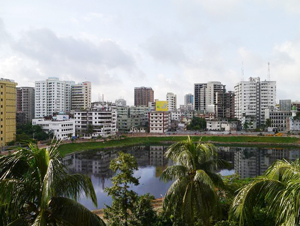
In spite of many achievements in the socio-economic arena of Bangladesh, the country lags behind in providing necessary civic facilities to its citizens. The city of Dhaka is a glaring example of the extreme inadequacies of such facilities.
Buildings are being constructed in an unplanned manner. Many construction works are taking place beyond the plans approved by Rajuk (Rajdhani Unnayan Kartipakkha). The streets are narrow and hazardous for passage of fire service vehicles and ambulances. There is chronic shortage of water supply. More than 40 per cent of city dwellers do not have water supply provided by WASA. The sewerage system is worse. The drainage system is almost non-functional. With a mild rainfall, the roads and streets become inundated. Traffic jam is the regular feature of the city-- taxing time, energy and purse of the commuters. City's garbage management is in shambles, city streets are found with heaps of waste and garbage in the open which emit foul odour and damage to public health. The surrounding rivers -- the Buriganga, the Turag and the Balu -- are biologically dead, as this writer wrote earlier. The city is full of several hundred garment factories, besides other small and medium scale factories including hazardous chemical factories.
Amid such a situation, Dhaka is facing huge migration of people from rural areas and other towns. They are coming to the capital city to explore income opportunities and to find medical and educational facilities. The city of Dhaka is now burdened with a population of nearly 20 million.
There are many organisations like the city corporation, WASA, Rajuk and others to look after the well being of city dwellers. Dhaka City Corporation is now split into two wings, but the purpose for which the splitting took place has not at all materialised. The city has about 2,500 km roads. Many of these roads are found worn out beyond small repair. The two city corporations do not have enough funds for development and infrastructure works. Raising revenue on the one hard and development assistance from the government on the other are required for carrying necessary development works. Apart from development works, garbage and waste management needs to be seriously looked into by the two city corporations. Water logging is another issue that disturbs city dwellers during the monsoon. WASA should correctly assess the demand for water and press for projects that will meet the demand. Sewerage system should be made efficient.
The Rajuk has a very important role under its mandate in planning, approving and monitoring building works. It should be courageous in implementing the policies and rules under building code. It is not acceptable that it will sit up only in times of accidents. When it gives permission to the housing society or construction of building, it must ensure that building code is followed and environment issue has been duly addressed. Theoretically, it performs these functions. In practice, however, deviations are found. For example, water bodies (lakes, jheel, beels) are essential for protection of environment. But people see innumerable housing estates in and around Dhaka city causing environmental hazards. The Directorate of Environment (DOE) has many responsibilities under law to keep the city environmentally sound. The Ministry of Industries and its subordinate Directorate of Industries have the responsibility to see that no factories are run in residential and commercial areas. Thus, many organisations have their mandated roles to keep Dhaka liveable.
All these have challenged Dhaka's liveability. According to the global liveability survey of the Economist Intelligence Unit in 2013, Dhaka is the second least liveable city in the world. The government knows it. The policy makers are aware of this condition. The green workers are found voicing to make Dhaka city liveable. But nothing tangible could be found to save Dhaka. If one examines the plan documents of the country, one will not find integrated projects or mutually supportive projects to make Dhaka liveable. Politicians who run the country should be visionary. The policy makers and the top brasses of bureaucracy should be imaginative and innovative capable of giving pro-people policies and programmes to political bosses. The civil society should be alert and supportive to government for pro-people and welfare oriented programmes and actions.
It is true that Rome was not built in a day. It is also true that proper planning and management can keep things in an orderly manner. First of all, there must be strong political will to see that Dhaka becomes liveable some day. The first step in this direction may be the formation of National Capital Commission or Authority which will co-ordinate, issue directives and ensure compliance to ensure better delivery of civic amenities for its inhabitants.
This commission or Authority may be created by an Act of Parliament and manned by renowned personalities from different professions like lawyers, engineers, environmentalists, retired bureaucrats and others.
Immediately what the government can do is to prepare a precise list of activities that will prevent further deterioration. These include : (i) shifting of tannery industries from Hazaribagh, (ii) enforcing measures for closure or transfer of chemical factories, (iii) relocation of garment factories in economic zones to be created by the government, (iv) adoption of projects to protect the Buriganga, the Turag and the Balu, (v) connecting the Dhaleswari with the Padma to increase water flow to the Buriganga, (vi) prohibiting lease of lands on both sides of these three rivers (Buriganga, Turag and Balu), (vii) making Rajuk, Dhaka city corporations and WASA effective organisations with required manpower and technical resources.
Gradually other measures including decentralisation of administration and facilities should be taken. If one means business, the aforesaid actions should be taken in no time and the process of creating a National Capital Commission or Authority should be started.
The writer is an economist & a columnist. chowdhuryjafar@ymail.com