
GOVT PLAN ON EASING DEBT-SERVICE BUILDUPS
Savings certificate yields lowered twice, further cuts in Jan
DOULOT AKTER MALA | Friday, 19 December 2025
A retired banker's daughter increasingly struggles to manage the daily expenses of her parents, who are almost bed-ridden, and a downturn in receipts from investment in savings certificates worries her.
Sadia Chowdhury, daughter of former private banker Humayun Chowdhury, whose parents live in their small flats in Mirpur, says their only source of income is earnings from government savings certificates-returns that were reduced by the government earlier this year.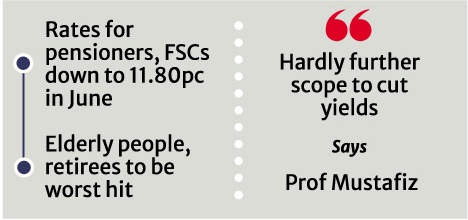 National Savings Directorate (NSD) data show the yield for pensioners and family savings certificate down to 11.80 per cent in June 2025, from 13.19 per cent and 13.45 per cent respectively in 2015.
Despite higher yields now available on bank deposits, fixed-deposit receipts (FDRs) and government bonds, many elderly citizens and retirees continue to invest in National Savings Certificates (NSCs) considering them as safe investment option.
Finance ministry sources say the profit on savings certificates would see a further cut in January 2026 as it is now linked to the average six-month Treasury Bill rate, which has declined in recent months, further discouraging new investors.
In 2025 calendar year, the NSC yields were pared down twice, in January and June, as part of a broader effort to gradually phase out high-cost borrowing amid rising pressure stemming from debt service.
With the latest cuts, investors in Family Savings Certificates and Pensioner Savings Certificates would see profits decline by Tk 128,000 per annum over five years on the maximum allowable investment of Tk 5.0 million, after deduction of 10-percent income tax.
"My parents need at least Tk 50,000 per month for medicines, doctors' fees, groceries, utility bills and other expenses. This entire amount comes from savings certificates," says Sadia, a housewife who lives with her in-laws in downtown Kalabagan.
The plight of Sadia's parents is far from being unique. Hundreds of thousands of elderly people-mostly retired private-sector employees-depend heavily on returns from savings instruments to meet their living expenses.
Although the government has been trying to shift its borrowing away from high-cost sources to ease the debt burden, NSC debt share declined to 29.71 per cent of total domestic debts as of March 2025 compared to 33.7 per cent in June 2024, according to finance ministry's debt-bulletin data up to March 2025, an FE analysis finds.
An additional cut of 1.0-to 1.5-percentage points is under consideration, which would make NSCs significantly less attractive to general investors, a finance official says.
Professor Mustafizur Rahman, Distinguished Fellow at the Centre for Policy Dialogue (CPD), says there is limited scope for further cuts in NSC returns given persistently high inflation.
"The highest rate on NSCs is now 11.93 per cent, while inflation stands at 8.2 percent. After 10-percent tax deduction, real returns fall to just 3.36 percent," he tells The Financial Express.
Nurunnahar Begum, a retired schoolteacher, says as many of the depositors are going to banks and purchasing bonds, automatically the high-cost debt burden on NSC is declining.
"Now, why the government would discourage us reducing the profits as borrowing from NSC is declining fast," she wonders.
Elderly citizens are among the worst-affected ones by sustained inflation, as they have little opportunity for side income or part-time work to offset rising living costs, she says.
Bangladesh has a rapidly growing elderly population, over 15 million or 9.3 per cent of total population. Living costs of elderly citizens are relatively higher as they need geriatric care, support and higher medical expenditures.
An analysis of NSD data shows the government interest payments on savings certificates declined by Tk 31.17 billion in FY25 compared to the previous fiscal year.
In the first quarter of the current fiscal year, sales of savings certificates fell sharply by 52.65 percent as investors found them less attractive due to lower profit rates.
Economists say many savers have shifted to treasury bonds, bills and even FDRs amid higher interest rates. However, a large segment of elderly citizens, women, low- to middle-income earners and retirees remain dependent on savings certificates as a secure investment option.
Savings certificates were originally designed to encourage small savings and serve as a social-safety net for women, senior citizens, expatriates and persons with disabilities.
Talking to the FE, Abdur Rahman Khan, Secretary at the Internal Resources Division (IRD) and Chairman of the National Board of Revenue (NBR), says the issue now falls under the Ministry of Finance as it is directly linked to debt servicing.
He says savings instruments still prioritise women and elderly citizens, particularly through Family Savings Certificates which continue to offer comparatively higher yields.
A senior finance ministry official acknowledges the need to continue social-safety support for women and senior citizens, possibly through tax relief or tighter investment ceilings to prevent misuse by wealthy investors.
"The government's debt burden has become a major concern in recent years and must be reduced in a rational manner," the official says.
Ministry of Finance data show domestic debt now hovers around Tk 11.57 trillion, as of March 31, 2025, in a 36.5-percent increase since June 30, 2022.
Under the IMF's $4.7-billion-loan programme, Bangladesh is required to ensure that no more than 25 per cent of its fiscal deficit is financed through savings instruments.
The programme also mandates aligning NSC returns with market-based rates.
Bangladesh Bank data show net investment in savings certificates plunge to Tk 3.37 billion in September 2025 -- down 96 percent from Tk 83.32 billion a year earlier.
As lending rates climb, commercial banks have raised deposit rates, prompting savers to move funds away from NSCs.
The Department of National Savings currently operates 11 schemes, including four savings certificates, two Post Office Savings Bank accounts, postal life insurance, prize bonds and three special bonds for expatriates.
doulotakter11@gmail.com