
Science concealed in Nature
Shahed Hassan | Friday, 20 February 2015
The vast treasure of knowledge is concealed in nature. In fact, nature itself is a hidden transcript that contains information pertaining to different branches of science. Our efforts to decode the concealed knowledge into human language are obstructed as we cannot understand the language of nature. Nevertheless, scientists and keen observers have tried to establish certain clues to reveal the dynamics of science in nature. Since the cradle of civilisation philosophers have made attempts to draw analogies between different branches of science and their reflections in nature or variables operative in nature having translated into sciences. It needs to be mentioned that nature does not only mean the inanimate elements surrounding us but also the biotic world.
Fibonacci Sequence or Golden Ratio is possibly a glaring example that has drawn attention for long. Without going deep into mathematical explanation, Fibonacci sequence (named after the most talented European mathematician Leonardo Fibonacci or Filius Bonacci of Pisa, Italy) can simply be said as 'proportion'. In everyday life, we use the word "proportion" either for the comparative relation between parts of things with respect to size or quantity or when we want to describe a harmonious relationship between different parts. In mathematics, the term "proportion" is used to describe an equality of the type: nine is to three as six is to two. The Fibonacci sequence provides us with an intriguing mingling, it is claimed to have pleasingly harmonious qualities. The Fibonacci numbers are Nature's numbering system. They appear everywhere in Nature, from the leaf arrangement in plants, to the pattern of the florets of a flower, the bracts of a pine cone, or the scales of a pineapple. The Fibonacci numbers are therefore applicable to the growth of every living and non-living thing, including a single cell, a grain of wheat, a hive of bees, water bodies and even all of mankind. It is interesting to note that Fibinacci series was observed much earlier by Eucid Alexandria of 300 B.C. and Pythagorus of 600 B.C. Once comprehended properly we will surely find the presence of this 'proportion' in artifacts, music, and architecture and even in paintings.
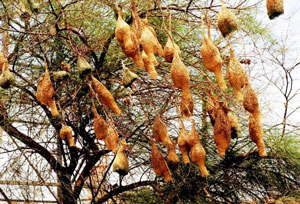
In the biotic world, we encounter certain species of animals with strong sense of science in designing their shelters. Baya Weaver birds (Babui in Bangla) build their nests taking certain important considerations i.e. physical facilities, wind direction, food preservation and even availability of light at night. Weaver birds' nests look neat and well-finished, as if made by an expert craftsman, without straws sticking out. The nests have a definite design that includes a looped attachment to the branch, a roof, the egg chamber, antechamber and entrance tube. These birds build instinctively. Even one-and-half-year-old weaver birds can be spotted building fantastic gourd-shaped hanging nests. The nest entrance is strategically located at the base and turned downwards, to avoid entry of predators. The Baya weaver may also build a sunshade in the form of an overhanging projection, an incredible tenacity. Baya birds make hundreds of trips to get bits of plant fibre to create nests. They build the nests over a few weeks' time, and the nests are quite sturdy and last a few seasons. The Baya birds collect fireflies to keep their nests lightened at night. We owe a great lesson on architecture of a house in nature and possibly for the same reason the Hindu Vastu Shastra says 'build it like baya' while referring to designing a home.
Honey comb is another case of dwelling in nature that teaches us appropriateness, division of labour and resource generation and preservation, bees are obviously intelligent and mathematicians. They perform a waggle dance which utilises speed and directionality to communicate the location of resources relative to their current position and the Sun. Over their evolutionary history, they have mastered the art of storing the most amount of honey while using the least amount of resources. The secret behind this efficient honeycomb is due to its hexagonal shape. And, there is a geometrical secret in such a structure. Scientists have marvelled at the angular perfection of honeycomb for centuries, but none have been able to clearly describe how it is formed. Engineers in the U.K. and China have taken a step forward by showing that the cells actually start off as circles, moulded by the shape of a bee's body and then flow into a hexagonal pattern seconds later. And silk produced by bees is the secret to honeycomb strength. The number of bees in a hive varies according to availability of nectar and pollen from less than 5000 to more than 100,000. The lessons we learn here obviously relate to optimum utilisation of labour and resources to avail maximum result through pragmatic planning and accommodation of justified number.
Spiders also teaches us the technique to survive at the face of predators and collect food from own sphere. Spiders are some of the most diverse animals on the planet. There are nearly 44,000 known species, all spinning a variety of different types of webs. Many different behavioural decisions about how to catch food, how to protect themselves from predators and survival strategy in the wild can be noticed in their webs. Spiders, thus, enriches our biomimicry knowledge base.
Technological innovation has made our life quicker and faster. We now travel from one continent to another in most sophisticated aircrafts. The basic principle of flying by aircraft is aerodynamics and that too has been borrowed from birds. The dream of flying is as old as mankind itself. However, the concept of the airplane has only been around for two centuries. Before that time, men and women tried to navigate the air by imitating the birds. They built wings to strap onto their arm or machines with flapping wings called 'ornithopters'. Nevertheless, further modification was needed to achieve perfection, safety and optimum speed and comfort while the borrowed concept of aerodynamics with four major factors i.e. lift, gliding, flapping and drag remain unchanged. This sketchy but important issue shows .what can be extracted, learned and duplicated by human beings from the natural world.
Each and every natural object has a role to play and that of a tree is tremendous. Besides, the photosynthesis and Fibonacci sequence in leaves and branches trees can also teach us to calculate time and understand climate change in a particular place. Such uniqueness of trees have influenced man to develop a science called "dendrochronology". This particular branch of sciences was developed during the first half of the 20th century originally by the astronomer A. E. Douglass, the founder of the Laboratory of Tree-Ring Research at the University of Arizona. Douglass sought to better understand cycles of sunspot activity and reasoned that changes in solar activity would affect climate patterns on earth which would subsequently be recorded by tree-ring growth patterns (i.e., sunspots ? climate ? tree rings). Application of tree rings study is found in climatology, art history, building history, archaeology and few other branches of science. The tree rings thus serve the purpose of calculating dates to the tune of perfection. It is a calendar in nature.
Today we talk about Global Positioning System (GPS) and its application in navigation by air, water and roads to foster our travel and to locate a place. This technology is relatively new for us. The GPS is a space-based satellite navigation system that provides location and time information in all weather conditions. Interestingly, scientists have found presence of GPS cells in certain animals. Instead of satellite, it is the earth's magnetic field that helps the animals and birds to move and fly to certain places. It has been observed that certain neurons in pigeon brains encode the direction and intensity of earth's magnetic field, providing the common birds with an internal global positioning system. It is strongly held that magnetic receptors in the retina, nose, inner ear and possibly the beak of birds receive and interpret magnetic field information, which then goes to the brain for processing. The GPS cells in the brain thus signal the direction, intensity and polarity of an applied magnetic field. Beside birds, honeybees, fish, turtles and even a few mammals, such as the blind mole rat are documented as being able to sense and use the Earth's magnetic field with their natural GPS cells. In fact, the GPS cells work as internal compass in their brain. Precisely, nature has blessed the animal kingdom with technologies appropriate for them. In contrast, we innovate, experiment and use only when tested with a positive result. Nature has given them signs and symbols while use numbers and alphabets, while other variables i.e. speech, smell and sight hardly differs. In many cases, we learn from nature without knowing but nature always remains a teacher and guide for us.
Purely from a philosophical perspective it would not be a fallacy if asked how can we be more like nature - more renewable, more constructive and more sustainable in a world that is filled with 7.0 billion of people that would soon destroy the only home that is the "Mother Earth". Since nature showers us with abundant gift we need to learn from nature and sense the instructions on how to survive in ways that are harmonious and friendly.
Dr. Shahed Hassan is Professor, Department of Anthropology, University of Dhaka.
shahedhassan@yahoo.com