
Sculpture represents human spirit
Nilratan Halder | Saturday, 10 June 2017
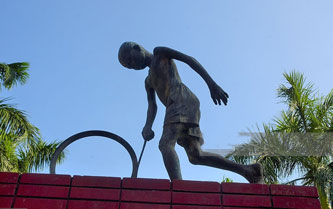
To many, sculpture and idols or statues of worship are not different. Most idols or images of gods and goddesses are, however, built with clay and when dry are coloured beautifully. Some statues or images of rock, basalt or other hard materials are also permanently housed in temples for worship. But a piece of sculpture is usually made of plaster of paris in order to give it a long life.
Now there is indeed some similarity in the shapes and sizes of the two types of work of art. Both are three-dimensional images. Most importantly, they are a creation of mind devoted to the cause beauty in the Keatsian sense. The artists try to give the ultimate shape they visualise in their innermost mind.
Where they differ most is that idols are meant for religious ritual where a particular community with deep devotion to the unseen try to get the feel through a beautifully carved image or images. In case of a work of sculpture the prime task is to capture a particular spirit through a concrete shape -not necessarily to be perfect in its structure. It can be life-size or many times taller or even smaller. But the essential ingredients deal with a theme either familiar to the viewers or something novel so much so that they experience a feeling of awe or pleasure or even sensuality in presence of the creation.
A kind of statues is 'as the doctor ordered it.' Statues of great leaders, poets, philosophers, writers, dramatists, scientists, politicians, philanthropists, social reformers et al are placed in strategic places for public viewing and paying respect.
Yet another type of statues is built in the image of their mythical or epical details. A Michael Angelo never saw the god Apollo but when he shaped the statue with the passion and emotion an artist usually feels, it became a unique creation. It is now difficult to think of Apollo in any other form. People throughout the ages have become accustomed to seeing the statue through the eyes of the great Renaissance artists. Similarly, all the Mahabharata and Ramayana characters are imagined by viewers as drawn by the great South Indian painter Ravi Varma.
When a row over the removal of a statue has been raging all across Bangladesh, one thought cannot help crossing the mind. This is the attempt to make an issue of a non-issue. Whether the sculpture is that of Greek Themis, Roman equivalent of Justitia or not is immaterial. Maybe, Mrinal Haque, its creator, was inspired by the Greek myth. The important thing is that it is a nice piece of art work and represents the theme of justice quite effectively.
This however is no ground for its placement before the High Court or Supreme Court. Unless the judges of the highest court expressed the need for such a statue as a symbol of justice, it should not have been there at all. Now the question is, if the highest authorities there desired that the symbolic representation of justice be made through the statue. The way it was removed does not give a good impression of the original decision taken for its installation there.
A radical religious group could make an issue out of it and this is where it hurts most that the authorities had to give in to their demand. A sculpture or an idol is not just a replica of something concrete. It is awash with love for and devotion to beauty. It was not for nothing that the finest Romantic poet, John Keats could proclaim, "Beauty is truth, truth beauty, --that is all .......
A small child may remember his/her fascination for the process of shaping images of Durga and the other gods, goddesses, demon, animals and birds which accompany her. One such boy watched intently how a lump of soft clay gradually took shape into an idol having similarity with a human being or other animals. The inner craving for beauty in a child of a tender age kept him spellbound at the work of a paul (image maker). This is how an aesthetic sense gets its sustenance in a human mind. Appreciation for beauty and a most tender feeling can keep a person free from many of the vices human beings are either heir to or prone to committing.
Statues of once most revered leaders rolled in the dust when Soviet Union fell apart. Saddam Hossain's statue was knocked down, reminding one of Satyajit Roy's satirical film Hirak Rajar Deshe where the chanted slogan 'dari dhare maro tan, raja habe khan khan' is actually staged in real life.
The religious groups should know that sculpture and idols of other religions are two different propositions. Sculpture may not be sacred but it is sanctified by the essence of a higher and pure inner glow, a belief in something extraordinary, a symbol that captures the innermost urge. When idols in temples are destroyed and sculptures are attacked, it strikes at the very core of human values and existence of man as a superior animal to other species.