
\\\'Secondary level edn remains most important missing link\\\'
FE Report | Monday, 24 February 2014
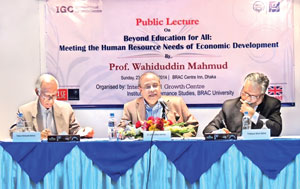
Professor Wahiduddin Mahmud listed Sunday the secondary level education as the most important 'missing link' in the country's entire education system and deplored the poor quality of education offered at the school level.
In this context, he said, the absence of good governance in the country's education system is seriously affecting the quality of education in the private secondary schools.
"Our entire education system suffers from serious governance problem. But the private secondary schools, mostly funded by the government and run by private boards, are perhaps the worst victims of poor governance," said Prof Mahmud.
"These highly politicised school boards often have members, who are not school graduates themselves," he added.
He also underscored the need for connecting higher education and training system with the labour market by reorienting the system of public higher education, reforming the regulatory framework for private education, and building effective industry-academia partnerships.
Prof. Mahmud, a member of the UN committee for development policy, was speaking at a public lecture titled 'Beyond Education for All: Meeting the Human Resource Needs of Economic Development' at Brac University in the city.
International Growth Centre (IGC) and Institute of Governance Studies (IGS) organised the event.
IGC Bangladesh country director Sultan Hafiz Rahman chaired the programme, while Brac university vice-chancellor Professor Ainun Nishat was present as the chief guest.
Prof Mahmud maintained that the secondary level education was the most important missing link in the country's education system.
"I have come to this conclusion by observing the university level students' skills in mathematics and language that are supposed to be acquired while studying in secondary schools," he noted.
He said some recent studies have found strong links between the mathematical proficiency of secondary school graduates with income level and economic growth performance.
Mr Mahmud said the global education goals, such as 'Education for All', with their emphasis on the quantitative indicators, such as enrolment rates or number of years of schooling, may have led to too narrow a focus in linking education to human resource development.
Citing examples he said various competency tests for school children in many parts of the developing world, especially in low-income countries of Africa and South Asia, show 'learning crisis'.
These also raise serious doubt about the content and quality of education, and indicate towards the need for a paradigm shift in education towards learning and skill development.
Although Bangladesh has made a remarkable progress in achieving universal primary education and is recognised as a 'star performer' in getting female children to school at primary and secondary levels, the country cannot claim much on quality of education in absence of systematic competency tests.
Referring to studies, the former caretaker government adviser said Bangladesh has outperformed most other countries at similar stage of development, particularly in secondary school enrolment for females, but the enrolment rate has become stagnant during the most recent years.
"The quality of education in terms of skill development can be a factor, but the deficient demand for skill-intensive employment opportunities also matters."
Prof Mahmud said equity issues are also important to be addressed, as increasing returns to higher education along with unequal access may lead to a deepening of income and social inequalities.
Studies have shown the degree of access to education has replaced family ownership of land and other assets as the main vehicle of transmission of poverty and inequality.
Criticising the present education system he said it has not been able to respond efficiently to increasing demand, let alone extending access on an equitable basis.
"How far the children from poor households can compete in a merit-based system of entry into higher education will depend on their access to quality education at primary and secondary levels. So far the policy focus has been on getting these children to school in the first place," said Mr Mahmud.
The time may have come to shift emphasis from the global agenda of 'Education for All' to providing access to quality education and to higher education for the children from disadvantaged families.
He referred to Bangladesh's economic growth driven by a 'replicative' approach - in respect of low-productivity ready-made garment export, export of low-skilled labour, and expansion of micro-enterprises.
For the next stage of growth, he suggested the country's need for switching from replication to innovation in terms of productivity increase and skill development.
"For this, the education system needs to be geared towards developing well-balanced human resources with appropriate skills and flexibility for adjustment to keep pace with increasingly competitive and globalized markets and rapidly changing technologies."
He said in the development discourse, quality of governance and investment environment or infrastructure development are identified as the factors that constrain or contribute to economic growth. Much less attention is given to human capital, although research has shown that this is the most basic determinant of long run economic growth, affecting all other growth-inducing factors.
Former finance minister M Sayeduzzaman, former Bangladesh Bank (BB) governor Saleh Uddin Ahmed, Bangladesh Institute of Development Studies (BIDS) researcher Anwara Begum, Kallyan Party chairman Syed Mohammed Ibrahim, Dhaka University professor Barkat e Khuda, AmCham president A Gafur, education expert at Australian High Commission James Jennings, Daily Star managing editor Salehuddin Ahmed, former vice-chancellor of North South University Hafiz G A Siddiqui, and Care Bangladesh representatives Tracy Evans and Jemmi Charlibios also took part in the discussion.