
Security concern a major threat to fresh investment, says CPD
FE Report | Monday, 5 May 2014
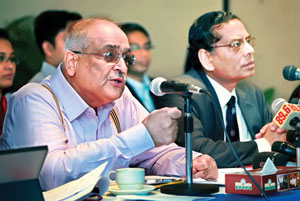
The Centre for Policy Dialogue (CPD) aired growing concern over security of people and assets Sunday saying this has now emerged as a major threat to fresh investment in the country.
Raising its voice against incidents of recent abductions, at a press briefing in the city CPD Distinguished Fellow Dr Debapriya Bhattacharya said the state of insecurity is affecting investors' confidence in undertaking new investment plans.
He said such type of insecurity both for people and assets will affect the aggregate consumption and savings significantly.
He cautioned that under such type of circumstances there are possible chances for capital flight.
He said budget financing will also face risks if the prevailing situation continues.
He also said the country will not get rid of the prevailing economic concern unless it gets back to a participatory political and electoral process.
"This will be necessary to provide confidence to the investors," he added.
Dr Bhattacharya was speaking at a press briefing organised by the CPD to unveil its budget recommendations for fiscal year (FY) 2014-15.
Research Director of the CPD Dr Fahmida Khatun presented paper on the proposals for the upcoming national budget.
CPD Executive Director Prof Mustafizur Rahman was moderator at the briefing.
Dr Bhattacharya said stimulating investment by overcoming the stagnation will be the key challenge for the next budget.
He said revenue mobilisation that the NBR (National Board of Revenue) envisaged will also be another key challenge.
He said the government should now review its different estimates undertaken in the sixth five-year plan.
He said investment must be raised up to 30 per cent of GDP (Gross Domestic Product) to attain different projections.
"We don't find any reason for a big jump in investment and the economic growth, so the projections under the sixth five-year plan will not be achieved," said Bhattacharya.
This is the right time to review the estimates of the sixth five-year plan and prepare new estimates under the existing economic reality, he noted.
While presenting proposals for the upcoming national budget, Dr Fahmida Khatun said the next budget should go for supportive fiscal measures to create an enabling business environment towards enhanced production and higher investment.
She said the upcoming budget may consider expansion of subsidised credit facility for domestic market-oriented small and medium enterprises (SMEs) in order to help them recover their losses due to political turmoil in 2013.
She said special incentives for non-RMG (readymade garment) export-oriented industries will improve their competitiveness in the export market.
She said the government may consider allowing nationalised commercial banks to mobilise the required capital from the capital market by off-loading shares.She said the export development fund needs to be increased further from the existing balance of Tk 1.2 billion in order to support export-oriented industries.
She said the government needs to come out with an effective exit plan for the quick rental power plants. Agreements of some 16 power plants with a total capacity of more than 1,400 megawatt were set to expire by 2015. She noted that annual development programme (ADP) allocation for the development of the railway sector needs to be increased.
She said the government may consider an upward revision of the exemption limit for personal income tax to Tk 300,000.
She said the demand of the business community for lowering the corporate tax rates on the grounds that it is high compared to other competing countries of Asia is not correct.
"The average corporate tax rate of Bangladesh is one of the lowest in South Asia," she said.
She said the government should not make an upward revision of tariffs on gas, compressed natural gas (CNG) and other public utilities on the grounds of reducing overall subsidy.
Rather, she suggested that the power sector should target reduction of operational inefficiency in electricity generation and distribution.
She said the government should go for a number of reform measures targeting public sector enterprises and organisations with a view to improving their operational efficiency and competitive practices.
"For example, the Board of Investment (BoI) should be reorganised appropriately with a view to transforming it into an effective investment promotion agency," she said.
She said the government should enforce the mandatory packaging act for the selected agricultural products to expand the domestic market for the jute sacks and other jute products against the backdrop of the decline in exports.
CPD proposed enhancing the profile and capacity of the Implementation Monitoring and Evaluation Division (IMED) so that it can deploy modern processes and techniques while monitoring the implementation of development projects.
The CPD also said the government should consider forming a taskforce to spearhead the adoption of pending reform measures, including the adoption of the Civil Service Act.
Additional Research Director Dr Khondaker Golam Moazzem and Senior Research Fellow Towfiqul Islam Khan and other researchers joined the function.