
Seed crisis puts Aman output at stake
Barguna paddy growers worried about their survival
Tuesday, 11 October 2022
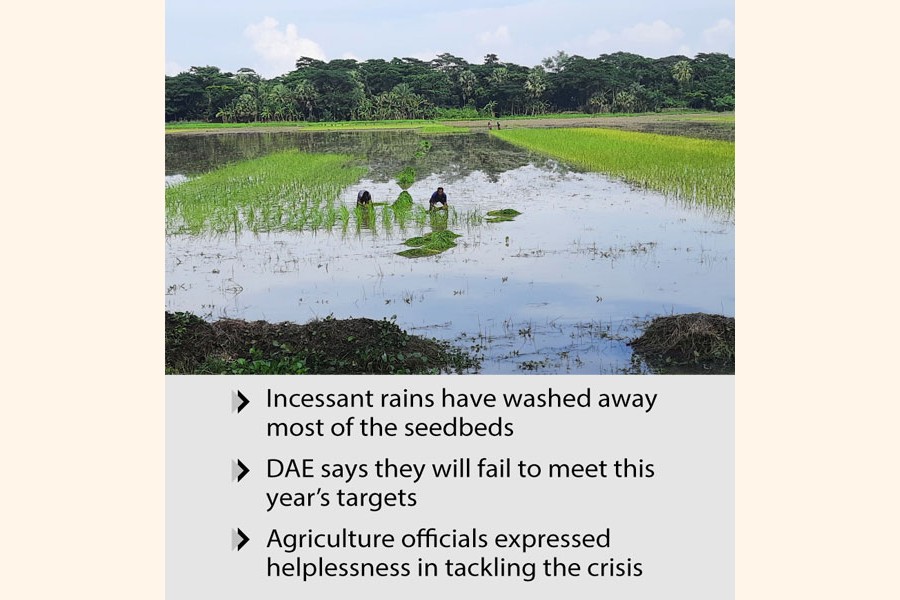
BARGUNA, Oct 10 (UNB): In Barguna, a shortage of Aman seeds has erupted as incessant rains have washed away most of the seedbeds of the district.
Agricultural lands of the farmers are lying idle as they are failing to manage Aman seeds for implantation.
This crisis is causing distress for the paddy growers as they are frustrated over how they will survive.
Barguna Water Development Board (WDB) said 477mm of rainfall had been recorded in the last week of July. Besides, another 100mm of rainfall drenched the coastal district throughout August. These two bouts of rain submerged most of the Aman seedbeds of the district.
Farmers said that those few seedbeds that were prepared on comparatively higher grounds remained unaffected by rainwater. The seeds are being sold at a rate of Tk 200 per kg, which isn't enough to meet the demand. As a result, much of the agricultural land in Barguna will remain uncultivated this year.
According to the Department of Agricultural Extension (DAE) of Barguna district, the government has targeted to cultivate hybrid, high-yielding and local variants of Aman paddy in a total of 9.8 million (98 lakh) hectares of land which will be missed if the ongoing seed crisis persists.
DAE sources said that Aman is the primary crop for the coastal people. The department assists farmers in their cultivation by supplying Aman seeds. Among the total cultivable land in Barguna, BR, BRRI and BINA variants of Aman paddy are produced in 55 per cent of land while local variant of Aman is cultivated in the remaining 45 per cent of land.
Abu Hossain Hawlader, a farmer from Barguna Sadar, expressed his disappointment for not being able to cultivate paddy this year.
"I had prepared seedbeds in two acres of land. The water in the fields has ebbed and the time has come for planting the seeds. But all my seeds have rotten due to heavy rain. The time for preparing new seedbeds is also gone. That's why I won't be able to harvest any paddy this year," Hawlader said.
In Barguna district, the highest amount of Aman paddy is produced in Amtali upazila. While visiting many Aman-producing areas of the upazila, this correspondent found most of the fields empty as farmers couldn't plant Aman paddy due to a shortage of seeds.
"We have prepared our land for Aman implantation, but all of our seeds have been wasted by rainwater," said Abdul Jabbar Mridha, a peasant from Kaunia village of the upazila.
Abu Sayed Md Jobaydul Alam, Deputy Director of Barguna District Department of Agricultural Extension, expressed his helplessness in tackling the crisis.
"Seedbeds getting wasted due to heavy rain is a natural calamity. We had tried to deal with the situation by supplying seeds to the farmers and advising them to choose high grounds for preparing the seedbeds. But all of our strategies have failed. There's nothing to do now except admitting the fact that our target for Aman production won't be met this year," Jobaydul said.