
Setting future development agenda
Saturday, 21 June 2014
The Bangladesh economy has surpassed early expectations and achieved remarkable progress with development within a relatively short span of 43 years since Independence.
This development progress compares favourably within South Asia and in the global context of all developing countries. Actually, in terms of growth and human development Bangladesh has done better than many in its peer group.
Bangladesh has the potential to grow faster than 6.0 per cent per year and achieve middle income status by 2021 and strive for better beyond. It can also create sufficient high-income jobs for its growing labour force. There are many challenges.
The incidence of poverty is still large in absolute terms and many people live close to poverty (the near poor). While vulnerabilities have been reduced, climate change and environmental degradation continue to pose a challenge. Strengthening institutions and improving governance are challenges that need continuous long-term efforts.
There is also the crying need for policy making and strategy formulation to take a longer term perspective trying to address a host of questions. How can Bangladesh achieve and sustain a faster growth rate than 6.0 per cent per year? How can the incidence of poverty be reduced and living standards of the near poor and the population at large be improved? How can Bangladesh create high income jobs at a rate that exceeds the rate of growth of the labour force? How can Bangladesh insulate the economy and the population from the adverse effects of climate change? What can be done to protect the environment while growing at a faster rate? What are the implications for policies and institutional reforms?
These are critical questions for Bangladesh's development moving forward. Finding answers require considerable empirical research. Unfortunately divisive politics and excessive focus on day-to-day events are constraining sound analysis and debate on how best to work together collectively on these long-term development issues.
The idea of the Bangladesh Economists' Forum emerged from these considerations. There are high calibre Bangladeshi professional economists, some living in Bangladesh and some abroad, who could be mobilised to provide a non-partisan Forum for providing policy advice based on sound empirical research and international best practices.
These economists are well established in their profession, are generally well-respected, and are non-partisan in their analysis. None of these economists is seeking any public office or publicity. They are willing to work pro-bono to serve the interests of the country. They are willing to work with any government and their research and policy analysis are available for all, based on wide dissemination.
Accordingly, the Bangladesh Economists' Forum (BEF) was constituted comprising this group of professional economists in April 2013 as a non-political voluntary professional body established to deliberate on longer-term issues of national, regional and global relevance, not normally addressed by existing institutions and professional bodies in Bangladesh.
Membership of the Forum is by invitation only. It will meet annually or bi-annually to reflect on one or two agreed issues of current and longer-term interest to Bangladesh. The Forum will bring out high quality monographs, policy briefs and other publications for the wider academic community, policy makers and the business world.
Eighteen distinguished economists of Bangladesh residing in the country and abroad are the founding members of the Forum.
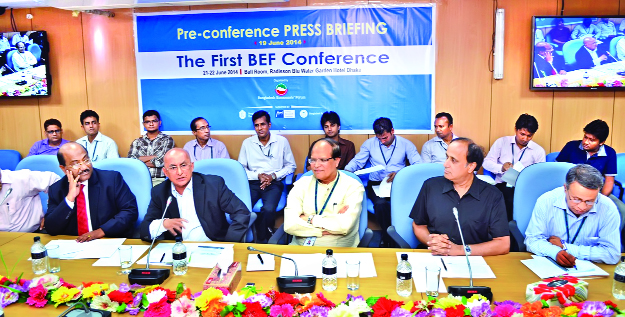
The first conference of the Forum is scheduled to be held on June 21-22, 2014 (today and tomorrow) at Radisson Hotel in the capital Dhaka. The theme of the Conference will be: Vision 2030: A Framework for Economic Policy Making and Strategy Formulation in Pluralistic Democracy.
Distinguished scholars, academics, civil society representatives, political and policy leaders and private sector representatives as well as members of the diplomatic community are expected to participate in the two-day long conference.
Honourable Abul Maal Abdul Muhith, Minister, Ministry of Finance has kindly agreed to open the conference. Some other Ministers will chair the various sessions. The honourable Speaker has kindly agreed to join a special session as chief guest.
Distinguished and keynote lectures will be delivered by Professor Michael Lipton of the UK, an old friend of Bangladesh, Professor Rehman Sobhan, Chairman, Centre for Policy Dialogue, Sir Fazle Hasan Abed, Chairman, BRAC, and Dr. Azizur Rahman Khan, Professor, University of California at Riverside.
The Bangladesh Institute of Development Studies (BIDS), Policy Research Institute (PRI) and the Bangladesh Bank (BB), the country's central bank, are co-sponsoring the conference.
Generous financial assistance has been received from the central bank of Bangladesh, the Hongkong and Shanghai Banking Corporation Limited, generally known as HSBC, Standard Chartered Bank and the Association of Bankers, Bangladesh (ABB).
Invited participants will present papers on a wide range of topics concerning future growth and development potential of Bangladesh and the underlying key issues.
More specifically, the conference will address issues related to growth strategies, macro and financial policies, fiscal policy and capital markets, trade, aid and infrastructure, poverty reduction strategies and policies, human development strategies and policies, sustainable development and public policy making and institutions.
Sadiq Ahmed, vice-chairman of the PRI, will open the discussion sessions with an expose on sources of growth in Bangladesh followed by Mohiuddin Alamgir, former president of the Bangladesh Economic Association (BEA), looking at ways to overcome binding constraints to growth so that Bangladesh can avoid middle income trap and jobless growth.
BB Governor Atiur Rahman will elaborate on the role of financial stability and financial inclusiveness for sustaining growth and development.
Financial governance and urban finance will be dealt with by Salehuddin Ahmed, former BB governor, who argues for financial decentralisation and augmenting the capacity of local governments and municipalities and city corporations to raise revenue for delivering quality services.
The role of fiscal policy in promoting inclusive growth and poverty reduction is the focus of the paper of Ahsan H. Mansur, executive director of the PRI, while Mirza Azizul Islam, former advisor to caretaker government, will dwell on the capital market in promoting savings and investment (including foreign direct investment) in Bangladesh.
Zaidi Sattar, chairman of the PRI, will make a strong case for export-led growth for Bangladesh and argue in favour of trade liberalisation eliminating anti-export and anti-intermediate product import bias.
Sultan Hafeez Rahman, country director of the IGC-Bangladesh, will explore how aid can be used more effectively to foster growth and equity and how policy interventions can increase foreign direct investment reducing aid dependence.
Mohammed Farashuddin, former BB governor, will map out policies and strategies for dealing with infrastructure constraints including transport, energy and social infrastructure. He will make a case for investment in health and education.
Mustafa Kamal Mujeri, director general of the BIDS, will discuss Bangladesh's development options in a post-MDG world and policy priorities to realise the vision. Over time social protection issues will gain prominence in Bangladesh.
Siddiqur Rahman Osman, former BIDS scholar, will lay out a feasible strategy for ensuring social protection for all by 2030 and the economic foundation for achieving this goal.
Food and agricultural issues will be taken up in a panel discussion led by Mahabub Hossain, executive director of the BRAC.
In two background papers Salim Rashid, distinguished fellow of the PRI, and Mahabub Hossain argue that with appropriate policy stance Bangladesh can push the frontier of hybrid and high-yielding variety rice to achieve food self-sufficiency, ensure food security and export rice.
The conference underscores the importance of human development with Rizwanul Islam, assistant professor of the BRAC University, making a convincing case for human capital development and inclusive growth in Bangladesh.
He will explain why education and skill development are essential for Bangladesh moving into higher growth trajectory with high quality employment at higher wages.
In this context Hossain Zillur Rahman, executive chairman of the PPRC, will present a framework for dealing with the problem of a serious gap in the quality of secondary education in Bangladesh which adversely impacts on skill development at higher level.
Qazi Kholiquzzaman Ahmad, chairman of the PKSF, will outline the strategy for universal access to education by 2030 as a basis for general human capital development in Bangladesh.
Recent trends in urbanisation suggest that the process is almost out of control and will get worse, unless urbanisation policies are not mainstreamed into overall development planning abandoning the current fragmented approach to addressing urban problems.
This is the main theme of the paper on urbanisation challenges by Zillur Rahman. Potential unsustainability of the present pattern of urbanisation in Bangladesh is further compounded by the emerging environmental stress from accelerated growth and climate change.
Larger sustainability and climate change adaptation and mitigation issues for Bangladesh are the focus of background papers written by Qazi Kholiquzzaman Ahmad.
A panel of experts will tackle the issues related to public policy making and institutions in Bangladesh drawing on two papers by Professor Wahiduddin Mahmud and Khalid Shams, member of the Bangladesh rice foundation. Mr. Mahmud explores governance and growth nexus while Mr. Shams tackles various facets of regulatory framework and governance for pro-poor growth.
He addresses the important question as to how we develop more effective, accountable systems of governance that will facilitate and accelerate economic growth and social development.
The message of the first conference of the BEF can be summarised as follows:
The BEF Conference is designed to mobilise support for Bangladesh as it -- Strives for longer term (post-MDG world) inclusive sustainable growth with full employment (productive) and improved quality of life, assured food security from domestic production, reduced poverty and inequality, and enhanced resilience to climate change;
Based on good governance embedded in transparency, accountability and corruption-free environment that will fully explore and exploit the growth-governance nexus, increased savings and investment through appropriate incentive framework and capital market development and regulation, infrastructure development with special emphasis on economic corridors, clean coal for energy and water resources management and development, emphasis on rice production within the framework of balanced rural and agricultural development combined with rational land use policy including making land available for special economic/industrial zone (SEZ) and export processing zone (EPZ), optimal development and utilisation of human capital through universal access to education and strengthening of secondary education and skill development and synchronised sector development policies, accelerated move towards a knowledge economy based on technology development and adaptation, financial inclusion and stability, fiscal balance, trade equilibrium by export expansion, effective use of foreign aid, balanced urbanisation and fiscal autonomy of local governments, social protection for all with priority attention to population groups characterised by extreme vulnerability, designing, operationalisation and enforcement of an optimal regulatory framework, and creation and upholding of sound technical basis for public policy making and institutional development, especially bureaucratic decentralisation; and
Founded in pluralistic democracy enshrined in rejection of violence as a means to achieve political objectives, respect for and adherence to the rule of law, respect for life, human dignity and welfare, respect and tolerance for all religious beliefs and practices, and respect and tolerance for alternative social and political views and philosophies.
The BEF members are Dr. Sadiq Ahmed, Dr. Mohiuddin Alamgir, Dr. Mustafa Kamal Mujeri, Dr. Atiur Rahman, Dr. Ahsan Habib Mansur, Dr. Mirza Azizul Islam, Dr. Zaidi Sattar, Dr. Sultan Hafeez Rahman, Dr. M. Farashuddin, Dr. Salehuddin Ahmed, Prof. S. R. Osmani, Dr. Rizwanul Islam, Dr. Q. K. Ahmad, Dr. Hossain Zillur Rahman, Mr. Khalid Shams, Dr. Mahabub Hossain, Prof. Wahiduddin Mahmud and Prof. Salim Rashid.