
COMMISSION ON ENFORCED DISAPPEARANCES SAYS
Sheikh Hasina, Tarique Siddiqui complicit in extrajudicial killings
FE REPORT | Tuesday, 24 June 2025
 Political high-ups of the past regime such as deposed premier Sheikh Hasina, General Tarique Ahmed Siddiqui and the former home minister and other senior officials were in strategic layers of ordering abductions and extrajudicial killings, says a latest probe report.
Below the secretive action chain was the executive layer comprising senior generals and high-ranking members of the police and other security forces, the Commission of Enquiry on Enforced Disappearances writes in its second interim report, titled 'Unfolding the truth'.
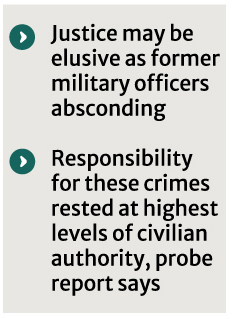
Part of the report, which was made available to reporters by the Chief Adviser's Press Wing on Monday, reveals that the former senior military officers found having complicity in enforced disappearances are now absconding and that impedes ensuring justice.
"These individuals directly received instructions from the political leadership and, as such, could serve as vital witnesses to their involvement. At the base is the functional layer, made up of lower-ranking personnel within the security apparatus who carried out the operations under orders from above," the probe report notes about direct evidence needed during prosecution of the suspects.
In the case at hand, it adds, the generals who headed DGFI served as direct interlocutors between the armed forces and figures such as Sheikh Hasina and General Tariq Siddiqui when they ordered disappearances.
"For instance, General Akbar informed the Commission that he had directly discussed the case of Humam Quader Chowdhury, a known victim detained in the JIC, with Sheikh Hasina herself."
In one case, as cited in the probe report, a junior DGFI officer recalled hearing his director speak about a detainee's fate "in a way that made clear Sheikh Hasina was informed of him and had expressed an opinion on the matter".
What surprised the commission was the casual manner in which the remark was delivered, indicating that even in cases that did not appear especially significant, "her involvement was understood to be direct and intentional".
Therefore, the commission remarks, it is these senior officers, positioned between civilian command and military execution, whose testimony could best demonstrate that "responsibility for these crimes rested at the highest levels of civilian authority".
"Their testimony could have served a dual purpose: advancing truth and accountability, and protecting the institutional reputation of the security forces by clarifying that operational orders did not originate from within their hierarchy."
However, when these officers absconded, that critical link was at least partly severed. "Their disappearance left the armed forces vulnerable to allegations that they had acted on their own when committing crimes against humanity," it is observed in the report.
This ongoing environment of noncooperation is causing immeasurable harm to justice and accountability efforts. It is also inflicting profound distress upon the families of those who disappeared.
The commission thinks the fate of the missing can only be determined through the testimony of those who were present at the time these victims were abducted and transferred to their final resting places.
When those very individuals are intimidated into silence, the victim families are denied the possibility of truth and closure.
This "denial persists even after the changeover of 5 August, after the window of opportunity opened for greater transparency and independence, marks an especially tragic and unjust outcome".
The commission notes that this "resistance to accountability appears to be present across various branches of the security forces".
It cites an example of hindrances to uncovering the truths about abducted persons held incommunicado under unauthorised detention and the ultimate fate of the victims.
An illustrative example is the event surrounding the issuance of arrest warrants by the International Crimes Tribunal (ICT) on 6 January 2025. On that date, the ICT issued arrest warrants against eleven individuals who were found, prima facie, to be complicit in the commission of enforced disappearances.
These warrants were based on information shared by the Commission from its inquiry, as well as findings from the 100 prosecution's own investigations.
Among the individuals named were several senior military figures. These generals held positions of command at the DGFI at a time when individuals such as Brigadier Azmi, Lieutenant Colonel Hasin, Ambassador Maroof Zaman, and many others were detained inside the JIC, the original 'Aynaghar'.
"Based on repeated checks on the command structure, we can state with certainty that enforced disappearances at JIC during that period could not have occurred without the explicit knowledge and acquiescence of these Generals.
Several of the individuals, as reported by witnesses, were residing in Dhaka Cantonment at least immediate before the warrants for their arrest were issued, except for Major-General Abedin who resides in the USA.
Moreover, it is understood that the military leadership was notified well ahead of the issuance of the arrest warrants. "And yet, since then, none of the warrants have been executed."
"The army's admission, combined with the non-execution of the warrants, strongly suggests that these individuals are now absconders," the report says.
Those who were within the country and residing in secured, well-known locations in January 2025, including inside the Dhaka cantonment, are now unavailable to the justice process.
This raises serious concerns, particularly given that their passports had been revoked, there appeared to be no alternative travel documents, and the military authorities had been informed in advance of the impending warrants. The implication is that, despite being within reach of enforcement mechanisms, these high-ranking officers were permitted to abscond.
This sequence of events has generated "deep disquiet about the future of accountability efforts".
"Those within the security forces who genuinely wish to support this inquiry have privately expressed concern that if such senior figures are allowed to evade justice without consequence, then the institutional will to pursue accountability is perhaps fundamentally compromised."
Crucially, the commission points out, the absence of accountability is not only harming the victims and their families, it is also inflicting "serious institutional damage on the security forces themselves".
mirmostafiz@yahoo.com